
You repack trailer bearings to prevent catastrophic hub failure and costly axle damage. You’ll need to choose between hand-packing or using a bearing packer, but the method you select depends on your timeline and precision requirements. The process demands clean grease, proper technique, and knowing exactly when the bearing is fully lubricated. Don’t assume you’ve done it correctly—there’s one critical sign you’ll miss if you aren’t watching closely.
How Often Should You Repack Trailer Bearings?
How frequently must you repack your trailer bearings? You’ll follow Dexter’s specification: repack annually and replace the grease during each maintenance cycle. You must lubricate bearings every 12 months or 12,000 miles, whichever threshold arrives first.
You can’t postpone this interval. Regular proactive maintenance prevents catastrophic hub failure, axle damage, and costly repairs. If you’re uncomfortable performing this task, you’ll use a local service center to repack and grease properly.
To keep your trailer operational and safe, you’re monitoring both time and mileage. You don’t guess—you track. Pre-greased hub and hub-drum kits streamline your installation and reduce on-site greasing steps, but you’re still verifying condition annually. Your adherence to this schedule protects your investment and ensures reliable performance.
Tools You Need (and What to Skip)
What tools do you actually need for repacking trailer bearings?
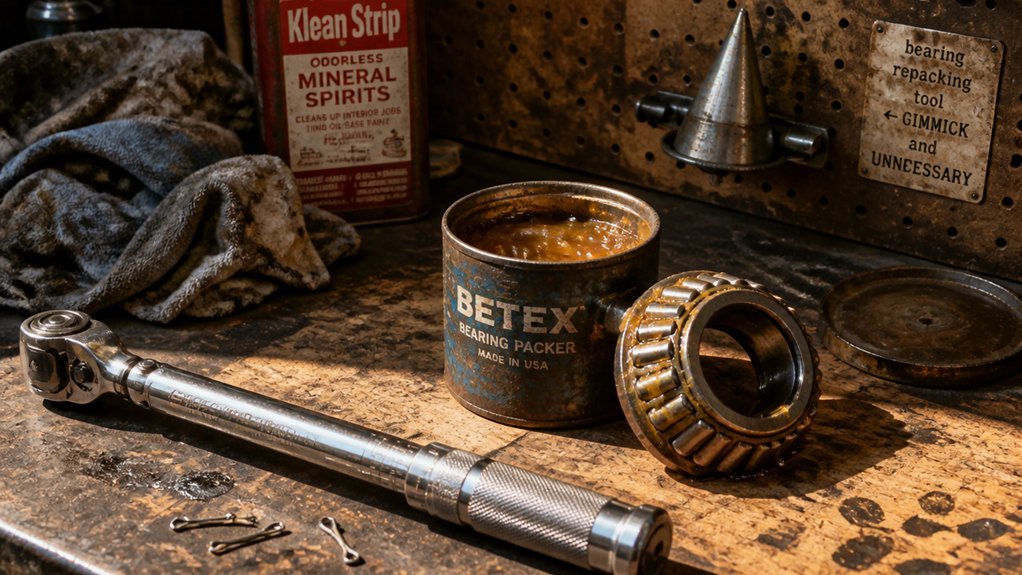
You’ll need a grease gun equipped with either a Universal Bearing Packer or Handy Bearing Packer Tool. These devices force grease through the bearing rollers and ensure complete packing faster than manual methods. Don’t waste money on specialized extraction tools—your hands remove bearings just fine.
You’ll also need shop rags and heavy-duty gloves (optional) for cleanup. Skip automated bearing cleaners; they’re unnecessary for this maintenance schedule.
Stock Dexter Grease as your required lubricant. When repacking by hand, you’ll place a half-dollar-sized amount on your palm and work it through. Before reinstalling, apply a light coat to the bearing cup. Verify visible grease through the rollers to confirm full coverage. Plan approximately 30 minutes per bearing depending on your expertise level.
How to Repack Bearings by Hand

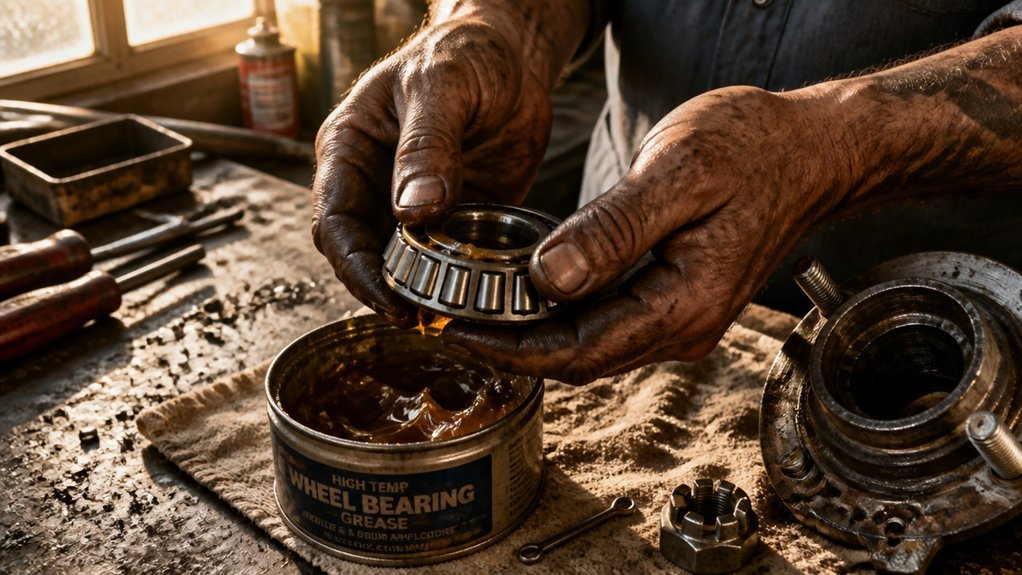
If you don’t have a grease gun with a bearing packer, you’ll repack the bearings manually using your hands and a controlled technique. Place a generous pile of grease in your palm. Press the outer edge of the bearing into the grease pile, forcing grease inward between the rollers and cage. Rotate the bearing from roller to roller, working grease into each cavity until you see grease extruding through the rollers on the opposite side—this confirms complete fill. Inspect the bearing to ensure no dry spots remain. Before reinstalling, apply a light coat of grease to the bearing cup. Check one final time for grease-free areas. Proper hand-packing demands patience and thoroughness, but you’ll achieve full lubrication equivalent to tool-assisted methods when executed correctly.
How Packing Tools Speed Up the Job
Why struggle with manual methods when packing tools can cut your work time dramatically? You’ll achieve faster, more consistent results by using a grease gun equipped with either a Universal Bearing Packer or Handy Bearing Packer Tool. These devices force grease completely through the bearing cavity, ensuring full coverage across all rollers and the interior race.
Manual repacking demands meticulous technique. Packing tools eliminate that labor. You’ll reduce your per-bearing time to roughly 30 minutes once you’re experienced, and you’ll minimize physical effort. The tool does the work—you operate the grease gun and monitor flow.
For maximum efficiency, select the proper packing tool for your bearing size. Verify that grease extrudes through all rollers. This confirms complete fill. You’re streamlining the job while maintaining professional-grade results.
How to Tell When Bearings Are Fully Greased
Where exactly should you look to confirm your bearings are properly packed? You inspect the interior cavity and the rollers themselves. Grease must fill the bearing interior completely and remain visible through each roller as you work.
Start with grease roughly the size of a half-dollar in your palm. Press the bearing into the grease, forcing it between the rollers and cage. Rotate the bearing from roller to roller while applying steady pressure—Dexter’s method ensures complete penetration. You’ll know you’re finished when grease extrudes uniformly through every roller and no dry spots remain inside the bearing.
Before reinstalling, coat the bearing cup with a light, even layer of grease. Eliminate all bare spots. Verify the entire assembly carries consistent lubrication throughout. Uniform coverage prevents premature wear and ensures proper function.
Pre-Greased Hub Kits: When Replacement Makes Sense
When you’re pressed for time or tackling a complete hub replacement, why wrestle with manual repacking? Dexter Pre-Greased Hub & Hub-Drum kits arrive ready for installation, eliminating on-site greasing steps entirely. You’ll install faster and achieve consistent lubrication from the outset. These kits prove particularly valuable when you’re replacing an entire hub assembly rather than servicing existing components. You bypass bearing packing, seal installation, and grease application—tasks that demand precision and consume significant shop time. The factory-applied lubrication ensures you meet specifications without variance, supporting reliable bearing performance immediately upon installation. Evaluate your situation: if the hub shows scoring, heat damage, or race wear, replacement trumps repacking. You’ll save labor hours and reduce error potential. Select the kit matching your axle rating and brake configuration, then bolt it directly into service.
Finding a Qualified Service Center Instead
If you’re not confident performing bearing maintenance yourself, locating a qualified service center becomes your next step. Dexter recommends selecting a local facility capable of handling your specific maintenance requirements.
Verify the center employs technicians trained in bearing repacking procedures, whether utilizing a grease gun with universal or handy packer attachments or manual packing methods. Confirm they apply Dexter Grease specifically and can inspect bearings for wear patterns, pitting, or scoring. Ensure they’ll replace damaged components and can install Pre-Greased Hub & Hub-Drum kits upon request.
Inquire about turnaround expectations; competent technicians complete bearing service in approximately thirty minutes per bearing, though duration varies with shop configuration and axle accessibility. Schedule maintenance annually or every twelve thousand miles to maintain safety and prevent component failure.
Conclusion
Repack your trailer bearings annually or every 12,000 miles. You’ll prevent catastrophic hub failure by forcing fresh Dexter grease through all rollers until it exudes fully. Hand-packing works, but a bearing packer ensures complete cavity fill. Inspect cups for scoring; replace damaged components immediately. Pre-greased hub kits streamline maintenance when you’re pressed for time. Don’t risk axle damage—verify grease penetration visually and repack both inner and outer bearings without exception.