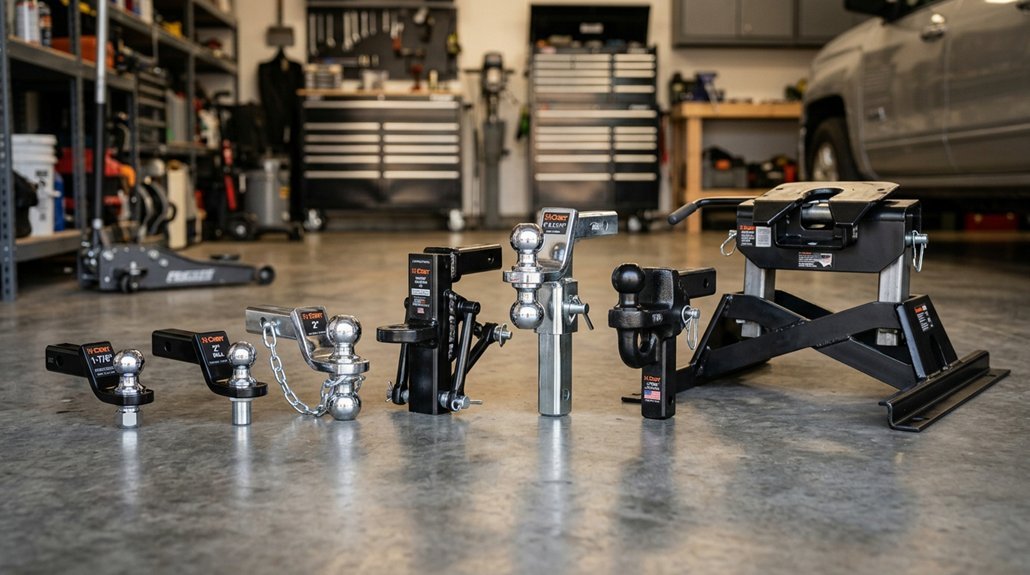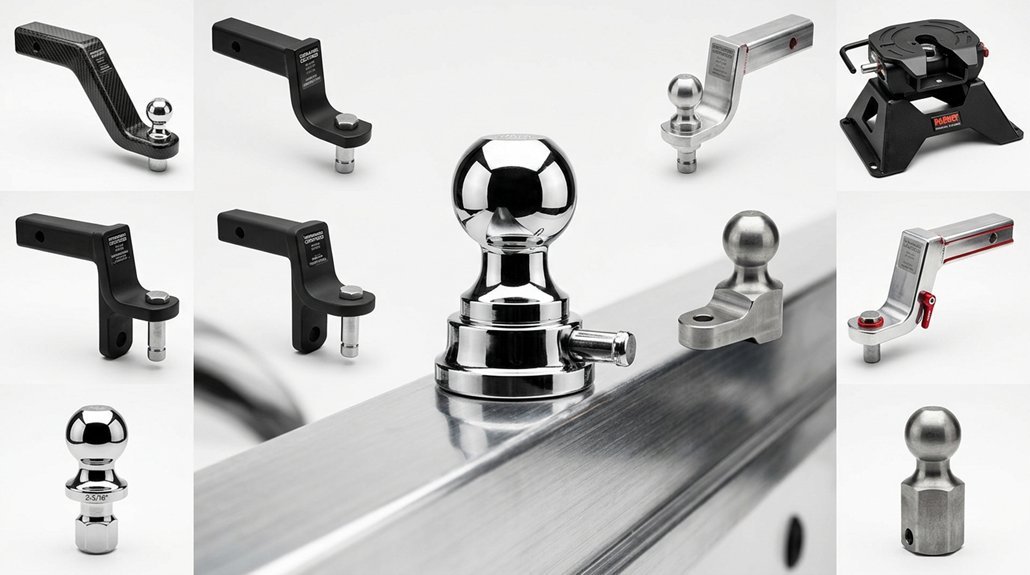


You’re towing a trailer, and the downward force pressing on your hitch ball is tongue weight—typically 9–15% of your gross trailer weight. Too little triggers dangerous sway; too much overloads your rear axle and extends braking distance. You’ll need precise measurement methods to find your actual number, because guessing puts your stability at risk.
What Is Tongue Weight?
Why does your trailer sway unpredictably at highway speeds? You’ve likely neglected proper tongue weight, the downward force your trailer tongue exerts on your hitch ball. This force represents load transfer from trailer to tow vehicle and fundamentally determines your towing safety.
When you achieve correct weight distribution—typically 9%–15% of gross trailer weight—you maintain balanced coupling between truck and trailer. Your coupler stays level, your front axle retains adequate load for steering response, and your rear suspension compresses appropriately for traction. Insufficient tongue weight lifts your rear, reducing tire grip and amplifying oscillation; excessive weight overloads your rear axle, degrading braking performance and front-end control.
You measure tongue weight using drive-on scales, dedicated tongue weight scales, built-in scale hitches, or lever-assisted bathroom scale setups. Precise measurement ensures you’re operating within engineered parameters for stable, predictable handling.
Recommended Products

[2-IN-1 SMART WEIGHING SYSTEM] – Combines a durable trailer tongue jack with a high-precision integrated digital scale. Monitor tongue weight in real time up to 1800lbs/816.5 kg (±25 lbs/±11.3 kg ) to maintain proper load balance and help reduce trailer sway for safer towing.
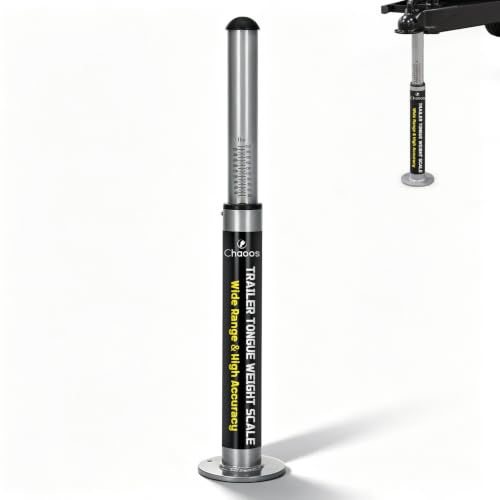
【Wide Range & High Accuracy】The Chaoos trailer tongue weight scale measures up to 2100 lbs with an accuracy within ±20 lbs, helping ensure proper tongue weight for safer towing and reduced trailer sway.

How Much Tongue Weight Do You Need?
How precisely should you calibrate tongue weight for safe towing? Target 9–15 percent of GTW (gross trailer weight). For a 5,000-pound trailer, you’ll need approximately 600 pounds—landing within the 10–15% sweet spot for optimal stability.
Too little tongue weight induces dangerous trailer sway at highway speeds; too much overloads your rear axle, degrading braking response and steering precision. Your weight distribution strategy directly controls this balance.
When tongue weight deviates from the 9–15% range, shift cargo toward the hitch to increase load or rearward to decrease it. You’ll recalibrate until proportions align.
Measure tongue weight before every trip. After any cargo change—reloading, unloading, or equipment swaps—reverify. Data-driven verification prevents dynamic instability and maintains predictable towing performance.
Recommended Products

ZEROLOCK True-Zero Accuracy: Recalibrate the trailer tongue scale back to true zero with the integrated adjustment screw, restoring factory accuracy and preventing the drift found in other scales

【Professional-Grade Accuracy & Durability】Engineered for professionals and meticulous owners, this scale combines an industrial Q235 steel structure with a military-grade spring mechanism for lab-like precision up to 1800 lbs. Its finish undergoes a rigorous 300-hour salt spray test, offering exceptional corrosion and abrasion resistance for use in marinas, construction sites, farms, or frequent highway travel.

1800 lbs Heavy-Duty Capacity, built with strong carbon steel to handle your toughest loads with reliability
How to Measure Tongue Weight at a CAT Scale

Where do you get an accurate, repeatable tongue weight measurement without procuring specialized equipment? You use a CAT Scale.
You’ll weigh your tow vehicle twice: first unloaded, then with the trailer attached but positioned so its tires remain off the scale. Subtract your unloaded vehicle weight from the loaded measurement to isolate tongue weight. For precise weight distribution validation, ensure your result falls within 9–15% of gross trailer weight. A 5,000-pound trailer, for example, targets approximately 600 pounds.
You’ll position carefully: trailer connected, tires clear of the platform, axle loads recorded cleanly. This method yields data traceable to certified standards, eliminating guesswork. You’re verifying that downward hitch force aligns with safe towing parameters, directly mitigating sway risk through verifiable, repeatable CAT Scale weight distribution analysis.
Recommended Products
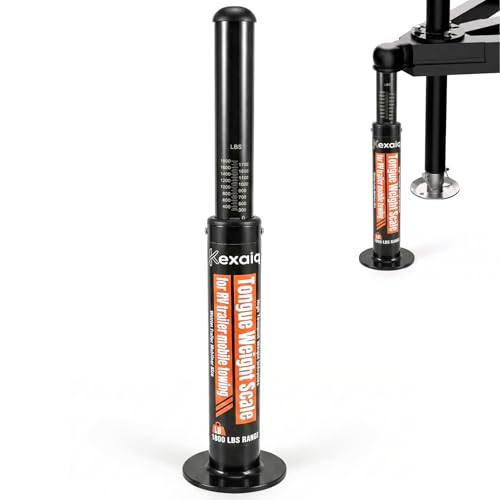
【Trailer Tongue Weight Scale 1800 LBS】Our Tongue Weight Scale has a measurement range of 300 to 1800 LBS, providing you with precise tongue weight readings to maintain a safe 10-15% ratio, eliminate dangerous trailer sway and suspension failures, and add or subtract protection for every trip you take

【Accurate Tongue Measurement】Measure tongue weight with confidence before every trip. This trailer tongue weight scale helps support proper weight distribution, reduce trailer sway, and improve towing stability for RV, boat, camper, cargo, and utility trailer setups.

Stable Operation: Our trailer tongue weight scale features an industrial-grade Q255 steel frame and military-grade spring structure, ensuring accurate tongue weight measurement every time. It operates stably in extreme temperatures ranging from -40°F (ultra-low temperature) to 150°F (high heat) and is fully protected by a corrosion-resistant powder coating. Designed to provide you with lifelong reliable and precise traction safety assurance.
How to Measure Tongue Weight With a Bathroom Scale
CAT scale access isn’t always practical when you need quick tongue weight data. You’ll employ the bathroom scale method for smaller trailer towing applications where precision instrumentation isn’t available. Gather a sturdy 4-foot lever, position a fulcrum approximately 1 foot from one end, and place your bathroom scale beneath the short lever segment. Set a support block on the long end, then rest the trailer tongue on the lever directly above the fulcrum. You’ll multiply your scale reading by four to calculate actual tongue weight in pounds. This mechanical advantage yields accurate downward force estimates without dedicated equipment. The bathroom scale method delivers low-cost, accessible measurements when built-in options aren’t feasible. You’ll find this approach particularly effective for lighter trailers where rapid tongue weight verification supports safe loading parameters.
Recommended Products

Adjustable Trailer Hitch: This truck hitch has a 4" drop and a 5" rise in 1" increments and comes with a Keyed Alike Dual Pin Lock, Receiver Pin Lock, Coupler Lock, and Padlock

Adjustable Trailer Hitch: This truck hitch has a 6" drop and a 7" rise in 1" increments and comes with a Keyed Alike Dual Pin Lock, Receiver Pin Lock, Coupler Lock, and Padlock

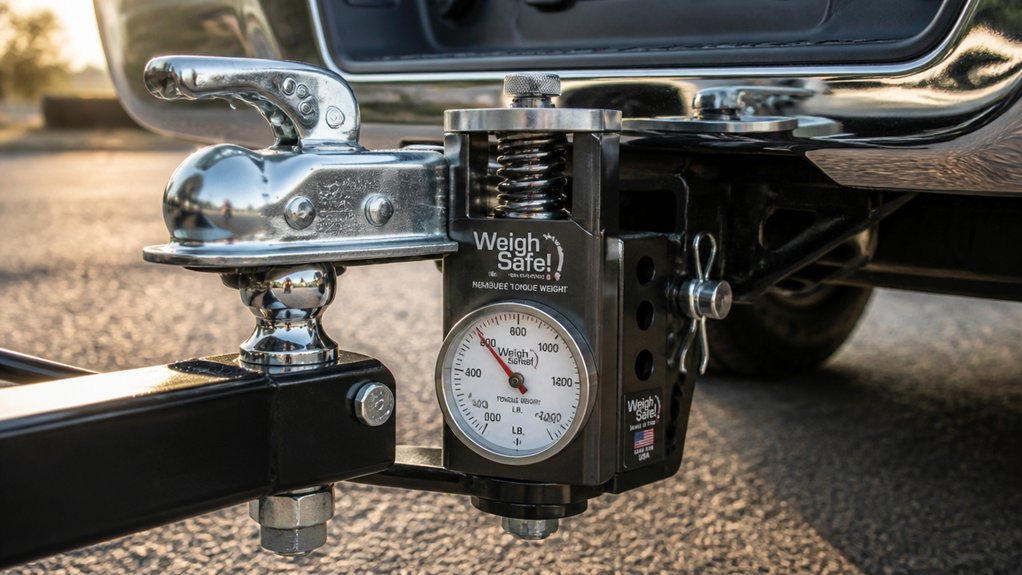
HELPS PREVENT TRAILER SWAY: Only trailer hitch ball mount that accurately measures tongue weight. Through Patented Technology, Weigh Safe Hitches include built-in scales that allow you to safely load and tow any trailer
How Built-In Hitch Scales Give Instant Readings
Why fumble with external equipment when you need tongue weight data fast? Built-in scales eliminate setup delays by integrating directly into your hitch assembly, delivering real-time tongue weight readings without disassembly or auxiliary devices.
You’ll observe immediate values as loads shift, enabling rapid corrections to maintain 9–15% GTW targets. These systems incorporate DTW guidance, showing how weight distributes across vehicle and trailer axles so you can optimize balance before departure.
Weigh Safe-style gauges exemplify this functionality: you hitch, read, and adjust. No leveling external scales, no mathematical interpolation. The precision reduces estimation errors that compromise stability.
For operators managing variable cargos, built-in scales adapt across load ranges—heavy equipment or lighter utility trailers—delivering consistent accuracy. You’re prioritizing measurable safety margins over approximation, with data visible throughout loading cycles.
Recommended Products

𝗨𝗻𝗺𝗮𝘁𝗰𝗵𝗲𝗱 𝗣𝗿𝗲𝗰𝗶𝘀𝗶𝗼𝗻: With 10 years of expertise, we’re trusted by over 5 million customers in 30+ countries. we take pride in our high-precision sensors—the core tech that's responsible for the accuracy in increments down to 0.05 lb

Digital Glass Bathroom Scale: This durable digital glass scale has a capacity of 400 pounds, precision electronic strain gauges for accurate weight measurements, and a jumbo 2" digital readout with metallic bezel and backlight display.
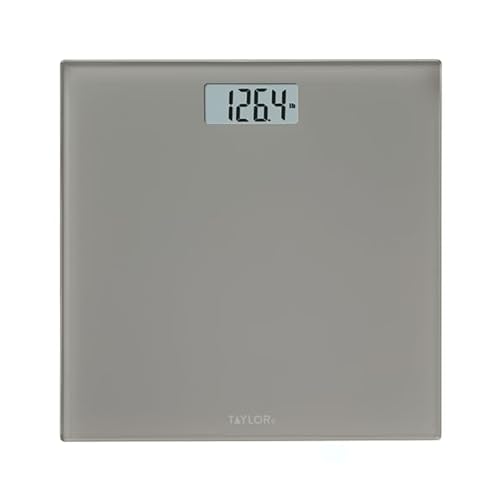
DURABLE TEMPERED GLASS PLATFORM: The 11 x 11 inch platform is crafted from sturdy tempered glass that supports up to 400 lb capacity; a sleek mid gray finish complements any bathroom decor while standing up to everyday use
Which Scale Type Should You Use?
The convenience of built-in scales raises an obvious question: which measurement method matches your operational demands? You’ve got three scale options to measure tongue weight, each with distinct operational constraints.
Drive-on scales require you to weigh your vehicle with and without the trailer disconnected, yielding tongue weight via differential calculation. Bathroom scale methods employ a lever-fulcrum configuration; you multiply the scale reading by four. Built-in hitch scales deliver instantaneous readings without disconnection or external equipment.
For heavy or variable loads, you’ll find built-in and drive-on configurations more versatile and less error-prone. Low-frequency operators with light trailers might accept bathroom scales’ cost advantage despite procedural complexity.
Regardless of your selection, you must maintain a level coupler during measurement and recheck tongue weight after cargo modifications or pre-departure. Accurate measurement underpins safe towing.
Recommended Products

1800 lbs Heavy-Duty Capacity, built with strong carbon steel to handle your toughest loads with reliability
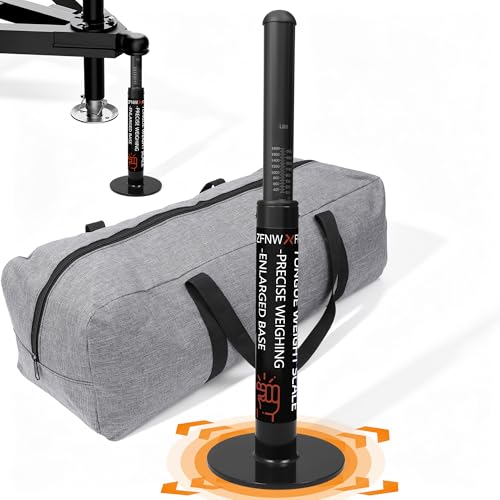
【Stable 6.3" Large Base】Our trailer tongue weight scale features an upgraded large base - 6.3" to prevent tipping, wobbling, or sinking in mud—safe and reliable for every towing trip, no messy mishaps.

【Wide Range & High Accuracy】The Chaoos trailer tongue weight scale measures up to 2100 lbs with an accuracy within ±20 lbs, helping ensure proper tongue weight for safer towing and reduced trailer sway.
How to Adjust Trailer Load for Proper Tongue Weight
Once you’ve measured your tongue weight, you’ll likely need to redistribute cargo to hit the 9–15% target of gross trailer weight. Proper load distribution centers mass strategically to balance trailer dynamics and towing stability.
When tongue weight falls below 9% of gross trailer weight, you’ll shift heavier cargo forward—closer to the hitch or axle—to increase downward force. Conversely, excessive tongue weight requires you to weight shift rearward, moving mass away from the hitch toward the trailer’s front or adjusting placement toward the tow vehicle’s rear. You’ll recheck measurements after each adjustment, as load variations alter distribution.
Leverage tow weight distribution calculators or integrated hitch gauges to quantify changes. These data-driven tools streamline adjustments, ensuring you maintain optimal tongue weight across varying cargo configurations and trip conditions.
Recommended Products
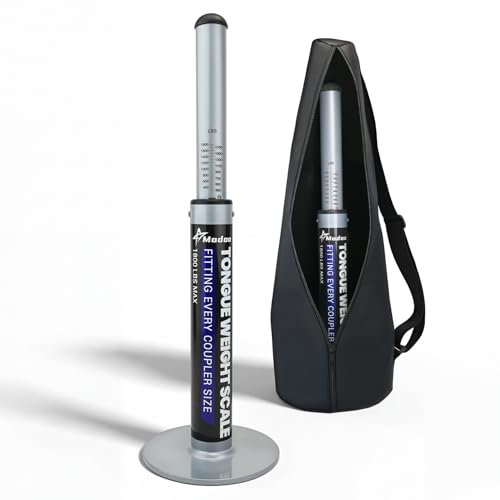
【Upgraded Large Base Trailer Tongue Weight Scale】Our tongue weight scale for RV features an upgraded 6.2-inch large base for extra stability. It effectively prevents the tongue weight scale from tipping, wobbling, or sinking into mud during use, ensuring a safer and more reliable experience

【Accurate Tongue Measurement】 Measure tongue weight with confidence before every trip. This trailer tongue weight scale helps support proper weight distribution, reduce trailer sway, and improve towing stability for RV, boat, camper, cargo, and utility trailer setups.

Quick and easy tongue weight measurements
What Happens When Tongue Weight Is Wrong
After adjusting your load to achieve optimal distribution, you must understand the consequences of missing that 9–15% target. Insufficient tongue weight shifts the trailer’s center of gravity rearward, triggering trailer sway at speeds above 55 mph. You’ll experience lateral oscillations that amplify without correction, exceeding 15 degrees of yaw within 3–4 seconds and elevating loss-of-control risk by 400% per NHTSA data.
Excessive tongue weight compresses your tow vehicle’s rear suspension beyond design load, reducing front axle traction by 20–30%. You’re impairing steering response and extending braking distance by up to 25%. Your frame stress increases proportionally.
Both deviations compromise towing safety. You’re creating dynamic instability or overloading structural components. Regular measurement prevents these conditions. Maintain 9–15% of GTW as tongue weight to preserve balanced load distribution, eliminate trailer sway initiation, and protect vehicle handling integrity.
Recommended Products

✅【Upgraded 2000 LBS Heavy‑Duty Capacity】This upgraded trailer tongue weight scale supports up to 2000 lbs tongue load. Built with high‑strength steel and heavy‑duty internal spring assembly, it delivers stable performance for heavy‑load towing, ideal for RVs, travel trailers, boat trailers and utility trailers

Accurate Tongue Weight Measurement - Reliable hitch weight readings help maintain proper load balance and reduce trailer sway.

When to Recheck Tongue Weight on the Road
How frequently must you verify tongue weight once you’re underway? You must recheck before every trip to account for cargo changes, then perform on-the-road adjustments whenever you add or remove load mid-journey.
On-the-road adjustments require immediate verification. If you redistribute cargo at a stop, reassess tongue weight promptly to maintain coupler level and preserve the 9–15% GTW range. Frequent rechecks detect load shifts that compromise vehicle dynamics.
You’ll use a built-in scale hitch, drive-on scale, or portable tongue weight scale for verification after loading. Regular rechecking reduces trailer sway risk, prevents impaired braking response, and preserves handling integrity. Static pre-trip values degrade as cargo settles or shifts; dynamic conditions demand continuous validation.
Data confirms improper tongue weight causes 60% of trailer stability incidents. Maintain vigilance through systematic rechecking protocols.
Recommended Products

Adjustable Trailer Hitch: This truck hitch has an 8" drop and a 9" rise in 1" increments and comes with a Keyed Alike Dual Pin Lock, Receiver Pin Lock, Coupler Lock, and Padlock

HELPS PREVENT TRAILER SWAY: Only 6" trailer hitch ball mount that accurately measures tongue weight. Through Patented Technology, Weigh Safe Hitches include built-in scales that allow you to safely load and tow any trailer
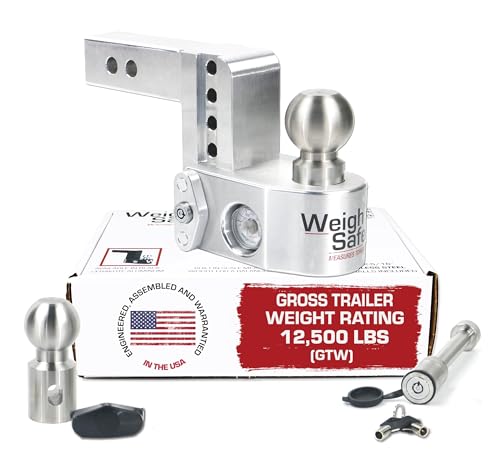
Adjustable Trailer Hitch: This truck hitch has a 4" drop and a 5" rise in 1" increments and comes with a Keyed Alike Dual Pin Lock and Receiver Pin Lock
Pre-Trip Tongue Weight Checklist
Rechecking tongue weight en route addresses dynamic load changes, but systematic pre-trip verification establishes the baseline that makes those mid-journey adjustments meaningful.
Your pre-trip checklist begins with measuring tongue weight before departure. You’ll verify it falls within 9–15% of GTW to ensure towing stability. Drive onto a CAT scale or use a built-in scale like Weigh Safe, keeping trailer tires off the platform for accuracy. If your reading falls outside parameters, shift cargo toward or away from the hitch until the coupler levels. Recheck after any loading modifications, as distribution shifts degrade handling. For small trailers without scale access, employ the bathroom-scale method or dedicated tongue weight scale. These steps create the data foundation essential for safe, predictable towing dynamics.
Recommended Products

Professional Accuracy: With 15 years of professional experience, our high-precision sensors ensure accuracy in body weight measurements. The convenient size is suitable for anywhere

Stainless Steel Platform: This scale comes with a smudge-resistant and easy-to-clean platform. While you might come across platforms that are made of glass and are prone to collect unwanted residue, our stainless-steel platform prevents smudges such as footprints or water marks

550lb Capacity, Extra-wide Platform: This body scale with a larger 550lb/250kg weight limit capacity is designed for different body builds, offering accurate and reliable weight measurements in 0.1lb/0.05kg increments. The expanded platform (13x11.8in/330x300mm) caters to various foot sizes, delivering enhanced stability and comfort to empower your wellness journey.
Conclusion
You’ve now got the data to optimize your tongue weight at 9–15% of gross trailer weight. Your measurements—whether via CAT scale, bathroom scale, or built-in hitch scale—give you actionable load distribution targets. Recheck after cargo shifts, fuel burns, or road conditions change. Maintain proper front axle loading, mitigate sway, and preserve braking performance. Apply these technical protocols before every trip; precise tongue weight management is your measurable control variable for safe, stable towing dynamics.