
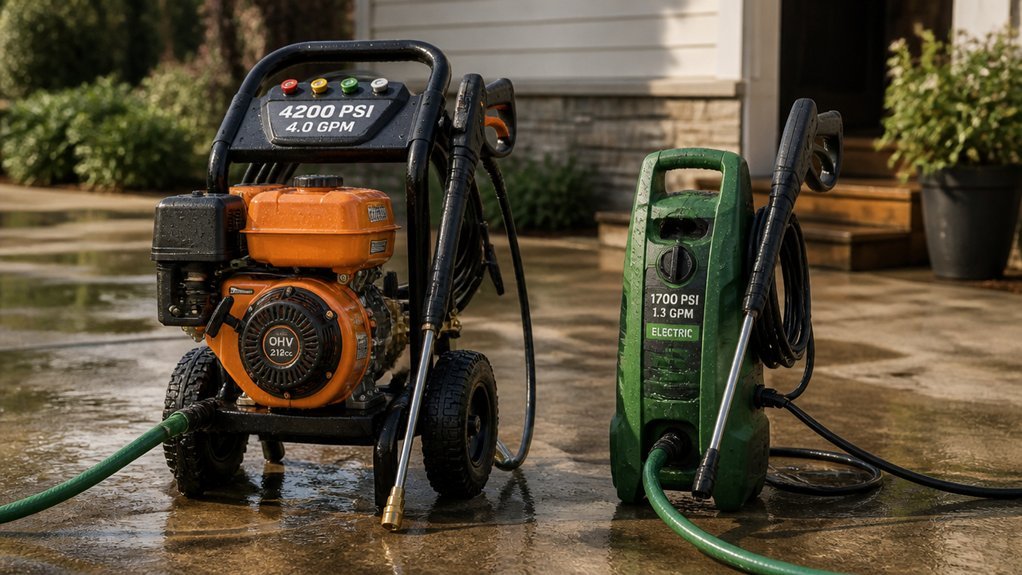
You’re weighing a gas unit’s 3,000+ PSI and 2.5+ GPM against an electric model’s plug-and-play simplicity, but the specs only tell part of the story. Your actual cleaning demands, maintenance tolerance, and local emission regulations will reveal which powerplant earns its keep in your setup. The deciding factor likely isn’t raw output—it’s whether you need sustained brute force or compliant versatility. So what’s your typical job profile?
Gas vs Electric Pressure Washers: Which Fits Your Budget?
How do upfront costs versus lifetime expenses shape your pressure washer decision? Electric units typically demand less capital expenditure at purchase, with zero fuel expenditure and reduced maintenance attributable to fewer mechanical components. Gas models necessitate higher initial outlay but can yield superior long-term value when you’re deploying frequent, heavy-duty cycles.
Your Budget must account for operational lifecycle: Electric washers eliminate gasoline procurement and oil changes, compressing total cost of ownership. Gas variants incur recurring fuel expenses and scheduled maintenance—carburetor cleaning, spark plug replacement, seasonal winterization.
Corded Electric configurations restrict your operational radius to extension cord length, potentially requiring infrastructure investment. Battery-powered Electric options with brushless motors now narrow cost-performance ratios against entry-level Gas units. Evaluate your duty cycle frequency: intermittent users optimize Budget with Electric; high-volume operators amortize Gas premiums across extended service life.
Recommended Products

POWERFUL PERFOMANCE: 3000 PSI and 2.3 GPM of powerful, deep-cleaning water pressure perfect for decks, sidewalks, siding, fences, railings, garage floors, exterior walls, cars and patio furniture – easy to fill 0.95 gallon gas tank

PREMIUM RESIDENTIAL PERFORMANCE: Easy-to-start with a DeWalt 208cc engine, perfect for cleaning decks, patios, siding, and prepping exteriors for painting. Simple assembly makes it ideal for residential use.

High Pressure Cleaning Output: Powered by a 212cc 4 cycle OHV engine, 70×55 bore/stroke, this gas pressure washer delivers up to 3500 PSI and 2.6 GPM for cleaning driveways, fences, decks, siding, and outdoor surfaces.
How Much Cleaning Power Do You Actually Need?
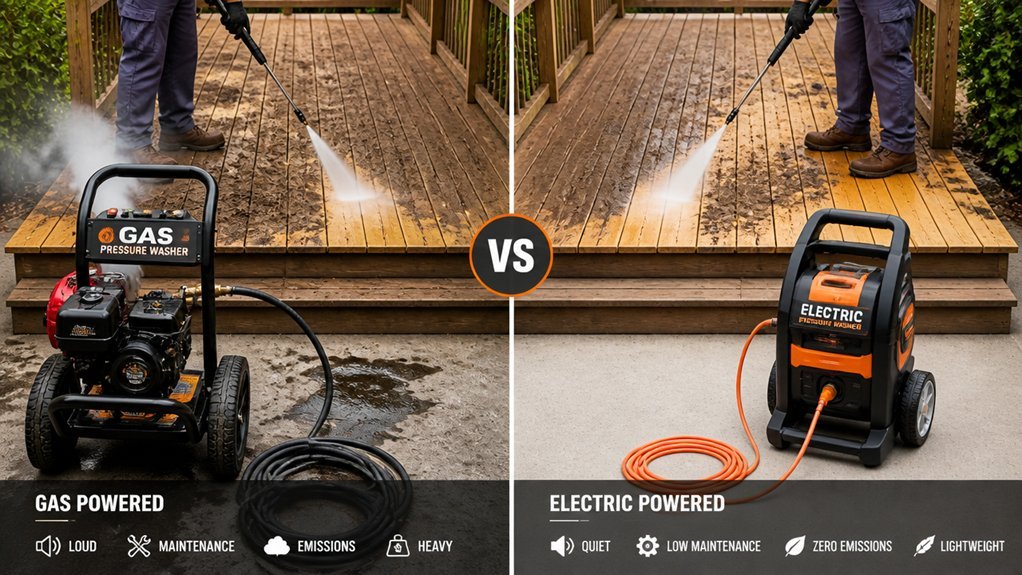
Budget considerations only matter if your tool can actually handle the job, and that’s where specification numbers tell the real story. You must evaluate PSI and GPM together to determine effective cleaning power, as these metrics reveal what your power source can actually deliver.
Electric pressure washers typically offer lower PSI and GPM ratings—consider Greenworks Pro’s 3000 PSI, 1.1 GPM unit, which handles driveways and decks competently. You sacrifice sustained performance with electric units, though brushless motor advances narrow this gap. Gas power sources push higher raw specifications, delivering sustained pressure for demanding cycles. However, excessive PSI risks substrate damage on routine tasks. Match your specifications to actual cleaning demands: electric suffices for standard residential maintenance, while gas specifications accommodate extended, high-intensity operations where thermal management and motor endurance become critical factors.
Recommended Products

Delivers 2500 max PSI and 1.76 max GPM (at lowest pressure), and 2000 rated PSI and 1.2 rated GPM of water flow; Pro-style steel extendable 17.5” wand with quick-connect nozzles (0°, 15°, 25°, turbo and soap applicator)

Delivers 2300 max PSI and 1.76 max GPM (at lowest pressure), and 1900 rated PSI and 1.24 rated GPM of water flow; Pro-style steel extendable 17.5” wand with quick-connect nozzles (0°, 15°, 25°, turbo and soap applicator)
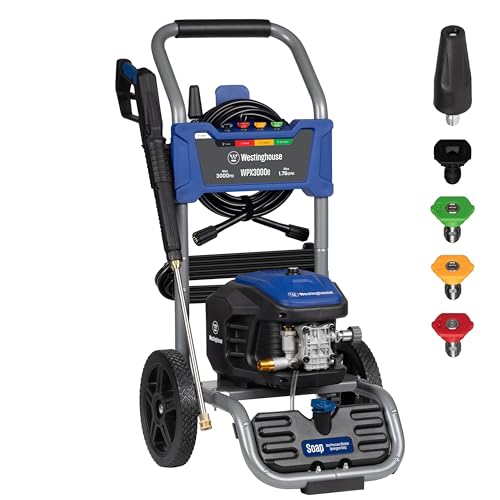
Delivers 3000 max PSI and 1.76 max GPM (at lowest pressure), and 2600 rated PSI and 1.1 rated GPM of water flow. Perfect for decks, sidewalks, fences, garage floors, exterior walls, cars and patio furniture; Comes with a .45 gallon soap tank
Heavy-Duty Cleaning: When Gas Pressure Washers Win
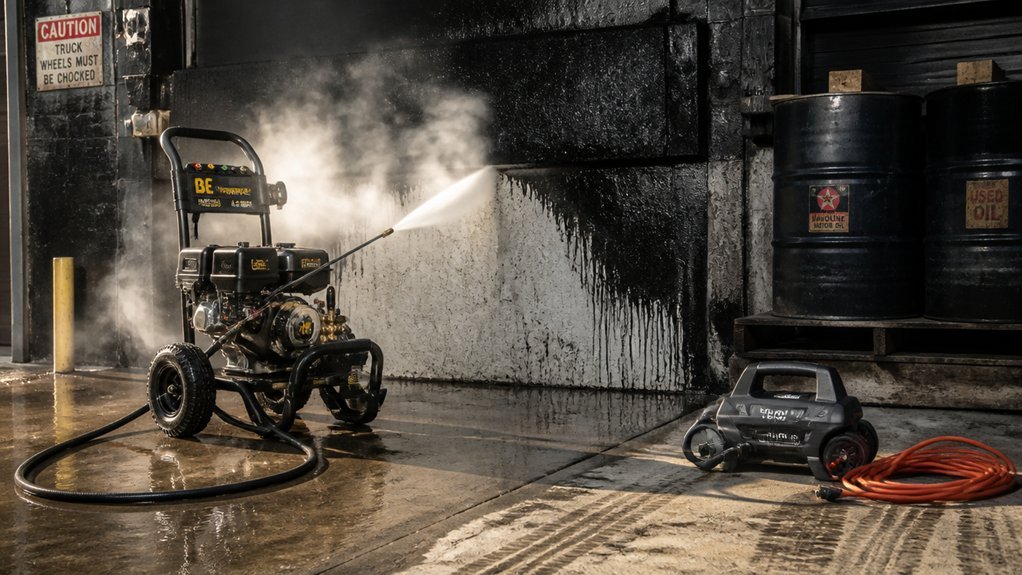
Why do professionals and serious DIYers still reach for gas-powered units when electric options keep improving? Gas power delivers superior PSI and GPM specifications that you’ll need for stripping paint, cleaning construction equipment, or blasting years of grime from concrete surfaces. When you compare sustained performance, gas engines maintain high torque under load where electric motors overheat or trip breakers. You’ll trade convenience for capability: weight and portability favor electric models, but gas units free you from outlet dependence despite heavier frames and challenging transport. Maintenance and cost considerations become significant factors— you’ll handle fuel storage, oil changes, and seasonal winterization, plus absorb higher purchase prices. For commercial-grade demands, you accept these compromises because specification sheets don’t lie: nothing matches raw cleaning output when specifications truly matter.
Recommended Products

3200 PSI and 2. 5 GPM of Powerful, Deep-Cleaning Water Pressure Perfect for Decks, Sidewalks, Siding, Fences, Railings, Garage Floors, Exterior Walls, Cars and Patio Furniture – Easy to Fill 0.9 Gallon Gas Tank

SIMPSON PRESSURE WASHER FOR PROFESSIONALS: The Simpson PowerShot gas power washer cleans decks, driveways, siding, fencing, equipment, and graffiti; The cold water machine is great for contractors; 49-State Compliant (Not for sale in California)

SIMPSON PRESSURE WASHER FOR HOMEOWNERS: The Simpson Clean Machine gas power washer cleans decks, driveways, siding, fencing, patio furniture, and cars; The cold water machine is great for homeowners; 49-State Compliant (Not for sale in California)
Home and Light Use: When Electric Pressure Washers Suffice
“Where does residential cleaning actually demand gas power?” you might ask. For most homeowners, Electric pressure washers deliver sufficient performance without the complexity. You operate units delivering 1.1 GPM at 3000 PSI—specifications matching corded models like the Greenworks Pro 3000 PSI—handling driveways, decks, and siding with measurable efficiency. You avoid gasoline exhaust, fuel storage hazards, and intensive maintenance schedules, reducing both environmental impact and operational overhead. The trade-off manifests in mobility: you tether to outlet reach, restricting range during light-duty tasks. Yet for typical residential cycles, this limitation rarely compromises cleaning objectives. Electric designs prioritize lower decibel output and reduced weight, factors you notice during extended sessions. When specifications align with application scope, you find Electric performance adequately addresses residential demands without gas-powered overengineering.
Recommended Products
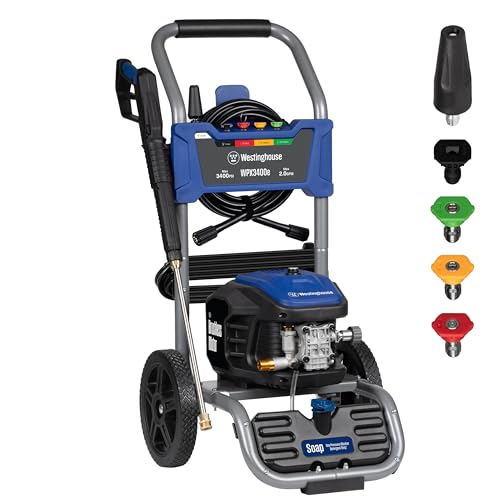
Delivers 3400 max PSI and 2 max GPM (at lowest pressure), and 3000 rated PSI and 1.1 rated GPM of water flow; Perfect for decks, sidewalks, siding, fences, railings, garage floors, exterior walls, cars and patio furniture; Comes with a half gallon onboard soap tank

Delivers 2100 max PSI and 1.76 max GPM (at lowest pressure), and 1800 rated PSI and 1.2 rated GPM of water flow.

Powerful cleaning: Electric power washer with1700 max psi* and 1. 2 gpm**
Cordless Electric: Has Battery Tech Caught Up?
How far can battery technology push cordless pressure washing before physics intervenes? You now see brushless motor designs squeezing 40% more efficiency from every watt, yet battery capacity still caps your runtime. Cordless performance reaches 2000 PSI and 1.2 GPM on flagship models—adequate for decks, vehicles, and siding—but you’ll notice output sag during sustained trigger pulls. You compare energy density: lithium-ion packs at 250 Wh/kg versus gasoline’s 12,000 Wh/kg equivalent. You accept trade-offs. You charge batteries in 60 minutes, swap packs mid-job, and avoid fuel stabilizers entirely. You calculate weight penalties: 10-15 pounds per battery. You recognize cordless electric dominates portability and residential duty cycles, while gas retains supremacy in continuous, high-volume commercial applications where kilowatt-hour throughput matters.
Recommended Products

Achieve Professional-Level Cleaning Results with This 16.5” Surface Cleaner, with Up To 4400 PSI of Pressure for Easy Cleaning of Flat Surfaces Like Decks, Patios, Driveways, Walls and More
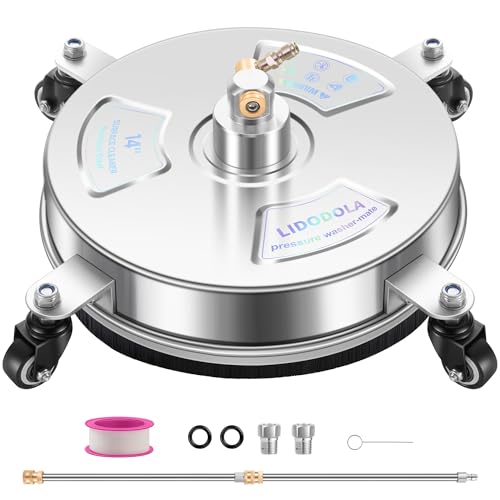
PROFESSIONAL CLEANING – The Lidodola surface cleaner achieves high-performance cleaning across a 14" wide area with dual spinning nozzles, delivering thorough removal of stubborn stains on driveways, decks, sidewalks, and other large surfaces.

IDEAL FOR FLAT AREAS: This 15” surface cleaner can concentrate up to 3400 PSI for quick cleaning of large areas like decks, patios, driveways, walls and more
Are You Willing to Maintain a Gas Engine?
Exactly what maintenance burden are you signing up for when you choose gas?
Gas engine maintenance demands regular oil checks, spark plug inspections, and air filter replacements to maintain peak performance and prevent fuel waste. You’ll face periodic tune-ups; neglect accelerates wear and increases consumption. When you store fuel, you absorb ongoing fuel costs and manage volatile exhaust emissions. Starting difficulty compounds these burdens—you’ll prime, choke, and wrestle with recoil starters, especially in cold conditions.
Compared to electric alternatives, gas units add substantial weight and bulk, requiring more storage space and reducing maneuverability. You’re trading plug-and-play simplicity for power density, but you must calculate whether the specification advantages justify the maintenance reality. Your operational costs extend beyond purchase price into fuel logistics, parts replacement, and mechanical upkeep.
Recommended Products

The gas powered pressure washer has a powerful 210 ml 4-spoke engine and can hold 0.8 gallons of gasoline. It's easy to start and has a aluminum pump.

TRUBRUSHLESS MOTOR : Powerful 14 Amp TruBrushless motor generates 3000 PSI and 2.0 GPM for maximum cleaning power.Cleaning Units 3300 C.U. Maximum Inlet Water Temperature 104°F (40°C).
Safety, Noise, and Handling: Real Mobility Differences
Why prioritize raw portability when safety and handling specifications directly shape your operational experience? Electric pressure washers eliminate gasoline exhaust emissions, improving indoor air quality metrics and reducing respiratory risk factors.
You’ll experience lower vibration frequencies and reduced noise decibels, minimizing operator fatigue during extended cleaning cycles.
Safety improves through diminished mechanical kickback and lighter chassis specifications.
However, electric units constrain mobility via tethered power requirements, whereas gas systems achieve unrestricted spatial range. You trade unconstrained mobility for increased mass: gas engines add substantial weight, elevating start-up torque demands and maneuvering difficulty.
You’ll notice gas models exceed 60 decibels above electric baselines, accelerating auditory strain.
Your handling limitations—strength thresholds, endurance capacity—determine whether gas mobility benefits outweigh electric safety and ergonomic advantages.
Recommended Products

[2100 PSI @ 1.2 GPM] - Great for medium-duty cleaning tasks. Great for medium-duty cleaning tasks. Ideal for use on fencing, decking, concrete patios, siding, sidewalks, patio furniture, small driveways & more.
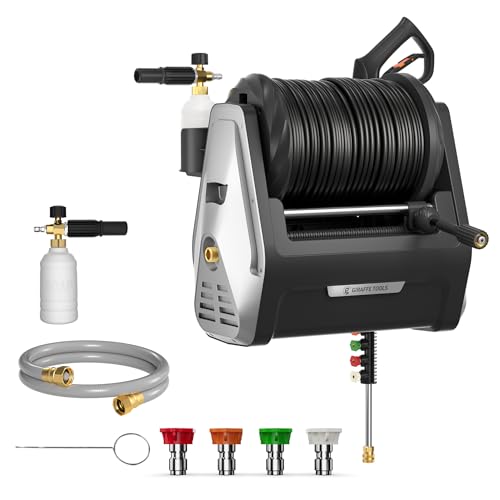
2-Year Hassle-Free Warranty: Free repairs for any quality issues. We fix it right—promptly & professionally. Relax, We've got you covered! Just reach out anytime (24/7!) for fast solutions. Keep cleaning confidently – guaranteed!
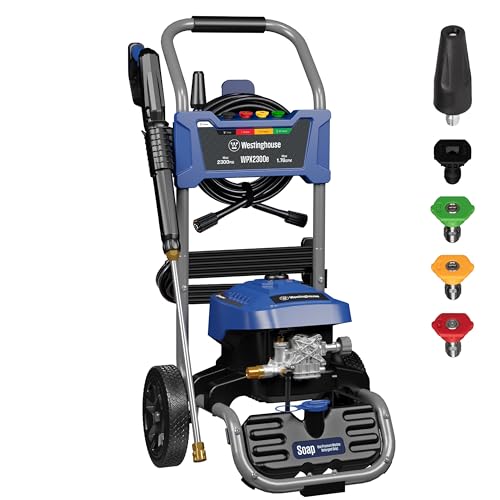
Delivers 2300 max PSI and 1.76 max GPM (at lowest pressure), and 1900 rated PSI and 1.2 rated GPM of water flow. Perfect for decks, sidewalks, fences, garage floors, exterior walls, cars and patio furniture; Comes with a .42 gallon soap tank
Environmental Impact: Emissions and Local Restrictions
Where do your cleaning operations stand against tightening emission standards and local air quality mandates? You’ll find electric pressure washers deliver zero direct emissions at the point of use, eliminating exhaust contaminants that gasoline combustion engines release. This specification advantage positions electric models favorably under increasingly stringent regulations targeting outdoor air quality.
Gas-powered units emit carbon monoxide, hydrocarbons, and nitrogen oxid es through their internal combustion cycles, requiring you to manage fuel storage protocols and ventilation procedures that local jurisdictions often mandate. You must also navigate noise ordinances that gas engines frequently violate due to higher decibel outputs.
Comparative regulatory analysis shows electric configurations typically bypass emissions-related permitting requirements entirely. When you evaluate operational specifications against regional restrictions, electric pressure washers demonstrate superior compliance profiles, reducing your exposure to enforcement actions and community objections while maintaining cleaning performance standards.
Recommended Products

【Extend Service Life & High Performance】Replace this HORIZONTAL 3/4" shaft pump to reborn engine instead of buying a whole new power washer, and produce up to 3400 PSI at 2.5 GPM. Easy-to-install kit for quick start, stainless steel pistons for improved seal life and features a stainless-steel integrated unloader with easy-start system, ideal for washing walls, sidewalks, vehicles and more. *Not for 7/8" pumps, SRMW footprints, or frames with shrouds blocking the mount.

[HIGH-QUALITY PUMP] Horizontal Power Washer Pump 3/4" Shaft MAX 3300 PSI / 2.5 GPM / @3400 RPM, Our pressure washer pumps replacement operation time is 150 hours, (50 hours longer than the market), so that you can save money for replace pressure washer accessories and time.Top performance at 2600-3300 PSI and fit most 180-225cc 6.0HP-8.0HP engine. Replacement for Simpson, Homelite, Honda, Karcher and more

REPLACEMENT POWER WASHER PUMP: Replace your SIMPSON pressure washer pump with the OEM Technologies Axial Cam Power Washer Pump to restore cleaning power; Get up to 3400 PSI at 2.5 GPM; Fits horizontal engines with 3/4" shaft like the Honda GX190 or GX200
Your Pressure Washer Decision: 4 Questions to Answer
Aligning your equipment selection with regulatory requirements and operational specifications begins with a systematic evaluation of your specific cleaning demands.
You’re weighing a gas pressure washer against an electric pressure washer, so answer four decision questions. First, what’s your cleaning frequency? You need sustained power for frequent, large-scale jobs—gas delivers; you manage lighter tasks—electric suffices.
Second, what’s your mobility requirement? You’re constrained by outlets with corded electric; you’re fuel-dependent but untethered with gas.
Third, what’s your maintenance tolerance? You’ll handle engine upkeep, storage, and higher investment for gas; you’ll accept lower pressure for minimal maintenance with electric.
Fourth, what’s your safety priority? You eliminate exhaust exposure and reduce injury risk with electric’s lower PSI; you accept louder, heavier operation for raw power with gas.
Recommended Products

JET FLOW TECHNOLOGY : 2300 maximum PSI with rapid rinse and high area reach (50% more flow).Pump type : Axial Cam. soap tanks : Single On-Board.onboard tool : Yes

Efficient Brushless Cordless Power Washer: This portable power washer built with an advanced brushless motor, delivers a powerful 1500PSI water flow that cuts through mud, dust, and stubborn stains with ease. Unlike traditional copper-core motors, this battery power washer with brushless technology runs cooler, quieter, and lasts significantly longer—so you get reliable performance for years to come

【Lightweight Yet Powerful Cleaning】 Leoter portable pressure washer features a cordless, battery-powered design with a lightweight 1.8 lb body for easy carrying and handling. Powered by a high-performance 300W brushless motor, this portable power washer delivers up to 24000 RPM and 1250 PSI for effective cleaning on cars, patios, decks, garden tools, outdoor furniture, and more.
Conclusion
Your choice hinges on four specifications: sustained PSI/GPM requirements, maintenance tolerance, mobility constraints, and regulatory compliance. Gas delivers 2,800–4,200 PSI for commercial stripping and concrete degreasing but demands fuel, oil changes, and emissions allowances. Electric provides 1,300–2,400 PSI for residential siding and vehicle washing with lower decibel output and zero exhaust. Cordless variants now achieve 1,000–1,500 PSI but remain runtime-limited. Match power output to task severity, not purchase price.
Recommended Products

IMPORTANT FITMENT NOTE – Equipped with a 1/4" quick-connect plug, this attachment fits most 2000–4000 PSI pressure washers. It connects to your pressure washer gun/wand only — garden hoses will NOT work. Machines with 3/8" outlets need an adapter (not included). Not sure? Check your pressure washer's specs before ordering.
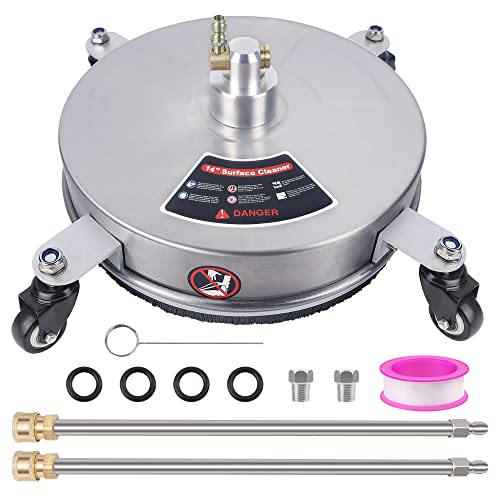
PROFESSIONAL SURFACE CLEANER: 14" Pressure Washer Surface Cleaner gives a commercial grade cleaning area of 14 inches wide. Hover action makes surface clean faster and effective than nozzles alone. Ideal for cleaning stubborn stains on large flat surfaces such as patios, driveways, decks, sidewalks. And also could be used on vertical surfaces like brick walls, stucco and other siding.

PROFESSIONAL CLEANING - The JANZ surface cleaner offers commercial-grade cleaning within an area 14" wide, featuring two spinning nozzles rather than one and guaranteeing exceptional cleaning performance. It is extremely appropriate for removing stubborn stains on extensive surfaces such as driveways, patios, decks, sidewalks, and numerous others.