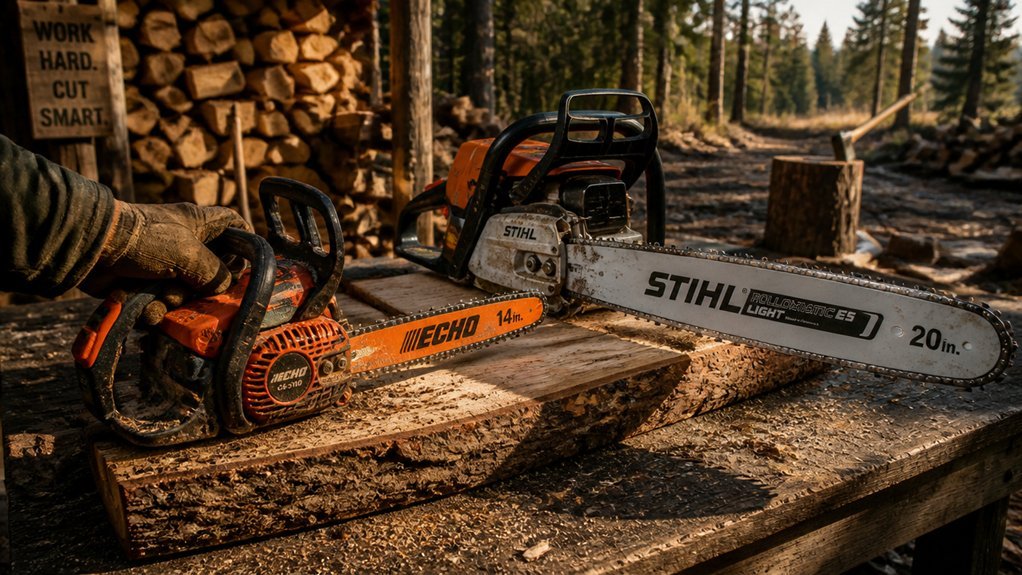

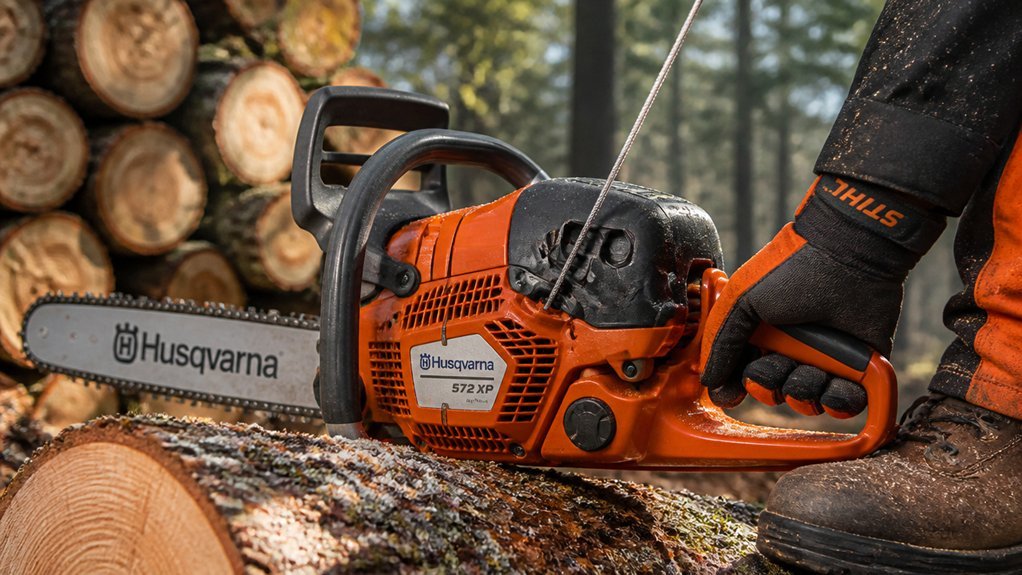
You need to start your chainsaw correctly, or you’re risking serious injury. Every year, operators suffer lacerations and kickback injuries from improper starting technique. The process differs sharply between gas, battery, and corded models, and getting it wrong can flood the engine or damage the chain brake. Before you pull that starter cord or press the power button, you’ll want to know which method matches your saw—and why skipping the pre-start inspection could cost you more than just time.
Prep Your Space Before Starting Your Chainsaw
Where should you start your chainsaw? You’ll start outdoors or in a well-ventilated area to avoid carbon monoxide accumulation from exhaust emissions. Before you start, prep space meticulously: inspect ground conditions for uneven terrain, debris, or slippery slopes that compromise stable footing.
You’ll maintain a fifteen-yard safety radius, clearing all bystanders, children, and pets from the zone. Position your fueling station ten feet minimum from the operating area, using correct fuel mixtures with spill containment protocols.
You’ll complete a pre-start safety check: verify chain brake engagement, remove the scabbard, and confirm adequate fuel and bar oil levels. These preparatory measures eliminate ignition hazards, ensure operational readiness, and establish controlled conditions. Your adherence to spatial preparation protocols directly prevents accidents before the engine fires.
Recommended Products

750 lbs High tensile Strength Pull Cord – The outer layer of this pull rope is engineered with 16 strands of high-strength polyester braid, boasting a breaking strength of up to 750 lbs. The 4mm thickness provides superior tensile strength and impact cushioning, making this pull start cord the most reliable choice for heavy-duty engines like Briggs & Stratton, Honda GX390, and Predator 212.

EXTRA LENGTH ROPE: Each pack includes a generous 10 feet of starter rope, perfect for all your equipment needs. Standard pull cord length for lawn mowers is only 6 feet, giving you more flexibility.

750lb Ultra-Polyester Construction: This pull string features a robust 16-strand polyester braid, 4mm thickness delivers 2.5x the tear resistance of generic nylon ropes, ideal for demanding snowmobile pull cord replacements and garage door pull cords. Before purchasing, please verify the required starter rope size
How to Start a Gas Chainsaw Step by Step
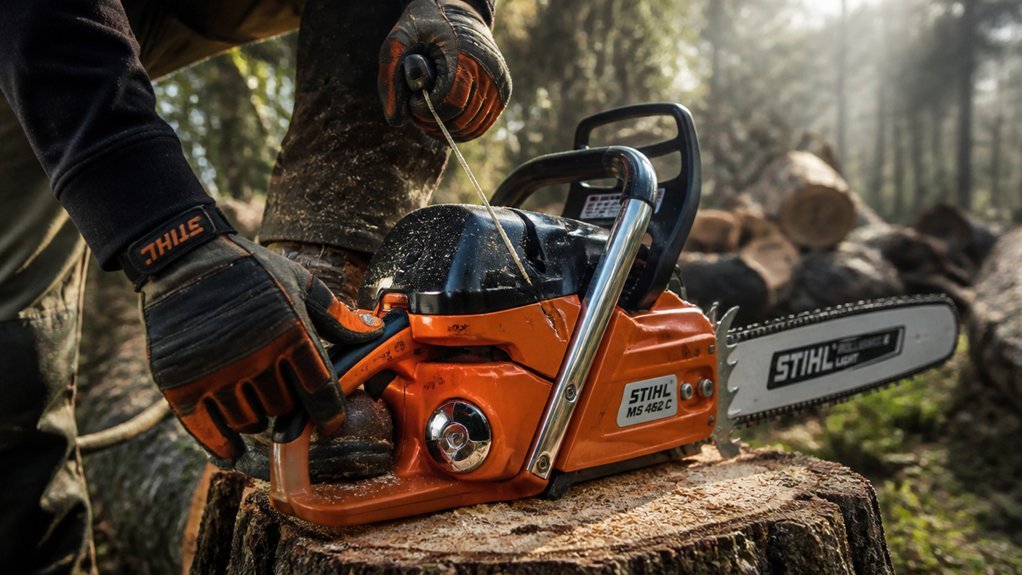
How do you start a gas chainsaw safely? First, verify the chain brake is engaged and confirm that you’ve topped up both fuel and bar oil.
For a cold start, set the choke to the closed position, establish your starting stance with your right foot in the rear handle and your left hand firmly on the front handle. Maintain this two-handed grip while pulling the starter cord two to three times.
If the engine fires briefly then stalls, advance the choke to half-throttle and continue pulling until the saw starts. Immediately set the throttle to idle and release the chain brake.
Before cutting, keep both hands on the handles, move to your cutting position, and ensure the chain brake stays disengaged only when you’re ready to cut.
Recommended Products

Compatible with Husqvarna Models: 455 E (2013-01), 455 E Triobrake (2013-01), 455 Rancher (2011-01), 455 Rancher (2013-01), 455 Rancher (2004-10), 455 Rancher (2005-01), 455 Rancher (2005-03), 455 Rancher (2006-02), 455 Rancher (2006-06), 455 Rancher (2007-01), 455 Rancher (2009-10), 455 E (2007-01), 455 E (2009-10), 455 E Rancher (2006-06), 460 (2005-03), 460 (2006-02), 460 (2006-06), 460 (2007-01), 460 (2009-10), 460 (2013-01), 461 (2013-01)

Powerful Brushless Motor: Tackle tough cuts with ease. This 16-inch battery chainsaw features a high-performance brushless motor that powers through logs, storm-fallen trees, and firewood. Our brushless design provides longer runtime, smoother cutting action, and extended motor life with built-in protection against overload and overheating.

CHAINSAW PROTECTIVE WORK BOOTS FOR MEN certified chainsaw protection ASTM F1818 Mid Class rating at 24m/sec, EN ISO 17249:2013
Start a Flooded Gas Chainsaw
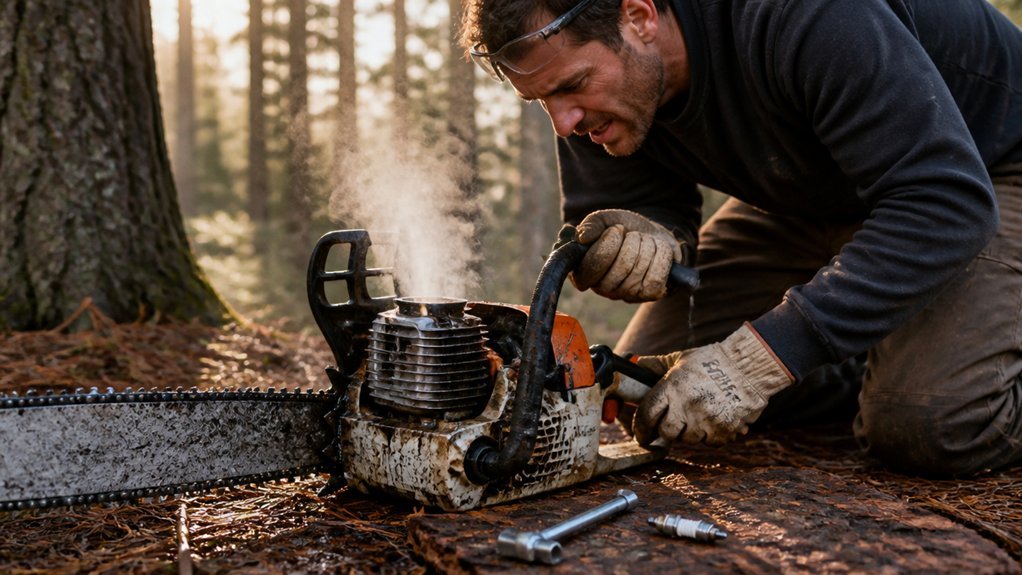
If your gas chainsaw refuses to start after several attempts, you’ve likely flooded the carburetor with excess fuel—a common result of leaving the choke engaged too long during a cold start.
To clear a flooded chainsaw, first remove the air filter cover and extract the filter.
Allow fuel to evaporate from the carburetor for 10–15 minutes; you can accelerate this by laying the saw on its side with the air filter cavity exposed to increase airflow.
Dry the air filter thoroughly before reinstallation—never operate with a saturated filter.
Once cleared, restart using the correct choke position for a warm engine, typically open or half-choke depending on your model.
Avoid repeating the cold-start sequence.
If ignition fails again, extend the evaporation period and verify proper choke position before subsequent attempts.
Recommended Products

Extends bar, chain and sprocket life

Engineered with anti-wear agent Zinc Dialkyl Dithiophosphate (ZDDP) to help provide a layer of protection for the bar and chain

1.PERFECT DESIGN: The liquor bottle pourers device adopts a special back-flow hole leakage prevention design to keep the air circulation inside and outside the bottle, and the liquid flow speed can be accurately controlled when used.
Gas Chainsaw Starting Positions: Ground and Between-the-Legs
Why risk losing control of a chainsaw during startup? Secure your starting position on level ground or between your legs.
For the ground starting position, place your right foot through the rear handle. Grip the front handle firmly with your left hand, keeping your arm straight. Engage the chain brake. Pull the starter cord repeatedly with your right hand until ignition occurs.
Use the between-the-legs starting position when ground space is limited. Stabilize the rear handle between your left thigh and behind your right knee. Maintain your left-handed grip on the front handle with a straight arm. Verify the chain brake remains engaged.
Both starting positions demand two-handed control and stable footing. Never compromise chain brake engagement. These methods prevent kickback and ensure you’re ready for operation.
Recommended Products

1137-140-1902 Air Filter Cover for Stihl MS193 MS193T Chainsaw with 1137-120-1604 Air Filter

For STIHL Blower Models BG56 BG66 BG86 SH56 SH86

【Package Includes】:1 × 799579 air filter, 1 × 595660 air cleaner cover and 1 ×594281 Primer Bulb. A well-functioning air filter keeps dirt from entering the engine through the carburetor.
Start a Cold Gas Engine vs. a Hot Engine
Where does your chainsaw’s engine temperature leave you? For a cold start, engage the chain brake, verify fuel and bar oil, purge the carb via priming if equipped, and activate decompression if available. Set the choke to full, then pull the starter until the engine fires. Smooth to half-throttle, then reach idle with the chain brake released.
For a hot start, you’ll skip the choke entirely—often you’ll need no priming or air purge. If starting proves difficult, apply half-throttle. Decompression and priming steps are typically unnecessary during hot starts unless the engine resists. Maintain two-handed grip and stable stance for both procedures. The hot-start method minimizes choke use, reducing flood risk while preserving safe starting protocol.
Recommended Products

MEEIHUI 45CC 52CC 58CC Chainsaw Parts ,Recoil Pull Start Starter for Chinese Chainsaw 4500/5200/5800

Material: High-quality new nylon for durability and reliability

DIRECT FIT: Replacement parts for STIHL 015L chainsaws.
How to Start a Battery Chainsaw
How does a battery-powered chainsaw simplify your startup routine? You’ll eliminate fuel mixing, choke adjustments, and exhaust concerns entirely. Ensure your battery holds a full charge and seat it properly in a clean, debris-free compartment. Engage the chain brake per your model’s specifications before activation.
Press the start button, then squeeze the trigger to engage the motor. Maintain two-handed control, stable footing, and full personal protective equipment—eye and hearing protection remain mandatory. Never start in damp conditions; moisture compromises electrical safety.
Monitor motor temperature during operation. If overheating occurs, stop immediately and allow cooling. Apply bar oil regularly, maintain chain sharpness, and adjust tension as needed. Store and charge batteries according to manufacturer protocols, avoiding temperature extremes. Your adherence to these protocols ensures reliable, safe performance.
Recommended Products

Fitment:45cc 52cc 58cc chainsaw parts single recoil pull starter assembly chainsaw spares for chinese chainsaw 4500 5200 5800 recoil starter accessories
650 lbs High-Strength Pull Cord – The outer layer of this pull rope is engineered with 16 strands of high-strength polyester braid, boasting a breaking strength of up to 650 lbs. The 3.5mm thickness provides excellent flexibility and smooth recoil, making this pull start cord the reliable choice for Stihl, Husqvarna, and Echo chainsaws.
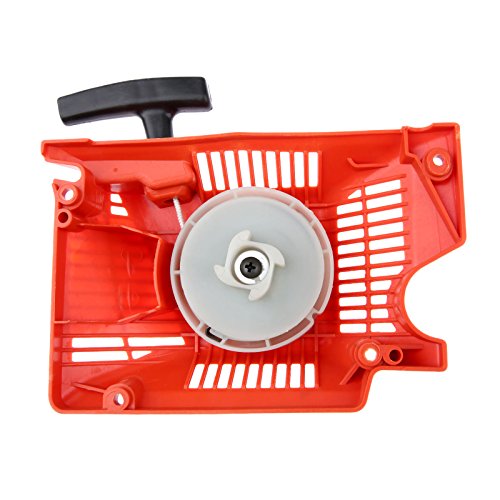
【Fitment】New recoil starter fit for Chinese chainsaw 4500 5200 5800 45CC 52CC 58CC engine. Garden Tool Parts.
Start a Corded Electric Chainsaw Safely
A corded electric chainsaw delivers consistent power without fuel or battery management—you’ll simply need a proper electrical setup to operate safely.
Plug your saw into a heavy-duty extension cord (#10-3) no longer than 50 feet to prevent voltage drop and overheating. Before engaging the power switch, verify the chain brake functions correctly and the chain tension meets manufacturer specifications. You’ll place the saw on stable ground with the chain brake engaged, then press the start button while keeping both hands on insulated handles. Release the chain brake only after the motor runs, then squeeze the trigger. Wear eye and hearing protection, avoid damp conditions, and inspect the cord for damage. Stop immediately if the extension cord or outlet becomes hot.
Recommended Products

Fits for Stihl: MS341, MS361 Chainsaw

High-Efficiency and Safe Braking: Braking assembly features sensitive braking response, quickly cutting off chain drive in case of equipment rebound or sudden situations, improving overall safety performance of chainsaw

Fitment: Fit for Husqvarna 440 440e 435 435e 135 140 Chainsaw
Run These 3 Pre-Start Inspections Every Time
Why risk preventable injury when three systematic checks take seconds?
First, test the chain brake. Start the saw, accelerate briefly, release the throttle, and confirm the chain stops reliably. A malfunctioning brake demands immediate repair before operation.
Second, verify chain lubrication. Run the saw at half throttle over a light surface and inspect for an oil trail. Absence indicates insufficient lubricant—service and retest.
Third, confirm the start sequence and safety features: engage the chain brake, remove the scabbard if required, and activate the decompression valve if present. These pre-start inspections ensure all safety features function correctly.
Complete these checks every time. They prevent mechanical failure, reduce kickback risk, and establish safe operational baseline before cutting begins.
Recommended Products

Includes one quart bottle of Husqvarna X-Guard Premium All Season Mineral Bar and Chain Oil

PACKAGE : Include 2 pcs stainless steel bottle pourers (individual package).

Material: Set of 2 The pouring spout is made from food-grade stainless steel and rubber, for liquor bottles or olive oil dispenser bottle, bottle mouth for 0.75"-0.9" inch (an error of 0.1-0.3mm is normal), please measure size of the bottle mouth before buying.
Chainsaw Won’t Start? Try These Fixes
When your chainsaw refuses to fire, systematic troubleshooting beats frustration every time.
First, inspect the chain brake; you can’t start with it engaged. Check the decompression valve—ensure it’s pressed if your model has one. For a flooded carburetor, remove the air filter and allow fuel to evaporate for 15 minutes, then restart with choke off and throttle wide open.
Cold start failures demand proper choke technique: engage the chain brake, prime until fuel fills the bulb, set half-throttle choke, then pull.
Battery models won’t start with depleted cells or improper installation. Corded electrics require #10-3 extension cords under 50 feet and verified live outlets.
Never bypass pre-start inspections. If chain brake, decompression valve, or fluid checks fail, don’t force ignition—address faults first.
Recommended Products

Air Cleaner Cover Replaces # 4229 141 0501, 4229-141-0501.

【Replacement part number】Air Filter Cover Kit for 1123 140 1902,1123 120 1650,1123 141 2301.

Replacement Part Number - Exact match for air cleaner cover OEM# 595660, 590581 & air filter OEM# B S 799579, 796579, 5434, 4248; M TD 751P22427, O regon 30-183, direct swap for original lawn mower air filter assembly
Conclusion
You’ve got the know-how to start your chainsaw safely now. Always prep your space, inspect your equipment, and match your starting technique to your power source and engine temperature. Keep your two-handed grip firm, your stance stable, and your chain brake engaged until you’re ready to cut. If your saw won’t start, troubleshoot systematically—don’t force it. Follow these protocols every single time, and you’ll minimize risk while keeping your chainsaw ready for work.