

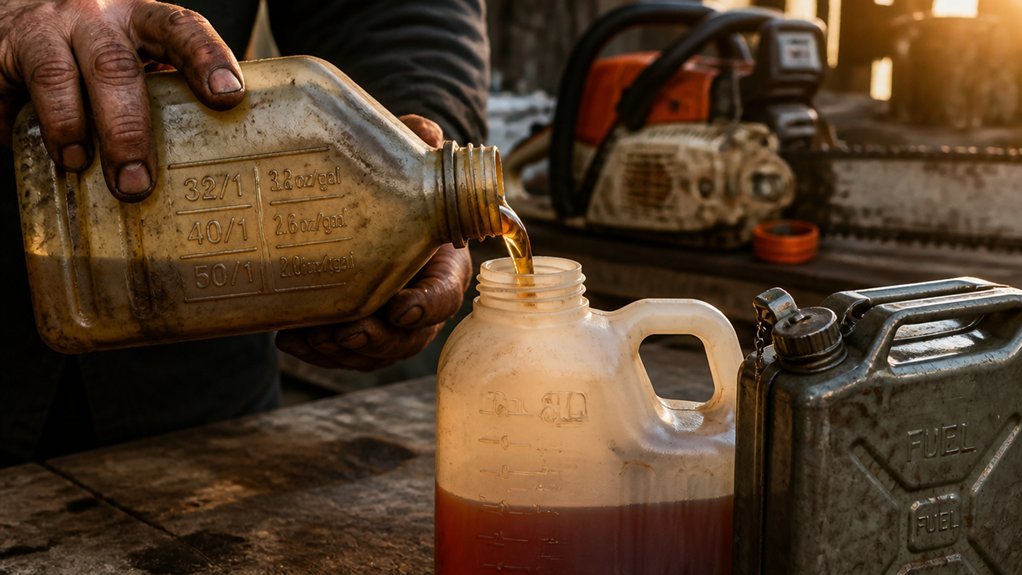
You need to mix 2-stroke fuel at precisely 50:1 to prevent engine seizure, but you’re probably making at least two critical errors in your current method. The sequence matters more than you’d expect, and your oil choice must match your fuel grade or you’ll face carbon buildup. Get this wrong, and you’ll cut your equipment’s lifespan in half. The fix is straightforward once you diagnose where your process fails.
Mix 2-Stroke Fuel at 50:1: A Simple Step-by-Step Guide
Why risk engine damage when a precise 50:1 fuel-to-oil ratio keeps your Husqvarna 2-stroke equipment running optimally? You must maintain this 2% oil concentration precisely; deviation invites piston scoring, bearing failure, and costly repairs.
Select genuine Husqvarna two-stroke oil matched to your petrol type: HP oil for E10 fuel, LS+ oil for regular unleaded. You’ll measure 100 ml of oil for each 5 L petrol batch to achieve the correct oil ratio. Pour petrol into an approved container first, add the measured oil, then seal and shake vigorously until thoroughly blended.
Never pour components separately into the tank—premixing ensures homogeneous distribution. Use your mixed fuel within 30 days; oxidation degrades combustion properties. If storage exceeds this window, drain the system completely or run the engine dry to prevent varnish deposits and hard starting.
Recommended Products

PROTECTS AGAINST ENGINE RUST: Designed to increase reliability and longevity of engines. Special additives reduce corrosion and rust. Help keep equipment running better and longer
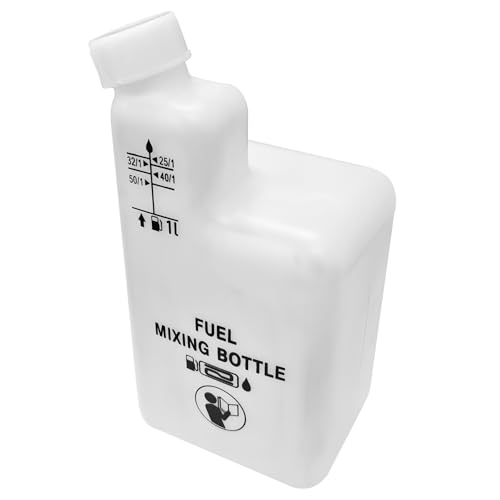
It features four precise mixing ratios (32:1,50:1,40:1,25:1) for precise fuel and oil blending in 2 stroke engines, the total capacity is 1L. Making it easy to adapt to different two-stroke engines (such as lawn mowers, chainsaws, motorcycles, etc.) and meeting diverse demands.

1ltr Mixing bottle for accurately mixing fuel and oil ratios for 2-stroke engines
Measure Accurately: Petrol, Oil, and Container Setup
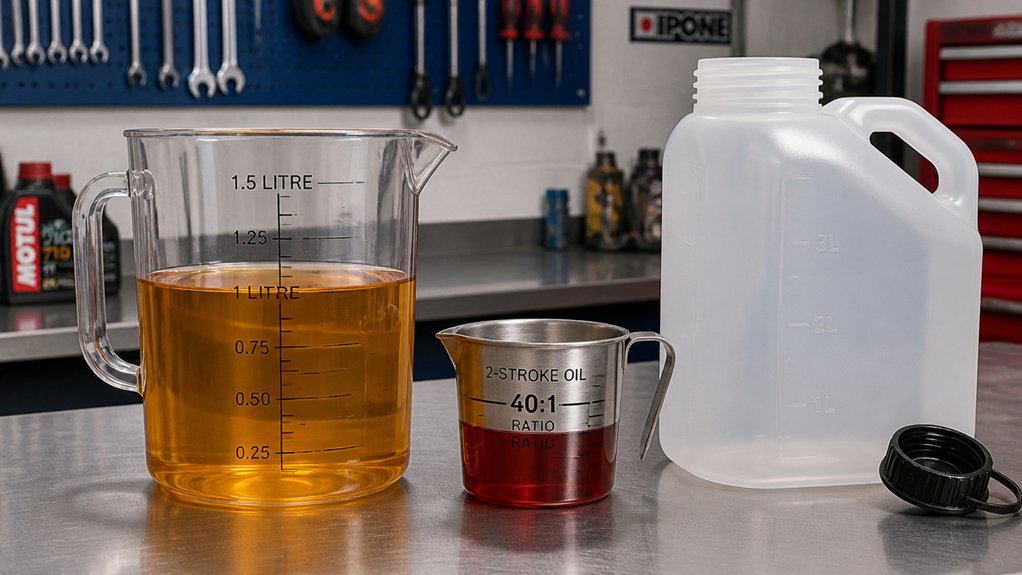
Achieving the 50:1 ratio demands exact measurement—small errors compound into engine damage. You’ll measure 20 ml of oil per 1 litre of petrol. Use a dedicated fuel container, clean and free of contaminants. Pour half the petrol first, then add the measured oil, then top with remaining petrol. This sequence ensures complete oil dispersion.
Shake or stir until the mixture achieves uniform consistency—visual stratification indicates inadequate mixing. Contamination destroys two-stroke engines, so verify your container’s condition before every batch.
After mixing, you’ll transfer the blend directly into your engine’s fuel tank. Don’t store mixed fuel beyond 30 days; degradation accelerates varnish formation and ring sticking. If extended storage’s unavoidable, add fuel stabiliser to prolong viability to 12 months. Track preparation dates—stale fuel causes erratic combustion and accelerated wear.
Recommended Products
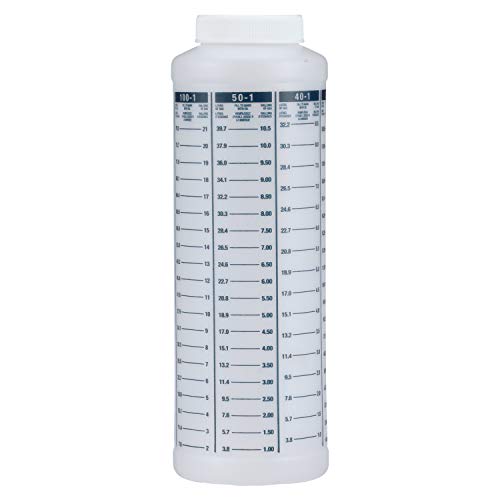
PRECISE MIXING MADE EASY: Clearly marked measurements help create accurate fuel-to-oil ratios for two-stroke engines

Specifications:Model Capacity: 1L trRatio: 25:1, 32:1, 40:1, 50:1Height: 215 Width: 120Length: 80
![[2-Pack] Wide Mouth Oil / Gas Measuring Bottle - Reusable Mixing Bottle For Two Stroke Engines - Six Different Ratios & Smudge-Proof Measurements in Gallons & Liters - Mix Oil / Fuel Hundreds of Times](https://m.media-amazon.com/images/I/51ILJkszVTL._SL500_.jpg)
Value 2-Pack: Get two durable, wide-mouth mixing bottles that make 2-stroke oil measuring simple and mess-free. Each bottle holds up to 20 oz (590 ml) and features easy-read markings in ounces, milliliters, cubic centimeters, gallons, and liters—perfect for quick, accurate oil/fuel prep on the job.
Choose the Right 2-Stroke Oil for Your Fuel Type

Your oil choice hinges on fuel type: you’ll match Husqvarna HP oil to E10 blends and LS+ oil to regular unleaded. You’ll determine compatibility before pouring any two-stroke oil. You’ll avoid TCW or outboard formulations entirely—these water-cooled engine oils will destroy your air-cooled Husqvarna unit through inadequate film strength and incorrect burn characteristics. You’ll reference your equipment manual or specification chart to confirm oil selection aligns with engine architecture. You’ll adhere to 50:1 fuel mix ratio (2% oil) across all Husqvarna two-stroke products regardless of oil variant. You’ll never substitute non-Husqvarna two-stroke oil; off-brand formulations risk seal degradation, port carboning, and piston scuffing. You’ll verify container labeling twice. You’ll match oil chemistry to fuel chemistry precisely—HP handles ethanol’s solvent effects, LS+ suits straight gasoline.
Recommended Products

Genuine Husqvarna replacement part.

Precision Measuring Cup: Create accurate Gas-Oil pre-mix every time for optimal engine performance
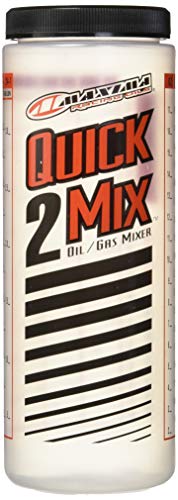
The Maxima Quick 2 Mix bottle has been calibrated to give you the ability to accurately mix in ratios of 24:1 to 100:1
Shake Thoroughly and Store Your Fuel Mix Safely
How precisely do you guarantee complete oil-fuel integration once you’ve measured each component? You shake the fuel mix gently but thoroughly after combining petrol and oil, ensuring even distribution of oil throughout the fuel. This mechanical homogenization prevents stratification and protects your engine from lubrication failure.
You’ll use a clean, designated fuel mixing container or Husqvarna Combi Can to minimize contamination and spills. After mixing, fill your engine’s fuel tank promptly to reduce exposure to air and moisture. Don’t store mixed fuel beyond thirty days—degradation reduces combustibility and risks engine damage. If storing longer than a few days becomes unavoidable, drain the fuel or run the engine dry. You’re eliminating variables that compromise performance and longevity.
Recommended Products

Specially formulated for any oil injection systems or premix up to 50:1

2 CYCLE ENGINE OIL: This 16 oz. two cycle oil mix bottle is your go-to solution for maintaining peak performance in two-cycle engines ensuring reliable lubrication and protection against wear and tear

High-Quality 2-Cycle Oil: Specially formulated for higher operating temperatures of air-cooled engines
Use Your Mixed Fuel Within 30 Days: or Stabilize It
Once you’ve homogenized your fuel mix and sealed it against contamination, you’re now managing a time-sensitive chemical system. Your mixed fuel’s stability degrades after 30 days; oxidation and separation begin compromising combustibility. You’ve got two options to prevent engine damage from stale fuel.
Use your mixed fuel within 30 days. For shorter storage cycles, drain the engine carburetor or run it dry before storage to eliminate residual degraded mix.
If you anticipate longer storage periods, you’ll need to intervene chemically. Add a quality fuel stabilizer immediately after mixing. This treatment inhibits oxidation, maintains homogeneity, and extends viable storage up to 12 months without performance degradation.
Monitor your fuel’s age precisely. Degraded stability causes hard starting, power loss, and internal deposits. Track mixing dates on containers. Dispose of untreated fuel exceeding 30 days; don’t risk engine compromise for nominal cost savings.
Recommended Products

TruFuel Pre-Blended 2-Cycle Fuel for Outdoor Equipment - 32 oz. (2-Pack, 50:1)

Great Product

PRESERVES FUEL: This fuel stabilizer ensures keeps gasoline fresh for up to 24 months for storing vehicles that are not in use, boats, outdoor power equipment during winter months, or stocking up on fuel.
Avoid These 5 Mixing Mistakes That Damage Engines
Why do so many 2-stroke engines fail prematurely? You damage your engine when you deviate from the specified fuel ratio. A lean oil mix increases friction and heat, causing accelerated wear or piston seizure; a rich mix fouls plugs and wastes oil. You’re also compromising combustion when you store mixed fuel beyond 30 days without stabiliser—fuel degrades, ignitability drops.
You must never substitute TCW outboard oil or four-stroke oil; these lack proper burn characteristics for air-cooled engines and leave harmful deposits. You prevent stratification by mixing properly: add half your petrol, pour in the oil, agitate thoroughly, then top up with remaining petrol. Finally, you verify whether your engine has automated fuel metering; premixing when unnecessary creates over-lubrication and carbon buildup.
Recommended Products

Essential equipment to ensure correct fuel mix. 1 Liter bottle for 2 stroke mix 50:1, 40:1, 32:1, 25:1

Includes (6) 6450001S Engine Oil Bottles.

Includes (1) 6550025S Engine Oil Bottle.
HP or LS+ Oil? Match Your Oil to Your Fuel Grade
Which oil you’re pouring into your canister depends entirely on what fuel you’re running through your engine. Match HP oil to E10 fuel; its formulation handles ethanol’s aggressive properties and maintains cleaner piston and cylinder surfaces under low-quality fuel stress.
Select LS+ oil for standard unleaded fuel; this mineral-synthetic blend cuts exhaust smoke and reduces operating temperatures.
Never substitute TCW or outboard-rated oils—these water-cooled formulations lack thermal stability for air-cooled Husqvarna engines.
Restrict your choice to Husqvarna-branded HP oil or LS+ oil exclusively; aftermarket alternatives risk additive incompatibility and lubrication failure.
Mix either oil at 50:1 (2% concentration) unless your specific model manual dictates otherwise. Verify your fuel grade first, then select accordingly.
Recommended Products

Mixing Your Own Is Economical: Pre-mixed bottles might be convenient, but they're far from budget-friendly; This 2 cycle oil measuring pitcher lets you blend fuel at a fraction of what you'd fork over on those tiny bottles

Low smoke formula - Designed to keep the startup of your equipment smoke free
Conclusion
You’ve now got the precise protocol for a clean 50:1 mix. Match your oil to the fuel grade—HP for E10, LS+ for regular—and always measure 100 ml per 5 litres. Don’t cut corners on sequence, container cleanliness, or stabilizer if you’re pushing past 30 days. Your engine’s performance hinges on this consistency; skip the TCW substitutes, shake until uniform, and diagnose any running issues from the fuel mix first.
Recommended Products
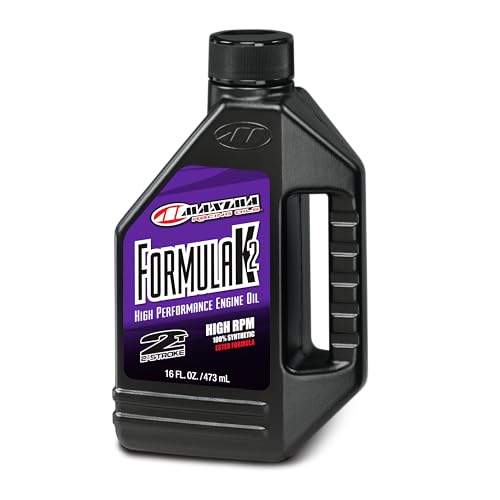
Race track developed with factory race teams

Advanced Quicksilver formulation provides superior lubrication to maintain peak performance for all 2-stroke outboards, PWC and small engines
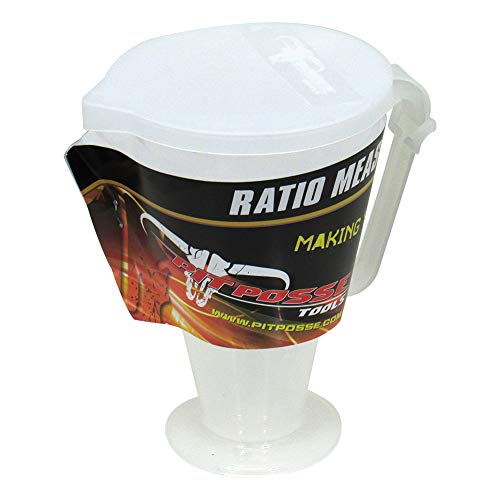
✅THE PERFECT SOLUTION TO MIXING OILS AND ENGINE FLUID RATIOS- Are you looking for a way to mix oil or other engine fluid's in the right ratio? We have the solution that will solve all your guesswork and frustration in a matter of seconds! The cup has scales on the side that gives accurate mixing ratios for 1, 2, 2.5 gallons and more