

You’re standing in the hardware aisle, weighing a 50-pound single-stage against a 150-pound two-stage machine, and the difference isn’t just heft—it’s physics. One spins a rubber auger against pavement; the other feeds an impeller that launches snow forty feet. Your seasonal snowfall totals, surface composition, and tolerance for diets of shear pins will determine which engineering solution actually clears your driveway.
Single-Stage vs Two-Stage: Start With Your Snow Depth
How much snow are you clearing? You’re matching snow depth to machine capability. Single-stage units clear 2–4 inches efficiently; their auger contacts pavement directly, limiting performance in deeper accumulation.
Two-stage systems employ auger-plus-impeller architecture, processing heavier volumes and deeper drifts without clogging.
You’re choosing between maneuverability and capacity: single-stage offers lighter weight and faster startup for frequent light events, while two-stage dominates when snow depth exceeds moderate levels or wet, dense conditions prevail.
For end-of-driveway compacted piles, specialized single-stage models with serrated augers perform comparably to standard two-stage units, though two-stage maintains superiority in sustained deep-snow operations.
Your snow depth determines optimal selection—underestimate, and you’ll overwork your equipment; over-specify, and you’ve sacrificed efficiency for unused capability.
Recommended Products

Universal 1/4" HD 3-Blade Snow Blower Impeller Kit, for Snow Blower - Modifies 2-Stage Machine

Universal 1/4" HD 3-Blade Impeller Kit, for Snow Blower - Modifies 2-Stage Machine

Universal 3/8" HD 3-Blade Snow Blower Impeller Kit, for Snow Blower - Modifies 2-Stage Machine
Gravel or Paved? Why Surface Type Decides for You
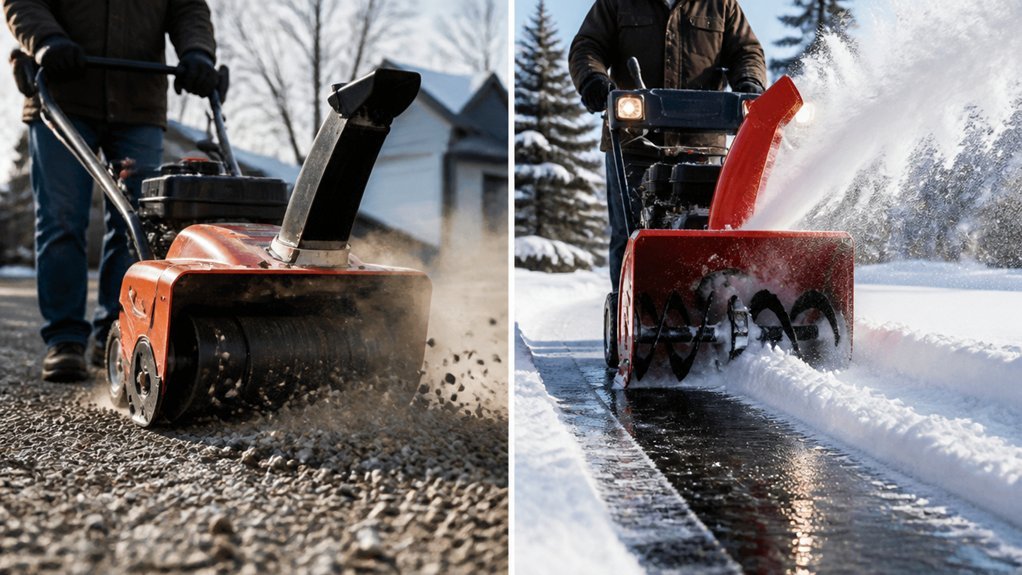
Surface type dictates your blower selection as much as snow depth does. For gravel driveways, you’ll want a two-stage machine. Its auger sits suspended above ground, preventing stone pickup and minimizing clogging from compacted debris. This ground clearance handles surface irregularities without launching gravel through your chute.
On paved surfaces, you’ll find single-stage models excel. Their rubber auger scrapes directly against concrete, delivering cleaner clearance and smoother results. However, that same ground contact accelerates wear on rough terrain.
You’ll compromise efficiency if you mismatch surface and machine. Deploy a single-stage on gravel, and you’ll wear the auger rapidly while scattering stones. Choose a two-stage for pavement, and you’ve overengineered a simple task. Match your blower to your surface, and you’ll optimize performance and longevity.
Recommended Products

Replaces Part Number: 753-04472 735-04033 735-04032 780-035 13167 953-04472

Unstoppable Power: The Snow Blower harnesses a 99cc 4-stroke engine with an optimized throttle curve and cold start technology, igniting dependable strength even at -22°F.
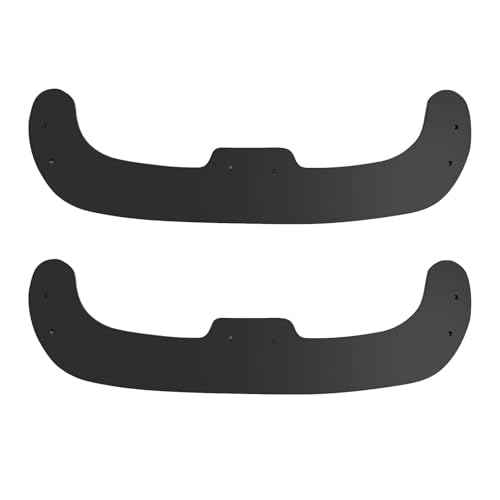
Replaces Part # 532442759, 442759, 961840002, 437459, 435302, 532437459, 584455201
Driveway Size and Shape: Matching Power to Your Space
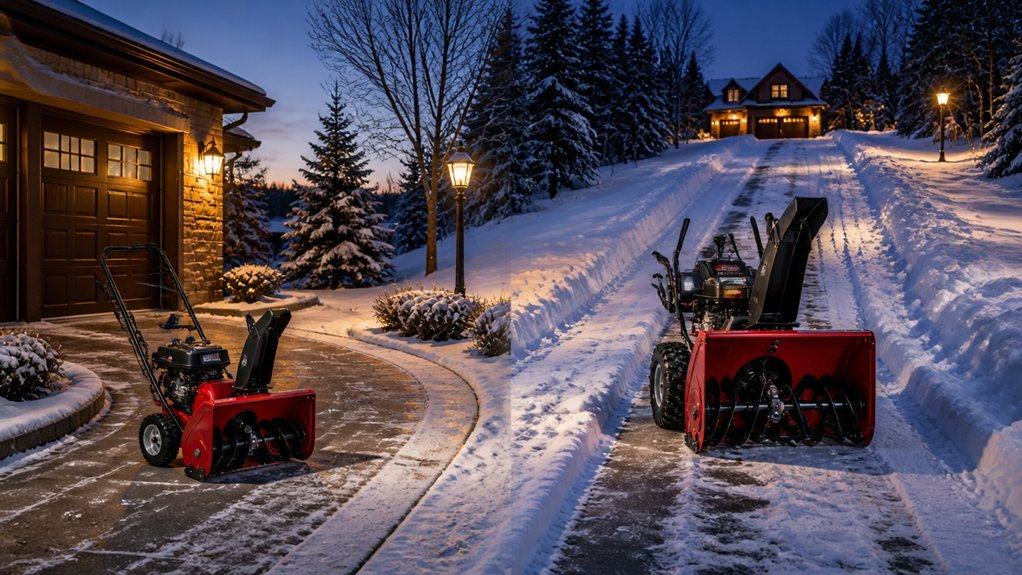
What dimensions define your clearing strategy? Your driveway size and driveway shape directly dictate your power matching requirements. You’ll select single-stage units for compact, paved areas—typically two-car garage footprints—where the auger’s pavement-scraping action delivers efficient, quick clearing.
You’ll deploy two-stage blowers when confronting larger expanses or extended approaches, as their greater throughput and traction manage heavy volumes without stalling.
For irregular driveways—curved, sloped, or multi-section layouts—you’ll assess whether surface contact matters. Single-stage machines excel where you prioritize speed over versatility; two-stage configurations accommodate rougher, larger terrain without auger-ground interference.
End-of-driveway accumulations challenge both systems, though serrated auger variants enhance single-stage breakout capability. Ultimately, you’ll align driveway size and driveway shape against engine displacement and auger design, ensuring your power matching solution sustains performance across your specific spatial constraints.
Recommended Products

20-Inch Clearing Capacity: Clears a 20-inch-wide path with an intake height up to 10 inches and throws snow up to 26 feet; results vary by snow conditions.

【EFFICIENT SNOW CLEARING】Tackle winter's worst with the SENIX 2X2 40V 21" Brushless Snow Thrower Clear snow effortlessly with an impressive throwing distance of up to 33 ft and a wide 21-inch clearing path. This electric snow blower delivers powerful performance, removing up to 680 lbs of snow per minute for fast and efficient cleanup.

【Powerful 40V Performance for Efficient Snow Clearing】 Conquer winter snowfalls with this 40V cordless snow thrower featuring a 20in (50cm) wide clearing path, a robust 10in (25 cm) cutting depth and an impressive 25ft (7.6m) snow throwing distance. This 3500W electric snow blower engineered to move up to 680 lbs of snow per minute—cutting your snow cleanup time significantly. This electric snow blower includes the 180° adjustable discharge chute lets you direct snow exactly where you want it.
Maneuverability vs. Power: What You’ll Feel Every Storm
Where will you feel the divide between agility and raw output? You’ll notice it immediately when you grip the handles.
Single-stage units prioritize maneuverability. Their lightweight construction lets you pivot quickly around tight corners and navigate narrow walkways without fatigue. You’ll clear small-to-moderate driveways efficiently when snowfalls stay within 2–4 inches.
Two-stage systems trade some maneuverability for substantial power gains. You’ll push through heavier, wetter accumulations and tackle gravel surfaces without hesitation. The separate auger-impeller mechanism demands more operator effort in tight spaces but rewards you with superior drift clearance and plowed pile penetration.
Your storm experience depends on matching capability to conditions. Single-stage excels when you’re dodging landscape features; two-stage dominates when depth and density challenge your timeline. Choose based on what you’ll face most frequently.
Recommended Products

Powerful Snow Clearing to Save Your Back: This cordless snow blower cuts through snow up to 8" deep and 13.5" wide each pass, tossing snow up to 30FT with ±30° adjustable discharge direction. Delivering a 350lb/min clearing capacity, this electric snow shovel swiftly removes fresh snow on driveways, patios, steps and walkways. Built-in 40V high-performance motor eliminates tiresome manual shoveling all winter long.

LIGHTWEIGHT & POWERFUL - This compact cordless snow shovel weighs only 9.3 pounds, making it lightweight and comfortable to use. Equipped with a powerful 24-volt motor and a rechargeable 4.0 Ah lithium-ion battery pack, this snow shovel battery powered has enough power to throw snow up to 20 feet, with a maximum runtime of 25 minutes.

High-Performance for Large Clearing: Equipped with a 15-amp motor that delivers gas-like power and moves up to 840 pounds of snow per minute without the noise, fumes, or maintenance
How Each Snow Blower Type Actually Clears Snow
How exactly does each machine transform accumulated snow into cleared pavement?
When you operate a single-stage Snow Thrower, your rubber auger spins rapidly to scoop and discharge snow in one continuous motion, scraping directly against pavement for compact maneuverability. You’ll clear light to moderate accumulations efficiently on small driveways.
With a two-stage unit, you’ll engage a separate metal auger that chews through snow, then an impeller launches it through the chute. This two-step mechanism lets you handle gravel surfaces without ingesting debris, tackle heavier plow-piled accumulations, and maintain speed across larger areas. Your auger never touches ground, preserving the surface beneath.
You choose based on your conditions: single-stage for quick, clean clearance where pavement meets your auger; two-stage for demanding volume and varied terrain where an impeller’s power becomes essential.
Recommended Products
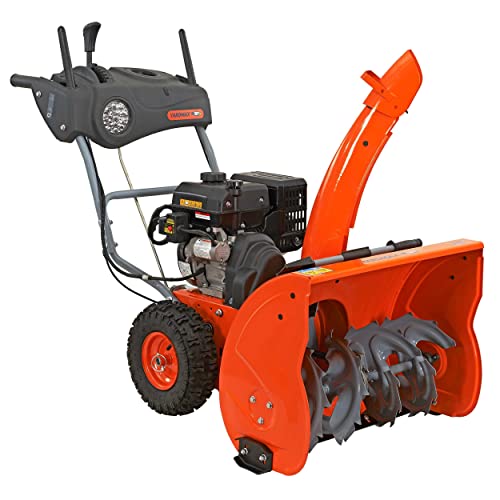
Electric start, high performance snow engine
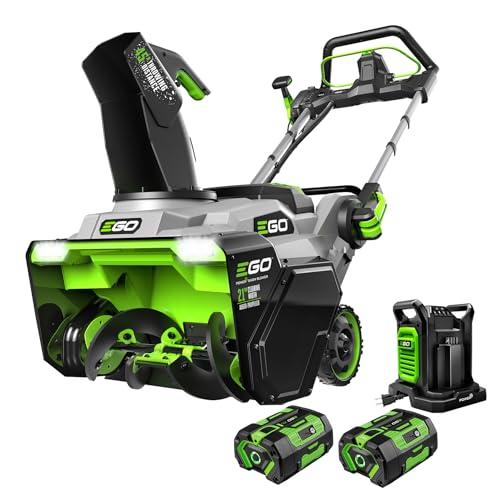
Peak Power technology combines the power of any two EGO POWER+ 56V ARC Lithium batteries

Product includs:3-Rubber Paddle , 3-Metal Straps , 9-Bolts & Lock Nuts , 3-Self-tapping Screws;Detailed in the product pictures
What Extra Money Buys in a Two-Stage Snow Blower
Why invest more in a two-stage snow blower? You’re paying for a fundamentally different mechanical architecture: an auger that gathers snow without ground contact, paired with a separate impeller that forces discharge through the chute at higher velocity. This dual-stage design lets you clear heavier, wetter, and deeper snow faster than single-stage units permit.
Your investment buys concrete performance advantages. The auger’s ground clearance protects gravel surfaces—you’ll pick up less debris. Self-propelled transmission handles hills and large driveways that’d exhaust you with manual propulsion. You’ll manage longer sessions with better drift penetration and sustained power output.
You’re trading maneuverability for capability: two-stage units weigh more and turn tighter, but they clear moderate-to-heavy accumulations that stall single-stage machines. The auger-impeller separation delivers throughput you can’t achieve with single-stage designs.
Recommended Products
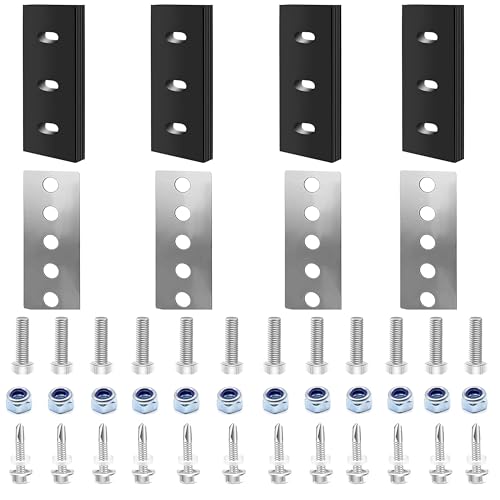
Part Name: 3/8-inch 4-Blade Snow Blower Impeller Modification Kit

Product includes: 3 x Rubber Paddles, 3 x Stainless Steel Blades, 9 x Bolts, 9 x Lock Nuts, 3

Product includs:3-Rubber Paddle , 3-Metal Straps , 9-Bolts & Lock Nuts , 3-Self-tapping Screws;Premium 304 stainless steel reinforcement plate & hardware
When to Consider a Three-Stage (and Who Doesn’t Need One)
Two-stage machines handle most residential demands, but physics imposes limits. When you face heavy snow regularly—especially plowed, packed, or icy accumulations—a three-stage unit adds an accelerator between auger and impeller, dramatically increasing throughput. You process up to 50% more snow per pass and work 30% faster than two-stage alternatives.
Your driveway size determines necessity. Large properties with frequent, extreme storms demand this efficiency; smaller surfaces don’t. You save significant time clearing expansive areas where two-stage units bog down, but you’ll overpay for capability you won’t use on modest lots or mild winters. Evaluate your snowfall frequency and typical storm severity honestly. If heavy snow remains rare or your driveway size stays under 1,000 square feet, a two-stage or single-stage serves you adequately without the three-stage premium.
Recommended Products

One New Aftermarket Replacement Snow Thrower Paddle Set
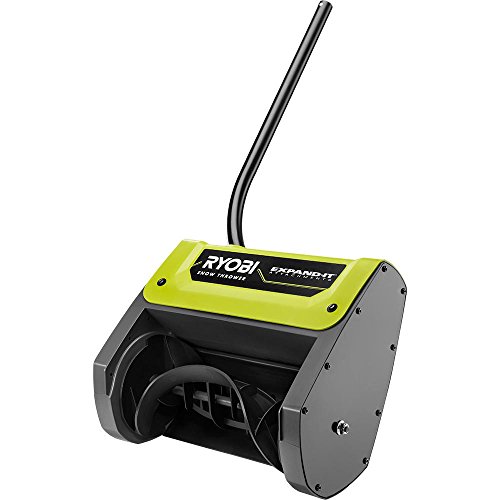
Fits Most Brands' Attachment Capable String Trimmers

Length: 17-5/8"
Which Snow Blower Should You Actually Buy?
Where exactly does your property fall on the snow-clearing spectrum? Your snow blower choice hinges on this precise calibration.
If you’ve got a small, paved driveway and receive light, powdery accumulations of 2–4 inches, you’ll find a single-stage unit delivers superior maneuverability and efficiency. But if you’re battling gravel surfaces, larger areas, or frequent storms dumping wet, heavy snow, you’ll need a two-stage machine. Its auger-impeller mechanism clears deeper drifts without clogging and won’t launch debris.
For expansive properties with relentless snowfall, three-stage systems accelerate clearing speed dramatically. Yet don’t automatically upsell yourself—real-world performance data shows single-stage models can outperform two-stage units in tight spaces and light conditions.
Analyze your terrain, storm frequency, and surface composition. Match specifications to actual demands.
Recommended Products

Cordless Power for Quick Snow Cleanup: The 40V brushless motor delivers consistent clearing power without gas, fumes or extension cords—ideal for everyday cleanup around entrances, walkways and other frequently used areas.

Quick & Effortless Mid-Sized Area Clearing:Specifically designed for efficiency, this corded snowblower quickly clears mid-sized driveways and walkways without the hassle of gas or manual shoveling. Get the job done in minutes and get back to enjoying your day, even after heavy snowfall.

【Built to Last】 Crafted primarily from high-grade PA6 and nylon, this sweeper is wear-resistant and impact-proof—designed to withstand long-term use and tough outdoor conditions, delivering reliable performance for years.
Conclusion
Your snow depth, surface type, and driveway dimensions determine whether you’ll prioritize a single-stage’s scraping efficiency or a two-stage’s throwing power. Paved, compact areas with moderate snowfall favor single-stage maneuverability; gravel, heavy accumulations, or longer runs demand two-stage auger-impeller throughput. Three-stage systems justify their premium only in extreme, high-volume conditions. Match the machine’s clearing mechanism to your specific environmental constraints—overbuying wastes capital, underbuying costs performance.
Recommended Products
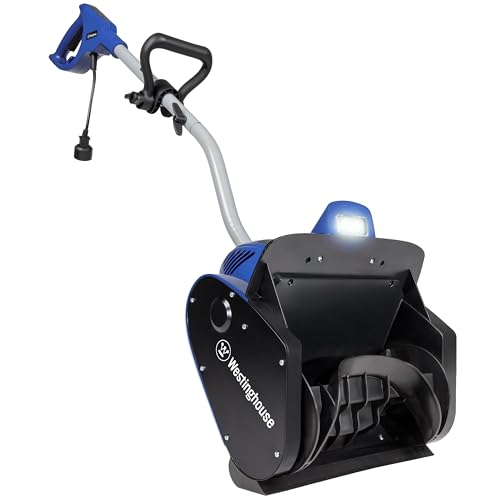
ELECTRIC SHOVEL POWER: The WSnow11SD is equipped with a 10A corded electric motor that can powerfully throw 300 pounds of snow per minute, clearing a path 11 inches wide and 6 inches deep in every pass. Make short work of a standard driveway with this heavy duty, easy to use snow shovel
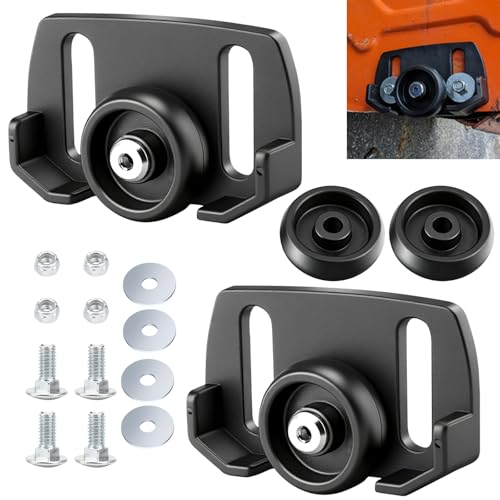
Fits many brands of two-stage and three-stage snow throwers, Fits machines with 2-3/4" and 3" bolt centers.Compatible with Craftsman, Troy-Bilt, Cub Cadet, Ariens, MTD, MTD Pro, Yard Machines, and Yard-Man

【Superb Performance】Efficiently Cleans off snow where traditional mowers can't. This power shovel cleans snow up to 12″ wide, and blows it up to 20′ far.