
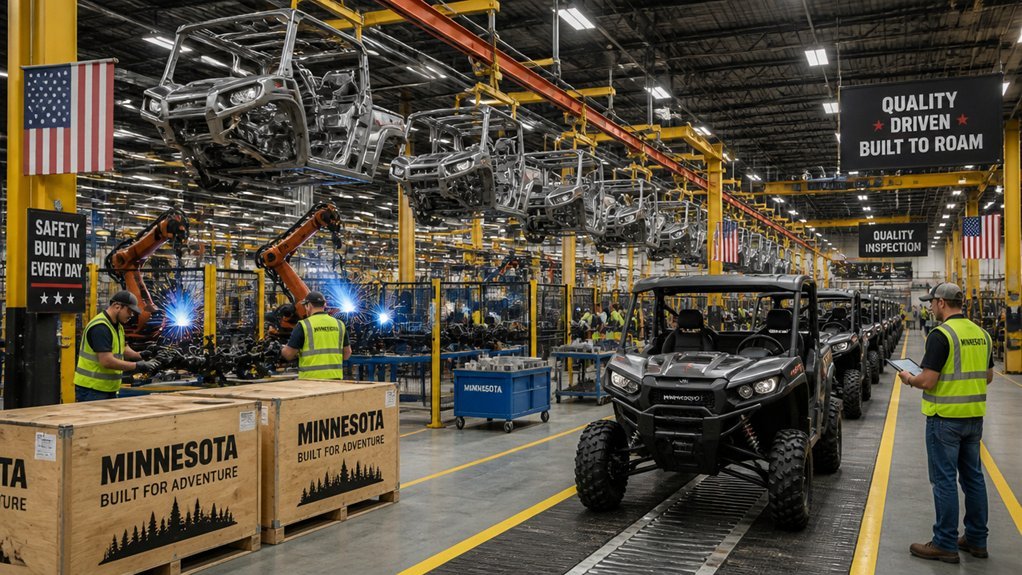
You’re likely familiar with Polaris as a major UTV manufacturer, but you might not realize how decentralized their production actually is. Your Ranger or RZR could originate from multiple facilities across North America and beyond. Each plant serves a distinct purpose in their supply chain, and the rationale behind this geographic distribution reveals strategic priorities. You’ll want to understand what this means for build quality and parts sourcing.
Where Are Polaris UTVs Made Worldwide?
Polaris engineers and assembles its UTVs across several strategically located facilities, with production spanning the United States and Mexico. You’ll find the primary assembly hub for Polaris UTVs in Roseau, Wisconsin, where final assembly and powertrain integration anchor their domestic manufacturing network.
You’ll also encounter critical powertrain component production in Osceola, Wisconsin, which supplies the majority of drivetrain systems for off-road vehicle lines.
Your global manufacturing picture expands to Monterrey, Mexico, where a facility opened in 2010 concentrates on Ranger side-by-side assembly to meet international demand.
You’ll additionally observe significant U.S. production capacity in Huntsville, Alabama, where Polaris operates a major plant manufacturing RANGER and Slingshot models.
You’re witnessing a deliberately distributed production architecture that leverages specialized capabilities across multiple North American locations while maintaining integrated supply chain efficiency.
Recommended Products

Non-Round Cage: UNIGT side view mirror designed for Polaris Ranger XP 900 2013-2026, Ranger 1000 2015-2026, Ranger mid-size & Full Size 570 2015-2026, and Defender pro-fit channel-shaped cage

This set of side-view mirror was customized design for the RANGER with the roll bars that are not round, it mounts to the clip bracket that the door net clips are mounted

What Do the Minnesota and Wisconsin Factories Build?
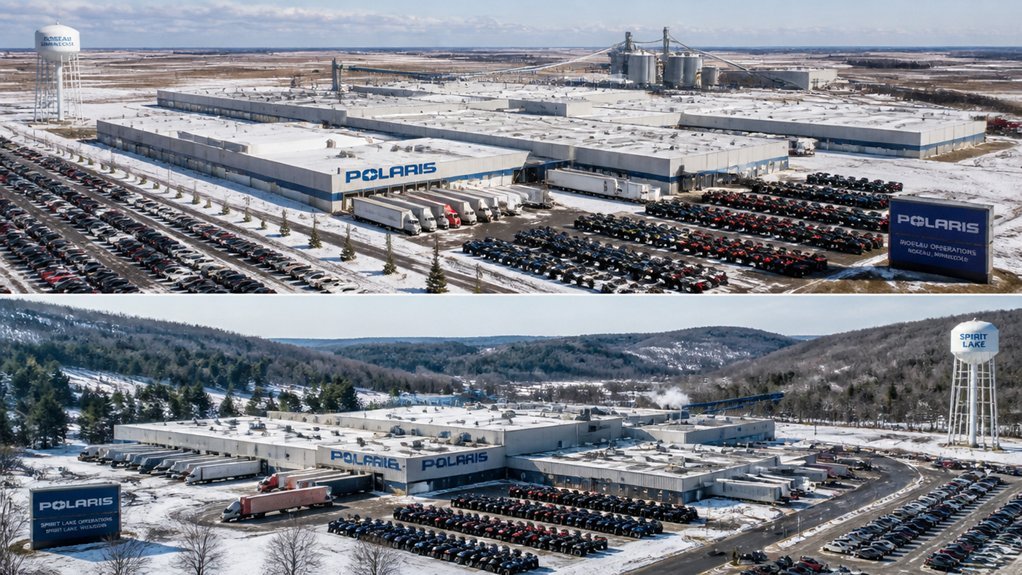
You’ll find Polaris’s core U.S. manufacturing concentrated in Minnesota and Wisconsin, where the company anchors its domestic production capabilities. In Roseau, Minnesota, you’ll observe final assembly operations for off-road vehicles including the RANGER and RZR lines, with concurrent powertrain component production reinforcing vertically integrated manufacturing. You’ll recognize Roseau as the historical birthplace of Polaris, maintaining its centrality in U.S.-made vehicle output.
At Osceola, Wisconsin, you’ll examine dedicated powertrain manufacturing facilities producing engines and drivetrain components that supply multiple Polaris vehicle platforms. You’ll appreciate how Osceola’s specialized powertrain work complements Roseau’s assembly operations, creating synergistic domestic production.
Together, these facilities establish a robust U.S.-based supply chain. You’ll note that final assembly and powertrain production across Minnesota and Wisconsin constitute the foundation of Polaris’s commitment to retaining most manufacturing within American borders, with Roseau and Osceola fulfilling central strategic roles.
Recommended Products

Polaris OEM Product, Part Number: 2884577
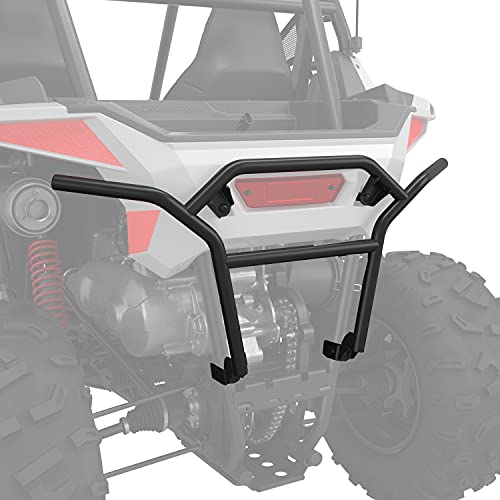
Durable steel material provides great protection for your vehicle

Enhanced Visibility: These high-performance adjustable folding mirrors for Polaris RANGER provide a crystal-clear view of what's behind and beside your vehicle. Includes (2) foldable UTV mirrors.
Why Did Polaris Move Some Production to Mexico?

Why did Polaris expand beyond its U.S. roots in 2010? You observe a calculated manufacturing network expansion, driven by operational necessity.
Polaris established its Monterrey facility on May 21, 2010, positioning Mexico as a strategic node for assembly operations. You recognize the Monterrey plant’s focus: Ranger side-by-sides roll off its lines to bolster global production capacity.
The move prioritizes cost reduction within an integrated supply chain, letting you access competitive labor markets without sacrificing quality benchmarks. You’ll note this diversification doesn’t diminish U.S. operations—final vehicle assembly and powertrain manufacturing remain anchored in Roseau, Minnesota, and Osceola, Wisconsin. Mexico-based production complements, rather than replaces, domestic engineering. You’re seeing Polaris execute a balanced strategy: design and testing stay stateside, while Monterrey handles targeted assembly to optimize operational efficiency.
Recommended Products

Secure load management - 150 lb rated steel D-rings provide reliable tie-down points for cargo

Adjustable: These ATV handlebar-mounted mirrors are fully adjustable - swivel or adjust up and down - for riders of all sizes and can fold into the vehicle to prevent them from being struck

FRONT TRAIL BRUSHGUARD PERFECTLY FIT: Compatible with 2025 Sportsman Touring 570, with 2021-2024 Sportsman 570 / EPS / Premium, with 2025 Sportsman 6x6 570, with 2023 Scrambler XP 1000 S, with 2025 Sportsman X2 570, with 2021-2024 Sportsman 450 H.O. Directly replace OEM part number 2884844. PLEASE NOTE: The front bumper is not suitable for your sportsman equipped with winch. Please refer to the compatible list in the description
What Happens at the Poland Plant for European Buyers?
The expansion into Mexico established a foundation for broader international manufacturing, and Polaris built on that momentum four years later with its first European production facility.
You find Polaris’s Opole, Poland plant serving as the central manufacturing hub for European buyers seeking off-road vehicles. At this facility, you’re looking at dedicated assembly operations producing quads, ATVs, and UTVs specifically tailored to European market requirements.
You avoid lengthy import timelines and transatlantic shipping costs when you source from this Poland location. The Opole plant demonstrates Polaris’s strategic commitment to regional manufacturing, allowing you to receive locally assembled products rather than North American imports.
You benefit from streamlined logistics and market-aligned production. This facility integrates into Polaris’s global network, expanding your access to efficient, region-specific manufacturing capabilities without dependency on overseas supply chains.
What Does the Huntsville, Alabama Factory Manufacture?
At the Huntsville, Alabama facility, Polaris concentrates substantial manufacturing capacity on two distinct product lines: the three-wheeled Slingshot auto-cycle and the Ranger series of utility vehicles. You witness this U.S. manufacturing plant execute comprehensive production processes including vehicle assembly, chassis and body painting, welding, fabrication, and injection molding.
The Huntsville facility opened in spring 2016 after its January 2015 announcement, expanding Polaris’ domestic manufacturing footprint. You observe how this plant strategically complements existing operations in Roseau, Minnesota, and Osceola, Wisconsin. The facility strengthens regional production capabilities for both off-road and on-road vehicles.
You recognize that Polaris Slingshot and Polaris Ranger production at Huntsville supports broader portfolio demands while reinforcing the company’s commitment to substantial U.S.-based manufacturing infrastructure for diverse vehicle categories.
Recommended Products
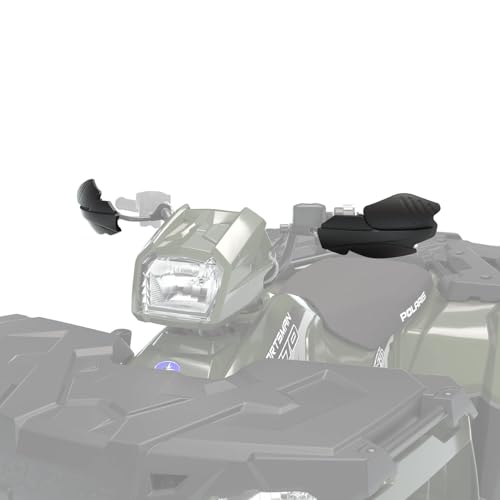
Two ATV Handguards - Black

Maximum Visibility: Transform your vehicle setup with Polaris XPEDITION mirrors. Engineered with automotive-quality style, these mirrors provide a clear and expansive view of your surroundings.

OEM Polaris Part Number: 2884853
Which Parts of a Polaris UTV Are Still American-Made?
Where exactly does American craftsmanship persist in a Polaris UTV?
You’ll find it concentrated in two critical manufacturing corridors. At the Roseau, Minnesota facility, you’re witnessing final vehicle assembly where completed UTV chassis receive their finishing components. Meanwhile, in Osceola, Wisconsin, you’re observing the fabrication of American-made powertrain systems—the engine, transmission, and drivetrain assemblies that propel these machines.
You should note that Polaris maintains this domestic infrastructure specifically to fulfill U.S. government contracts requiring verified American construction. While you’re aware that some earlier Ranger variants emerged from Mexican facilities, you’re now examining a supply chain where core UTV production and powertrain manufacturing remain anchored in Wisconsin and Minnesota. When you evaluate a Polaris UTV’s provenance, you’re tracing American metal through Osceola’s powertrain production and Roseau’s assembly lines.
Conclusion
You now understand Polaris’s distributed manufacturing strategy. Your UTV’s final assembly likely originates in Roseau, Minnesota, with powertrain components from Osceola, Wisconsin. You’re seeing Monterrey handle international Ranger demand, while Huntsville builds select Ranger and Slingshot models. Your European-market unit ships from Opole, Poland. While assembly spans multiple facilities, you’re still getting substantial American engineering and component manufacturing, though not every part originates domestically.