
You’re staring at a trailer spec sheet, wondering if your truck can handle that new side by side. Dry weight, curb weight, GVWR—the numbers blur, but they dictate what you can tow, where you can ride, and how machine performs when you’re threading through tight trails. Most buyers fixate on horsepower; you’ll soon see why weight tells the real story.
How Much Does a Side by Side Weigh? (Quick Answer)
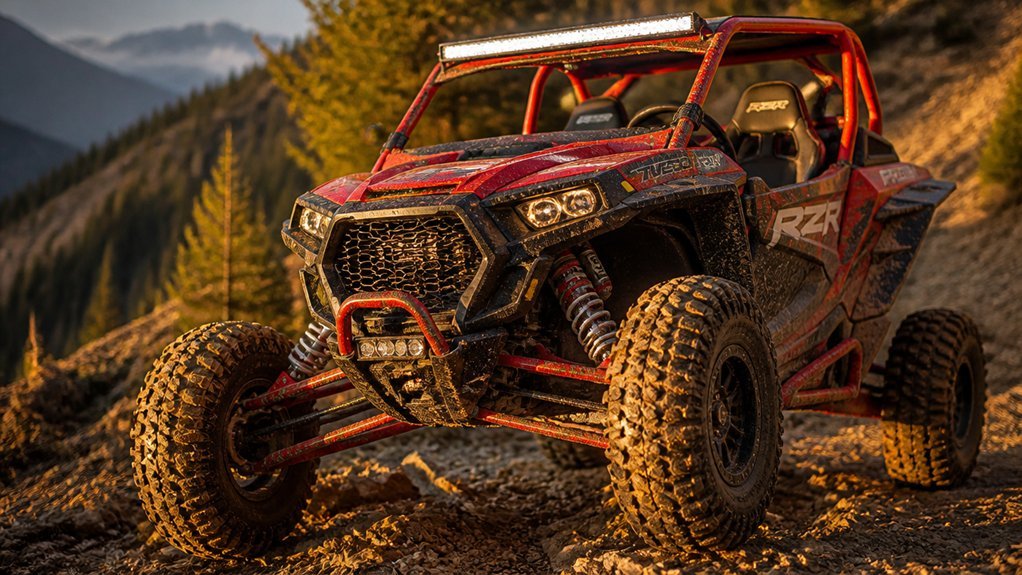
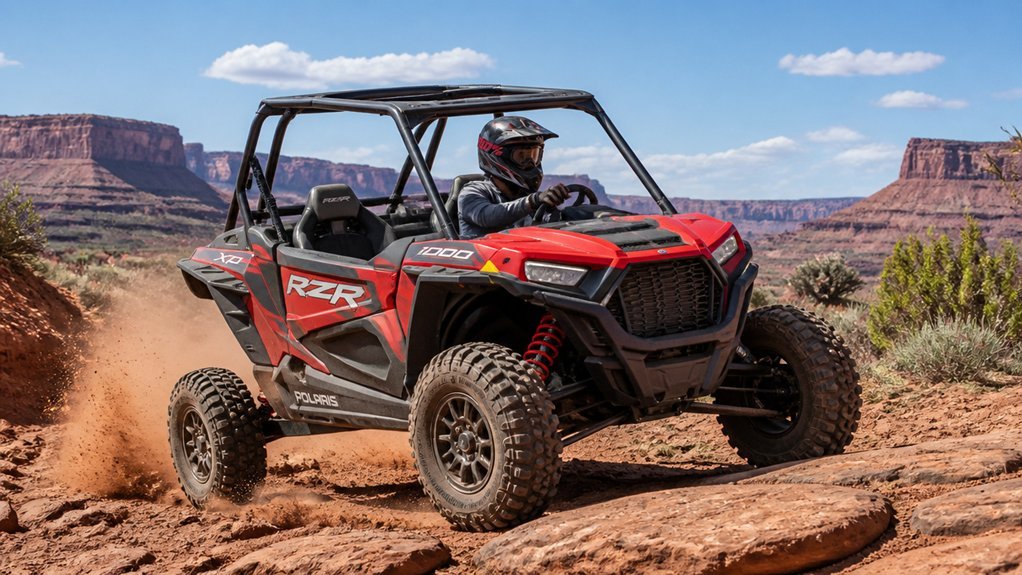
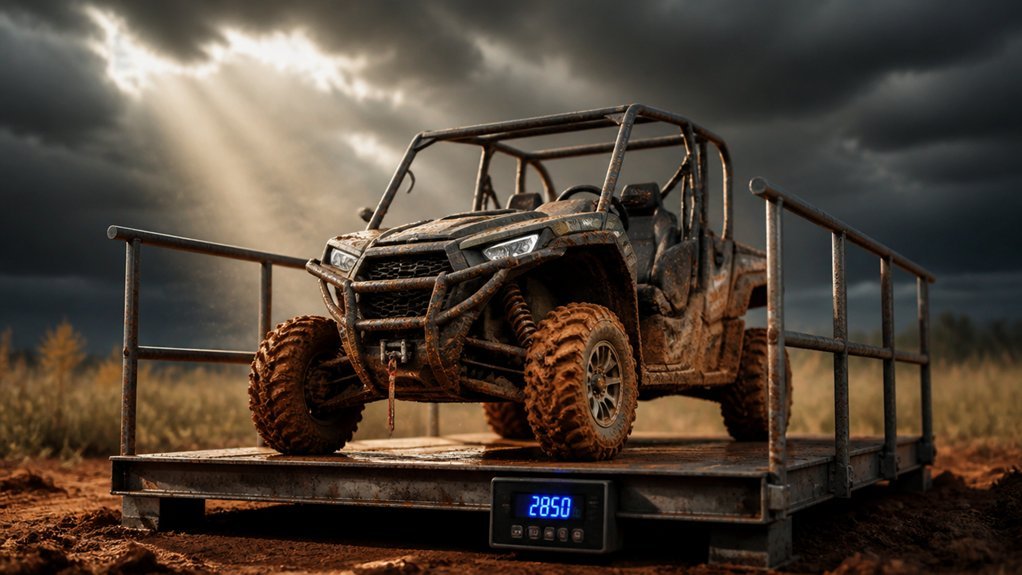
How much does a side by side weigh? You’ll encounter significant variation in UTV weight across manufacturers and models. Dry weight figures reveal stripped specifications: you’re looking at approximately 1,460 lb for a Polaris RZR XP 1000 Sport, 1,538 lb for a Honda Pioneer 1000, and roughly 2,225 lb for a Can-Am Maverick R. These numbers exclude fluids, fuel, and cargo.
You’ll find GVWR marks your ceiling for safe operation, encompassing vehicle weight plus payload capacity. Heavier configurations typically deliver increased payload and cargo box ratings, though you’ll sacrifice handling responsiveness and fuel efficiency. When you evaluate Bobcat specifications, you’ll notice operating weight alongside distinct payload ratings and cargo bed capacities. Understanding these metrics lets you match machine capability against your operational demands precisely.
Recommended Products
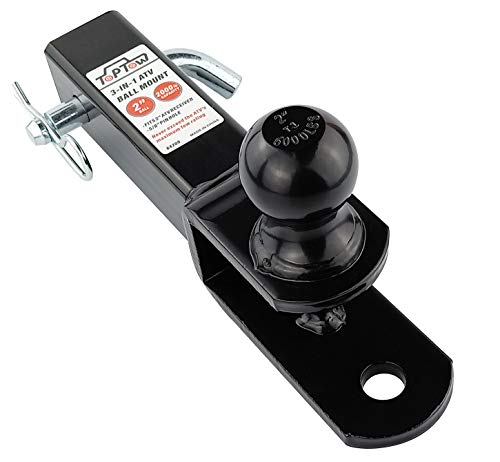
★ OPTIMALLY VERSATILE ATV/UTV ACCESSORIES: This tow hitch adapter offers three different coupling styles. The riser hitch easily mounts to your ATV /UTV hitch for yard work equipments, dog hitches, utility trailers and other towable tractor accessories in the fields. It provides a 2" weld-on trailer ball for standard couplers, a 1/2" clevis pin for latching on clevis hook or winch strap loop, a 3/4-inch pin hole for clevis mount.

Superior Recovery Power & Complete Kit: Engineered for extreme towing and recovery scenarios, our heavy duty tow rope is crafted from 12-strand ultra-high molecular weight polyethylene (UHMWPE), delivering a massive 31,200 lbs break strength. Ready to pull Jeeps, SUVs, and trucks from tough spots. It arrives with two 7/16" x 22" synthetic rope soft shackles, each rated at 48,000 lbs MBS, creating a powerful, lightweight, and safe connection far superior to risky metal hardware

The information below is per-pack only
Side by Side Weight Terms: Dry, Curb, and GVWR Explained
Why should you care about weight terminology when evaluating a UTV? You need precise metrics to calculate safe operational limits and avoid mechanical failure or hazardous handling.
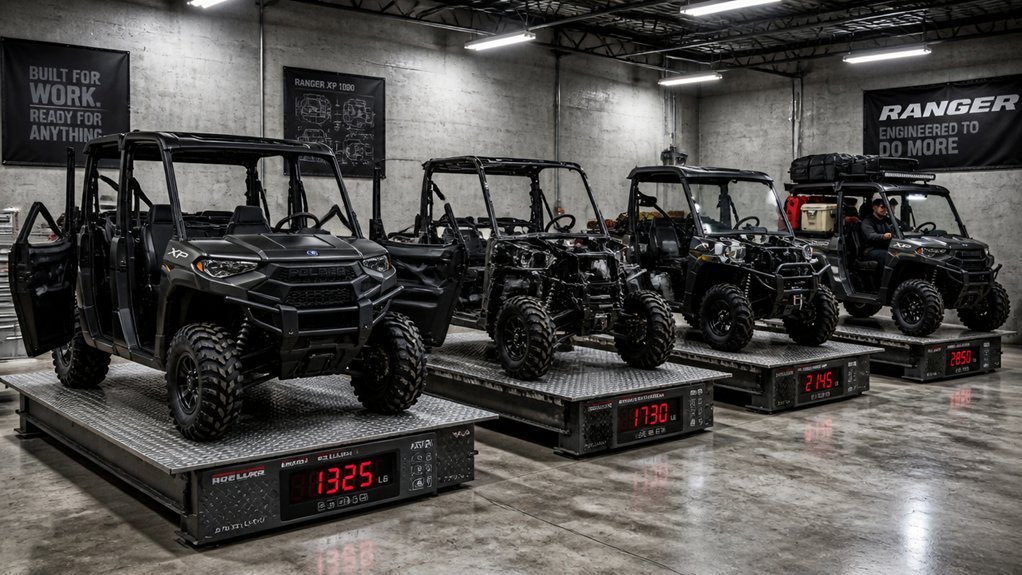
Dry weight represents your base machine stripped of fuel, oil, fluids, passengers, and cargo—manufacturers list this most frequently.
Curb weight adds essential fluids, creating a more realistic baseline for your calculations.
You derive payload capacity by subtracting dry weight from GVWR, revealing how much additional mass you can safely load.
GVWR itself constitutes the absolute maximum safe threshold encompassing machine, fluids, occupants, and gear; exceeding it risks component stress and compromised stability.
Cargo box capacity operates as a distinct, typically lower constraint governing rear bed loads specifically.
You must track both figures independently—overloading the box while under GVWR still damages your machine.
Recommended Products

Contoured design allows for maximum sight reduction while operating ATV

Extra Storage Space : The Pro XP rear cargo box is 42QT, and has a large storage space. It can store travel essentials. KEMIMOTO UTV bed storage box can hold your maintenance tools, clothing, gloves, shoes, fishing tackle, lighting tools, personal safety tools, and sleeping supplies. It saves space in the rear bed box, which can store other bags, coolers, etc. Thoughtful consideration for your smooth off-road activities

45.3L/11.9GAL Large Capacity: KEMIMOTO Passenger Side bed box with 45.3L/11.9 gal larger space for storing all your essentials, such as gloves, first aid kit, straps, and other tools. Choose the left side box to match it. (Please pay attention, this tool box is NOT compatible with Polaris General, Ranger 570 SP)
Popular Side by Side Weights by Brand and Model
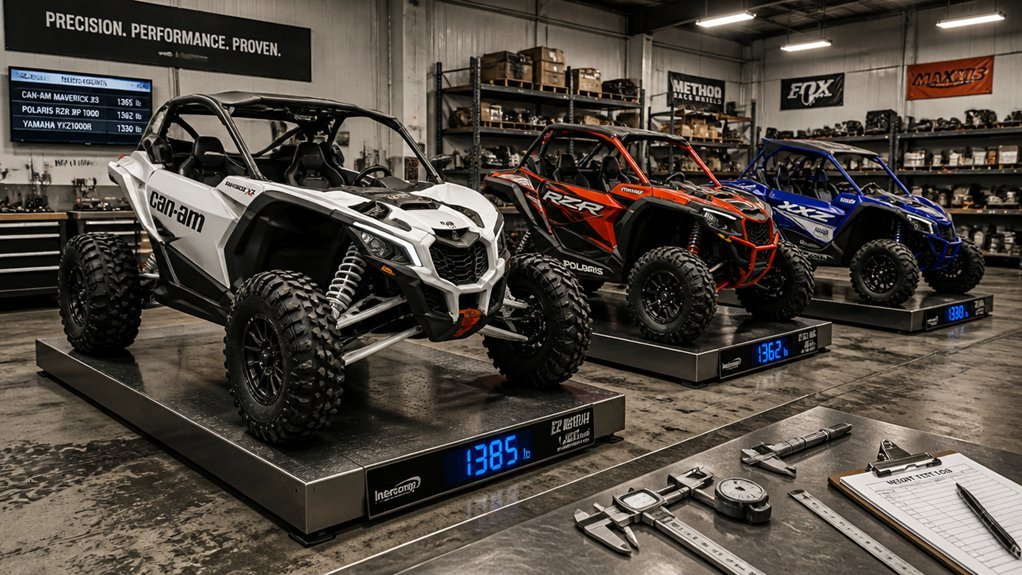
What precisely distinguishes a nimble trail runner from a heavy-duty workhorse? You’ll find the answer in dry weight figures across brand models. When you’re analyzing UTV weight, you notice Polaris RZR spans 996 lb to 2066 lb dry weight—you’re choosing between the featherlight RZR 570 and the robust RZR Pro XP 4 Ultimate. You’re examining Can-Am Maverick variants at 1405 lb to 1869 lb, noting how turbocharged platforms increase mass. You’re comparing Kawasaki Teryx models clustering near 1600 lb, delivering consistent load capacity without extreme variance. You’re evaluating Honda’s spectrum: Pioneer 500 at 1025 lb versus Talon range approaching 1753 lb. You’re observing Bobcat’s mid-range positioning, where higher vehicle rated capacity correlates with increased structural mass. You’re recognizing how each side by side occupies distinct operational niches through engineered weight distribution.
Recommended Products

VERSATILE TOWING. This trailer hitch ball is specifically designed to equip an ATV, UTV or lawn tractor for towing. It's perfect for hitching up a small utility trailer and towing through the woods or working in the yard

Superior Recovery Power & Complete Kit: Engineered for extreme towing and recovery scenarios, our heavy duty tow rope is crafted from 12-strand ultra-high molecular weight polyethylene (UHMWPE), delivering a massive 31,200 lbs break strength. Ready to pull Jeeps, SUVs, and trucks from tough spots. It arrives with two 7/16" x 22" synthetic rope soft shackles, each rated at 48,000 lbs MBS, creating a powerful, lightweight, and safe connection far superior to risky metal hardware

AMERICAN OWNED, FAMILY OPERATED - Join the Rhino USA Family and Support a Father/Son Business With the Best USA-Based Customer Support.
How Side by Side Weight Affects Towing Requirements
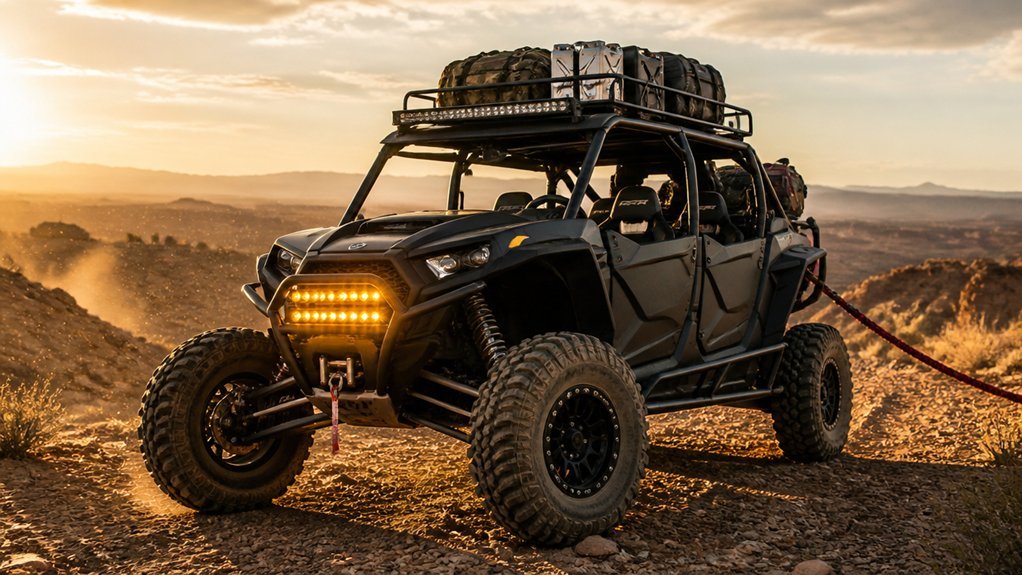
Understanding dry weight differences across brands prepares you for the practical realities of moving your machine. You can’t exceed GVWR when towing or loading, as this maximum safe weight includes passengers, cargo, and fluids. Your dry weight baseline determines available payload capacity before you reach limits.
You analyze your vehicle’s rated capacity alongside GVWR to calculate permissible additional weight. Compare trailer weight plus load against these specifications to ensure compliant operations. Heavier machines demand higher towing capacity ratings and reduce maneuverability margins. You observe fuel efficiency degradation during towing operations with increased mass.
Effective load management requires precise calculations: you subtract dry weight from GVWR to reveal payload headroom, then verify your trailer configuration stays within combined limits. You experience immediate feedback through handling responses when approaching thresholds.
Recommended Products

Extra Storage Space : The Pro XP rear cargo box is 73QT, and has a large storage space. It can store travel essentials. KEMIMOTO UTV bed storage box can hold your maintenance tools, clothing, gloves, shoes, fishing tackle, lighting tools, personal safety tools, and sleeping supplies. It saves space in the rear bed box, which can store other bags, coolers, etc. Thoughtful consideration for your smooth off-road activities

Massive 45-Gallon Capacity: Carry more gear for longer rides with a spacious 44” x 23.3” x 10.2” storage area, offering ample room for tools, recovery straps, camping gear, and trail essentials.

18 cubic foot (510 L) internal cargo capacity
Lightest Side by Sides for Easy Trailering
When you’re prioritizing trailering convenience, where do you find the most practical starting points? You examine dry weight figures first. The lightest side by sides—like the Polaris RZR 570 at 996 lb and Honda Pioneer 500 at 1025 lb—offer you immediate advantages in trailering ease and fuel efficiency through reduced mass.
You recognize dry weight as your baseline comparison metric before adding fluids, cargo, and passengers that push total mass toward GVWR. Even with these lightweight platforms, you must respect payload limits and GVWR ratings to prevent overloading during transport. You select trailering-friendly units by balancing low dry weight against adequate GVWR and cargo capacity. This analytical matching ensures you don’t sacrifice practical utility while minimizing tow strain.
Recommended Products

Fits Mid-Sized 2 passenger UTVs up to 113"L x 60"W x 70"H
Fits Larger 2-3 passenger UTVs up to 125"L x 64"W x 70"H

2” wide, 20' long tow strap, tow rope with loop ends. Can also be used as a tree saver for light vehicles like ATV, UTV, small trucks, side by sides, four wheelers, boat while using a winch or come along pulley. TGL ATV tow strap, UTV tow strap is compatible with all Polaris, Honda, Can-Am, ATV, UTV, Side by Side and other utility vehicles.
Heaviest Utility Models: When Extra Weight Helps
Why does extra mass become an asset rather than a liability? When you operate a heavy utility UTV, you’re leveraging physics to your advantage. The Can-Am Maverick X3 Max RS Turbo R, at 1,869 lb dry weight, demonstrates how extended cabins and reinforced frames add substantial mass. You’ll notice this difference immediately when traversing uneven terrain—your stability increases dramatically as the machine’s center of gravity resists tipping forces.
You must distinguish between dry weight and GVWR. The former measures your baseline machine; the latter defines your absolute safe limit including passengers, fluids, and cargo. This distinction determines your actual payload capacity. Heavier models sacrifice acceleration but deliver superior traction and predictable handling. When you’re hauling tools or navigating slopes, that extra weight transforms from burden to benefit.
Recommended Products

Extra Storage Space - Keep Your Essentials Safe and Organized. With a generous 69QT capacity, the KEMIMOTO UTV Rear Bed Tool Box provides ample space to store all your travel essentials. From maintenance tools and clothing to fishing tackle and personal safety gear, this cargo box is designed to make your off-road activities simple. The thoughtful design also saves space in the rear bed box, allowing you to store other bags and coolers

Compatibility : The UTV Rear Cargo Box #2889611 is compatible with 2024/2025/2026 Polaris RZR XP 1000/4 1000 Ultimate/Sport/Premium. Please confirm the compatible model and size specifications before purchase. Adopting a trapezoidal design with a wider top and narrower bottom, maximizing storage space while ensuring a precise, interference-free fit to the XP 1000 rear

95L Large Capacity: Combining storage and seating in one, VEVOR 42.5 x 24.8 x 16.9-inch ATV rear storage box & lounger offers a generous 95L capacity to store helmets, gloves, maintenance tools, and more essentials. And the integrated safety backrest and seat ensures comfort and support during long rides, perfect for outdoor adventures.
Electric vs. Gas Side by Side Weight Differences
Your choice between electric and gas powerplants reshapes the mass distribution throughout your side-by-side’s chassis. When you compare electric vs gas configurations, you’ll notice electric UTVs eliminate hundreds of pounds of engine components, yet battery pack density quickly offsets these savings. You encounter this tradeoff directly: a 20kWh pack adds substantial weight, while 40kWh+ systems push your total weight toward gas-model territory or beyond.
You observe dry weight figures spanning 1,000–1,900 pounds for gas units, with GVWR ratings climbing to 2,600+ pounds. Electric alternatives often approach similar GVWRs through heavier chassis reinforcement. Your payload suffers measurably—you’re hauling cells, not cargo. Range requirements dictate pack size, and you’re calculating usable capacity against battery mass. You’re selecting between fuel weight variability and fixed electrical overhead.
Recommended Products

Winch mounting kit for the Can-Am Maverick Trail and Sport ATV Mounting systems bolt directly to the ATV's structure - no cutting or fabrication required Winches and mounting...
How Weight Changes Acceleration, Braking, and Handling
How does weight reshape your side-by-side’s behavior across the performance envelope? You’ll feel it immediately in acceleration: heavier machines demand more power to overcome inertia, leaving lighter UTVs with quicker throttle response and snappier launches off the line.
Braking tells a different story. Your heftier rig resists nose-dive and maintains tire contact through loose descents, giving you predictable deceleration when traction’s scarce.
Handling shifts dramatically with load placement. Center the weight and you’ll carve corners with neutral balance; let it pile rearward and you’ll fight oversteer as the tail swings wide.
Here’s where unsprung mass punishes you: every pound below the suspension amplifies impacts through rocks and ruts, though that same mass damps high-speed chatter. You’re trading plush compliance against planted stability—choose your compromise.
Recommended Products

Saddle Storage Box provides 1.375 cu ft of weather resistant storage in the bed of your UTV Store tools, rope, rain gear anything you want to keep dry and protected, it even...
Choose the Right Side by Side Weight Class for Your Needs
Where exactly do you draw the line between capability and restraint? You examine GVWR, payload capacity, operating weight, cargo box capacity, and vehicle weight class to determine operational boundaries.
You analyze dry weight specifications, then calculate how fluids, fuel, and equipment push you toward GVWR limits. You recognize that vehicle rated capacity and payload capacity function as interchangeable ceiling markers, though GVWR establishes your absolute threshold. You distinguish cargo box capacity—a localized load limit—from your total carrying capability.
When evaluating Bobcat UTVs, you weigh operating weight against rated capacity alongside bed load specifications. You experience how exceeding any threshold compromises structural integrity, handling, and safety. You select your vehicle weight class by matching calculated operational demands against manufacturer specifications, ensuring your loaded configuration never approaches critical mass.
Conclusion
Your side-by-side’s weight directly determines your trailer, tow vehicle, and performance requirements. You’ll balance dry weight against payload needs, recognizing that 500 pounds separates nimble trail machines from heavy-duty workhorses. Analyze your typical terrain, cargo, and towing frequency to select the most suitable weight class. Remember: heavier configurations demand stronger braking, wider turns, and steeper approach angles, while lighter units sacrifice stability for maneuverability. Match specifications to your operational reality.