
You need to understand that Texas law prohibits direct street-legal UTV registration, but reciprocity agreements create a narrow pathway. Your compliance hinges on precise equipment installations and out-of-state registration strategies. The penalties for misclassification are severe—vehicle impoundment and criminal charges aren’t uncommon. Which registration jurisdiction actually protects you on Texas roads?
Can You Register a UTV as Street-Legal in Texas?
Where does Texas stand on street-legal UTV registration? You can’t obtain street-legal registration for a UTV through the Texas Department of Motor Vehicles. The department doesn’t register OHVs for highway operation, and conventional UTVs fall outside all registrable vehicle categories for road use.
You must pursue out-of-state registration to achieve street-legal status. States like Montana and South Dakota offer UTV registration with reciprocity agreements that Texas honors. When operating under out-of-state registration, you carry physical copies of your registration and insurance proof. You’re bound by both the issuing state’s regulations and Texas reciprocity rules.
Texas offers an Off-Highway Vehicle License Plate for limited road use in approved areas, but this doesn’t confer full street legality. You must maintain equipment standards—lights, signals, license plate, windshield or eye protection, DOT tires—per your out-of-state registration requirements.
Recommended Products

Set of 4 UTV/ATV Tires (Front & Rear) – Includes two 27x9-12 front tires and two 27x11-12 rear tires designed for medium-hard terrain performance.

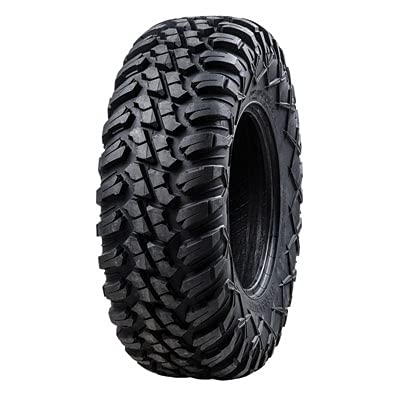
Includes Four 30x10-14 Tusk Terrabite Tires mounted to Four Tusk 14" Cascade wheels with a 4/156 bolt pattern for Polaris UTV's.
OHV Plates vs. Street-Legal Registration: The Critical Difference
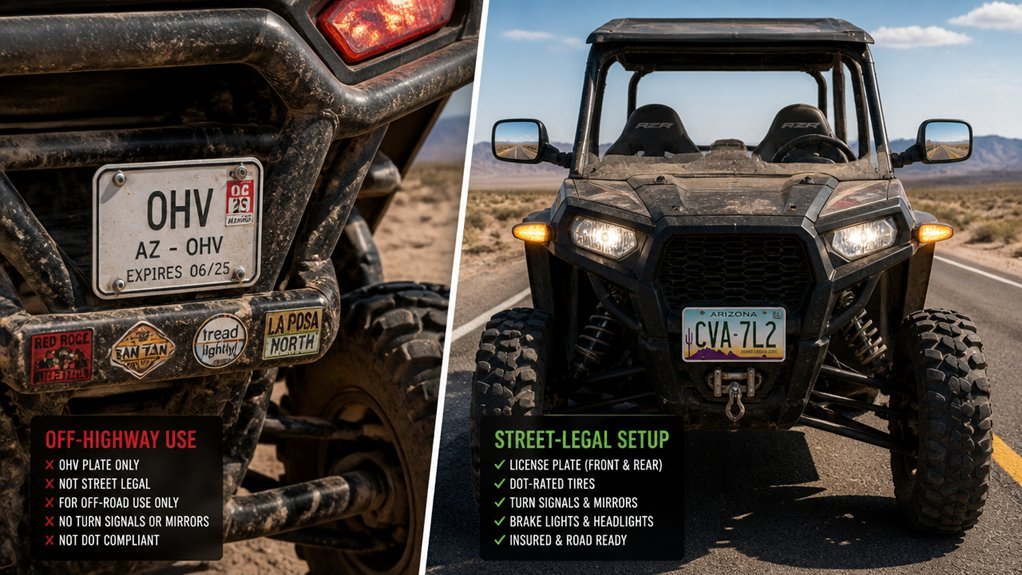
How exactly do you distinguish between an OHV Plate and true street-legal registration? You’ll recognize that OHV plates authorize limited road use within approved Texas areas only, whereas street-legal registration—often obtained out-of-state—activates broader operational privileges through interstate reciprocity.
You’ll observe that OHV plates don’t require full equipment standards; street-legal registration demands compliant lighting and signals, mirrors, a visible license plate, and a valid driver’s license per state vehicle requirements. You’ll note that OHV plates exclude highway operation and lack guaranteed interstate recognition, while out-of-state street-legal status creates variable road-use rights depending on that jurisdiction’s rules.
You’ll understand that neither classification automatically satisfies Texas on-road mandates. You’ll evaluate your specific travel needs: restricted OHV-area access versus expanded, reciprocity-dependent mobility. You’ll verify equipment standards and driver’s license compliance before selecting your registration pathway.
Recommended Products

Universal Compatibility: Our street-legal turn signal and license plate holder kit is designed to fit a wide range of vehicles; it is compatible with Polaris RZR Ranger, Pioneer, Talon, Can-Am X3, Kawasaki Teryx, Mule, Arctic Cat, CFMOTO, Golf Cart, LandMaster, Segway, and more. Saving your time by letting you skip the browsing

Universal Compatibility: Our street-legal turn signal kit is designed to fit a wide range of vehicles; it is compatible with Polaris RZR Ranger, Pioneer, Talon, Can-Am X3, Kawasaki Teryx Mule, Arctic Cat, CFMOTO, Golf Cart, LandMaster, Segway, and more. With our kit, you can easily make your vehicle street-legal and improve safety on the road
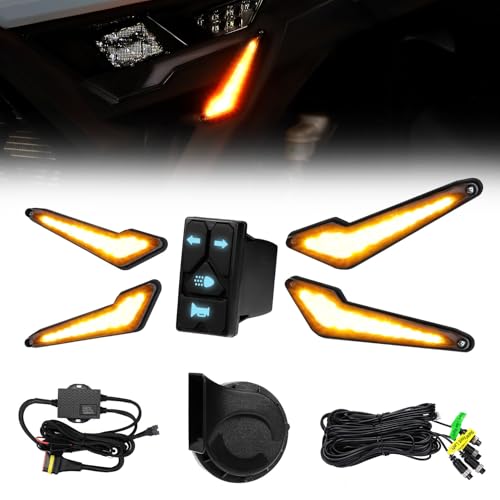
Universal Compatibility: Our street-legal turn signal kit is designed to fit a wide range of vehicles; it is compatible with Polaris RZR Ranger, Pioneer, Talon, Can-Am X3, Teryx, Mule, Arctic Cat, CFMOTO, Golf Cart, LandMaster, Segway, and more. Saving your time by letting you skip the browsing
Which States Let You Register Your UTV as Street-Legal?

You’ll find that several jurisdictions permit street-legal UTV registration, creating viable pathways for operators seeking expanded road-use privileges. Montana registration and South Dakota registration accommodate out-of-state registration, enabling you to obtain a street-legal UTV designation that leverages Texas reciprocity for limited road access. Arizona issues an OHV plate with specific DOT standards compliance, including horn audibility and mirror requirements. Florida mandates comprehensive state registration through DHSMV with full safety equipment and titling. California imposes stringent emissions protocols alongside DOT standards for UTV street-legal status. Texas restricts direct state registration to OHV plates for approved areas only, though you’ll access roads via out-of-state registration reciprocity. You must verify each jurisdiction’s evolving statutes, as regulatory frameworks governing street-legal UTV operation shift frequently across state lines.
Recommended Products

32SMD high brightness 2835 LED chips per lights for maximum illumination. Working Voltage: 12V.

Wide Compatibility: The Vi9000 UTV turn signal kits is designed to fit most 2-seater, 4-seater, and 6-seater UTVs and side-by-side vehicles. Compatible with popular models from Polaris, Can-Am, Kawasaki, Honda, CFMOTO, Arctic Cat, Segway, golf carts, beach vehicles, and more. Ideal for riders looking to add turn signal functionality to a wide range of off-road vehicles

Universal Compatibility: Our street-legal turn signal kit compatible with 2018 + Polaris Ranger 1000 / 1000 XP FULL-SIZE (3-seat) and CREW (6-seat) models,2016+ Polaris General 1000 2-seat and 4-seat models, 2019-2023 Polaris Rzr XP 1000 2-seat and 4-seat models, 2020-2025 Polaris RZR PRO XP 2-seat and 4-seat models
What Equipment Your Chosen State Requires
Once you’ve identified a jurisdiction permitting street-legal UTV operation, you must equip your vehicle to meet that state’s specific regulatory standards. UTV equipment requirements vary significantly across jurisdictions.
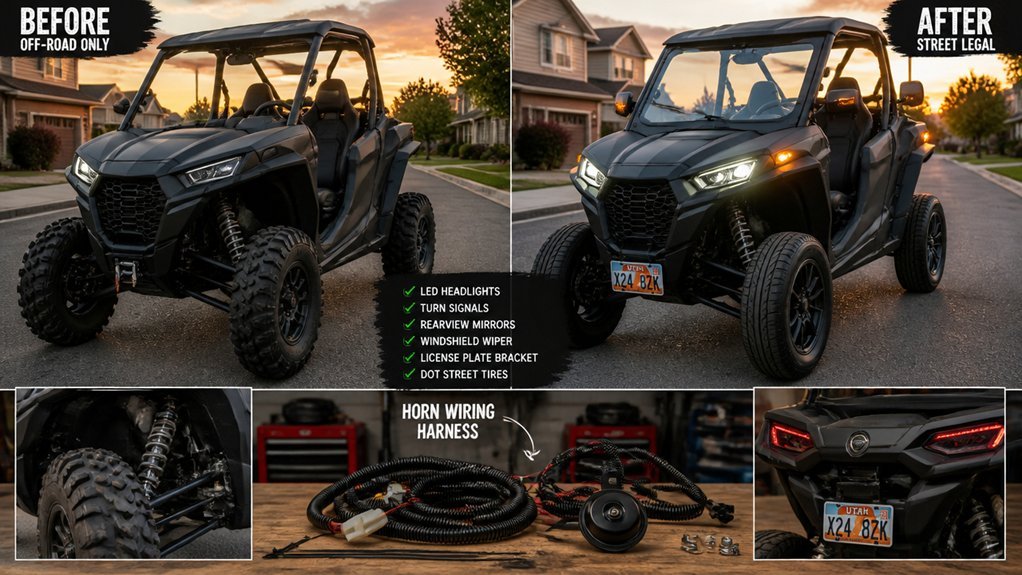
Florida mandates DOT-approved tires, headlights, taillights, brake lights, turn signals, side marker lights, rearview mirrors, horns, and windshield or eye protection. Arizona requires OHV plates, horns audible from 200 feet, rearview mirrors on both sides and center, and windshield or eye protection. Texas stipulates DOT-approved tires, turn signals, horns, rearview mirrors, brake lights, headlights, taillights, windshield or eye protection, and license plate placement. California imposes stricter emissions standards alongside required lighting, horns, mirrors, taillights, and windshield or eye protection. Verify your state’s complete specifications before modification.
Recommended Products
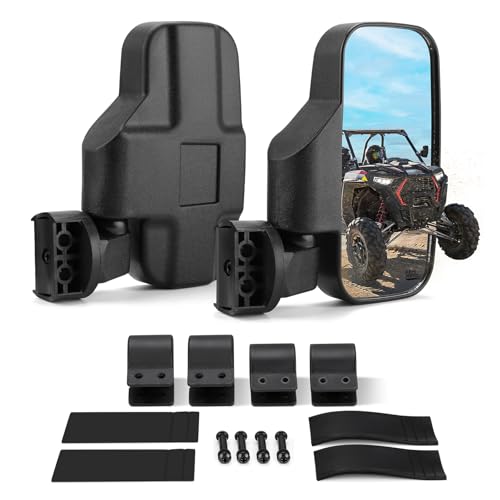
COMPATIBILITY: KEMIMOTO UTV mirrors fit all UTVs with 1.6 inch to 2 inch round tube roll cages.Compatible with Polaris RZR, Kawasaki Teryx Mule, Pioneer 1000/700, Zforce, Rhino, YXZ, Viking, Wolverine, Segway Villain and Can-Am Maverick X3/Commander. Notice: NOT compatible with Pioneer 520, Defender, Uforce and Ranger models with pro fit cage, ONLY fit round bar cage
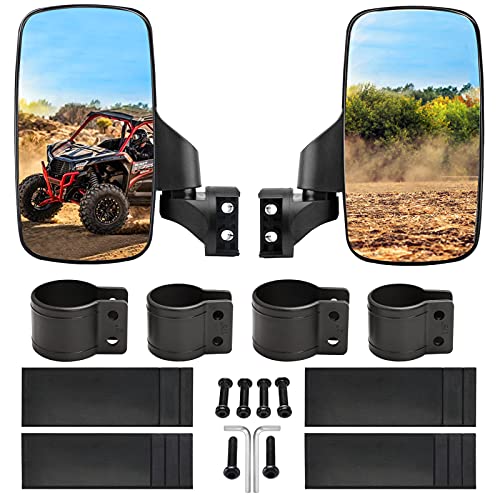
Oversized Mirror: 4.5 x 8.5 inch convex mirror offers a wide viewing range. Features a new glass mirror and symmetrical shell structure that distributes stress evenly across the mirror surface, enhancing durability.
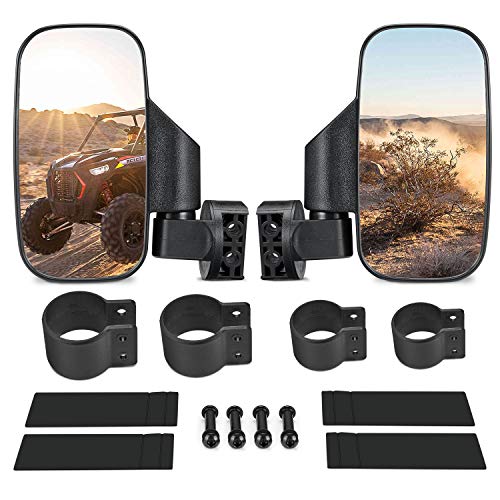
2 Set of Mounting Clamps: Comes with 1.75" & 2" clamps, fits all UTVs with 1.6"-2" round tube roll cages. Compatible with Polaris RZR, Kawasaki Mule/Teryx, Pioneer, Rhino, YXZ, Kubota RTV, Arctic Cat & more. Notice: NOT compatible with 2015-2025 Ranger, Defender, Uforce models with pro fit cage, only fit round bar cage
Turn Signal Kits: Installation and State Compliance
Why do most UTV owners start with a turn-signal conversion kit? You’re addressing the foundational lighting requirements for street-legal UTV operation. A turn signal kit transforms your off-road vehicle into a compliant machine meeting Department of Transportation (DOT) standards.
You’ll encounter options spanning budget LED inserts to comprehensive $600+ systems. Premium plug-and-play harnesses with OEM-compatible mounting ensure reliable installation and superior visibility. Cheaper alternatives demand drilling and custom wiring, compromising UTV safety and state compliance.
Your installation approach directly impacts vehicle registration success. Integrated plug-and-play systems minimize failure points compared to DIY wiring. When selecting components, verify compatibility with your state’s specific lighting requirements—signal timing, visibility distance, and mounting height vary jurisdictionally. Prioritize kits explicitly engineered for your UTV model to streamline compliance verification and avoid registration delays.
Recommended Products
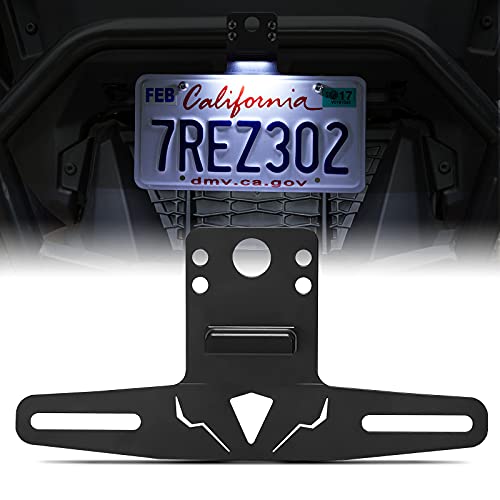
Long Lifespan: KEMIMOTO UTV license plate mount is not only strong and solid but also has good stability and corrosion protection, resists all kinds of weather conditions, much better than the plastic license plate mount
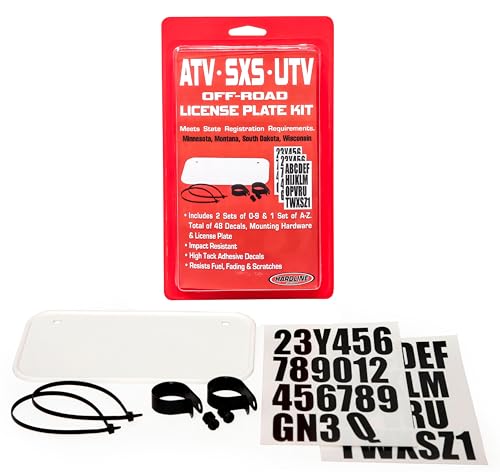
ALL-IN-ONE REGISTRATION SOLUTION: Complete off-road license plate kit includes one durable white mounting plate (4" x 7.5"), rust-proof mounting hardware, two sets of 0-9 numerals, and one set of A-Z letter decals. Everything you need to get trail-legal fast.

Black plastic license plate measures 7.5-inches wide by 4-inch high
How to Cross Public Roads With Your UTV
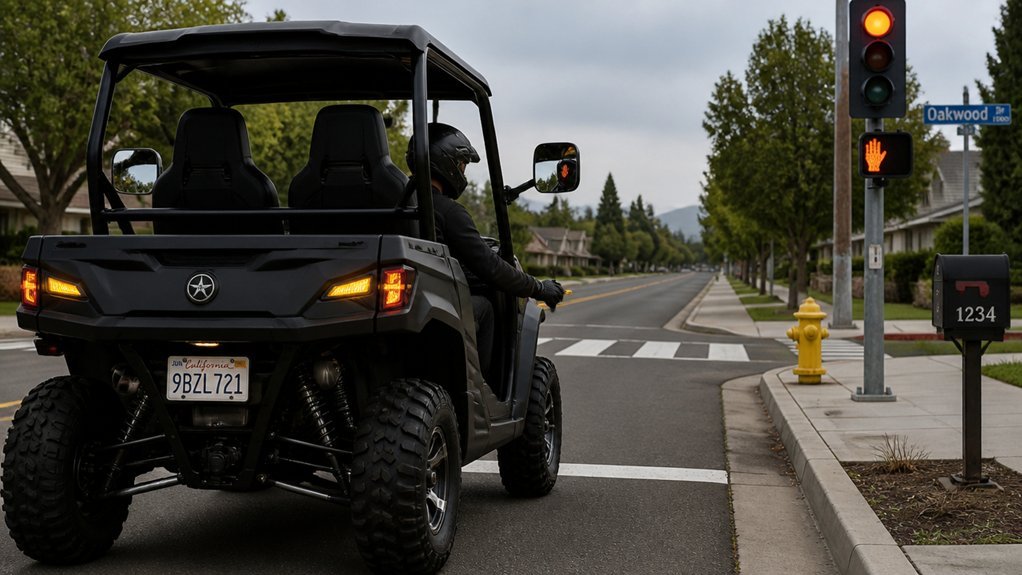
Installing compliant turn signals brings your UTV closer to street-legal status, but road use isn’t limited to continuous travel—many situations require crossing public thoroughfares legally and safely. To cross public roads with your UTV street-legal machine, you must stop completely, yield to traffic, and cross at a 90-degree angle or at intersections—never on limited-access highways or interstates.
Before attempting any crossing, verify your registration and proof of insurance are current and accessible. State reciprocity determines recognition of your out-of-state UTV street-legal status in jurisdictions like Texas. Ensure all required equipment functions properly: headlights, taillights, brake lights, and turn signals constitute compliant lights and signals, while mirrors provide necessary rear visibility. Without these elements, you violate regulatory standards and risk penalties.
Recommended Products
Complete Set of 4 UTV/ATV Tires – Includes two 29x9-14 front and two 29x11-14 rear tires designed for medium-hard terrain.
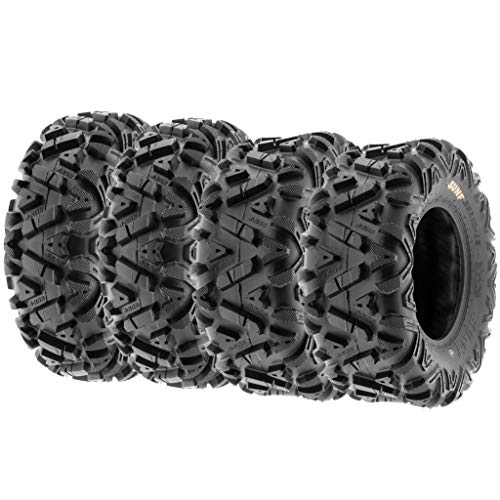
Front Size: 25x8-12 - Rear Size: 25x10-12 | Wheel (Rim) Diameter: Front 12 in - Rear 12 in

Fitment is for POLARIS brand UTVs with a 4/156 bolt pattern- such as the RZR, Ranger, General. This will NOT work on Polaris machines with a 5 lug bolt pattern.
Driving Your Out-of-State-Registered UTV on Texas Roads
Where exactly can you drive your out-of-state street-legal UTV in Texas? You operate under reciprocity agreements, which permit road use when your vehicle maintains valid registration and insurance from its home jurisdiction. Texas recognizes DOT compliance from your issuing state; you don’t modify equipment to meet Texas-specific standards. Carry physical registration documents and proof of insurance—law enforcement demands immediate verification. Understand that enforcement varies regionally; officers may scrutinize your out-of-state street-legal UTV unfamiliarly.
You distinguish your vehicle from OHV-plated machines, which lack reciprocal street access. Your registration must remain current, and your insurance must satisfy minimum liability requirements. You anticipate roadside stops by maintaining complete documentation. Reciprocity enables limited operation, but you respect Texas traffic regulations governing your road use. Non-compliance invalidates your reciprocity protection and subjects you to standard penalties.
Recommended Products

3-in-1 Multi-Function Stalk: This KEMIMOTO utv turn signal kit features a column switch that integrates three street-legal functions: turn signals, hazard lights, and horn. It ensures easy, comfortable operation, enhances safety and compliance, and clearly communicates turn intentions without hand signals

Universal Compatibility: Our street-legal turn signal and license plate holder kit fits a wide range of UTVs, side-by-sides, and golf carts; it is compatible with Polaris RZR, Ranger, Can-Am X3, Teryx, Mule, Arctic Cat, CFMOTO, Segway, and more. No more browsing or guessing fitment

Drive Like Your UTV with Column Control: Ditch the dash rocker switches. Our ergonomic, column-mounted trigger switch puts turn signal, horn, and hazard controls right at your fingertips. This Blinker Kit offers the safe, hand-on-wheel operation you expect from your daily driver, for keeping focus on the trail
Best States to Register Your UTV for Texas Road Use
How do you secure street-legal status for your UTV when Texas offers no direct path? You pursue out-of-state registration in jurisdictions with favorable vehicle registration requirements. Montana and South Dakota dominate this space; they issue UTV street-legal titles without imposing state inspection or rigid DOT standards compliance. You submit your application, pay fees, and receive plates—no physical presence required.
These registrations function via reciprocity agreements, permitting Texas road use without Texas-specific equipment mandates. You carry physical registration and insurance documentation; law enforcement encounters remain manageable. Your OHV license plate remains irrelevant for street operation—file it for off-highway trails only. You can’t cross intersections on limited-access highways, but standard roadway travel proceeds legally. Verify current statutes; regulations shift.
Recommended Products

IMPRESSIVE BRIGHTNESS - New design 30 inch LED tailgate light bar was built with 216Pcs 2838 Dual color SMD LED chips, this compact and concentrated LED chip illuminates with more smooth lighting effect than others. Bright 2 color design will wakes up everyone behind you and guarantee your vehicle is seen even in the thickest foggy, busy traffic or night.

Outstanding brightness: Each light is composed of 20pcs high-quality and durable LED, stably output super bright red running/brake light, white reverse light and amber turn signals light. The rear vehicles can clearly see your light changes during the day and night, ensure your travel safety.

【Multi-functions】Each light has 11 high quality LED diodes, providing maximum visibility. Functions as marker, side marker, parking light, stop light, turn signal light, tail light, Third 3rd brake light and high mount stop light, meet ALL your need.
Conclusion
You’ve navigated the regulatory framework: Texas won’t register your UTV as street-legal, so you’re leveraging out-of-state reciprocity. You’ve distinguished OHV plates from street-legal registration, identified compliant states, installed DOT-spec equipment, and integrated plug-and-play turn signals. You’re carrying documentation, observing crossing protocols, and understanding highway restrictions. Verify your chosen state’s current statutes quarterly, as reciprocity agreements and equipment mandates evolve. Compliance isn’t optional—it’s your shield against liability and enforcement action.
Recommended Products

Widely compatibility: UTV rearview mirror with aluminum C clamp fit for 1.5"- 2" roll bar cage, compatible with most UTV/SXS,compatible with polaris RZR, Maverick can am X3, Kawasaki Mule Teryx, Arctic cat wildcat,Honda pioneer, Talon,CFMOTO and etc PS: Aluminum alloy clamp allows the RZR center mirror to be windshield and roof compatible,and silicone pad is embedded inside the clamp to protect your roll cage

Better Driving Experience: The KEMIMOTO UTV center mirror mount has two installation methods, which can be adjusted in different ways according to your height. You no longer have to worry about being uncomfortable looking at the vehicle behind you during driving. At the same time, the low profile clamp design allows the UTV rear mirror to be windshield and roof compatible, maximizing the upgrade of your UTV

Shockproof and Worry-Free Transport: Waterproof PVC Mesh Fabric and 12mm Padded Neoprene Core, This cover features a durable, tear-resistant PVC mesh exterior. It's waterproof and easy to clean, backed by a thick shock-absorbing, padded neoprene layer to defend against gravel, road debris, UV rays, and rain—ideal for hauling, trailering, and towing.Please confirm the size before purchasing to ensure that the purchased size is suitable.