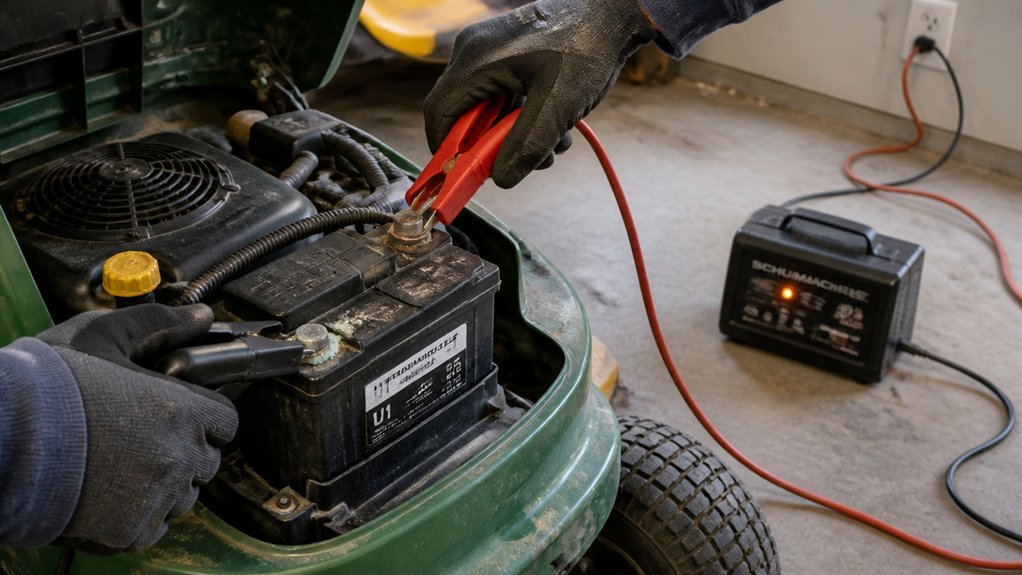

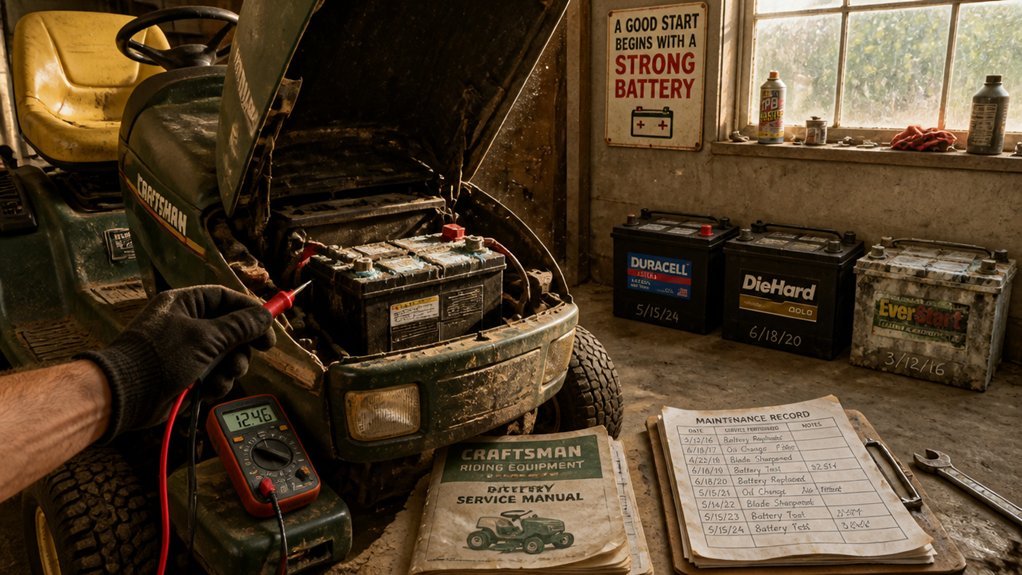
You expect your riding mower to fire up every season, but the battery beneath the seat quietly degrades with every charge cycle. Most lead-acid units deliver three to five years of service—if you manage temperature exposure and maintenance correctly. Yet you’ll find no warning light flashing when capacity drops below critical thresholds. The real question isn’t when failure occurs; it’s whether you can spot the preventable failures before they leave you stranded mid-mow.
How Long Do Riding Mower Batteries Last? (3–5 Years Explained)
How long can you expect your riding mower battery to perform? Typically, riding mower batteries deliver a lifespan of three to five years. Your replacement interval depends heavily on maintenance practices and operational habits. Most units utilize lead-acid technology, which responds predictably to care.
You extend battery longevity through consistent use and adherence to a proper charging routine. Regular cycling prevents sulfation buildup that degrades capacity. You must monitor temperature impact closely; both extreme heat and cold stress electrochemical reactions, accelerating wear even when the mower sits idle.
You can’t overlook maintenance. Terminal cleaning, electrolyte level checks, and secure cable connections preserve performance. When you store the mower seasonally, you maintain charge levels rather than allowing full discharge. These technical practices ensure you maximize your investment and avoid premature replacement.
Recommended Products

√ Dimensions: Length 7.68 inches, Width 5.12 inches, Height 6.22 inches, Total Height 7.09 inches; Weight: 21.5 lbs, Terminal Type: Square Hole Nut and Bolt, NB, Nut and Bolt, J; The positive terminal is on the left side of the battery; Cold Cranking Amps: 200CCA; Terminal: Left : Positive (+)-Red, Right: Negative (-)-Black.

YTZ12S is a 12V 11AH 210 Cold Cranking Amps (CCA) Sealed Lead Acid (SLA) Battery

ML-U1-CCAHR is a 12V 320 Cold Cranking Amps (CCA) Sealed Lead Acid (SLA) Battery.
What Shortens Riding Mower Battery Life?
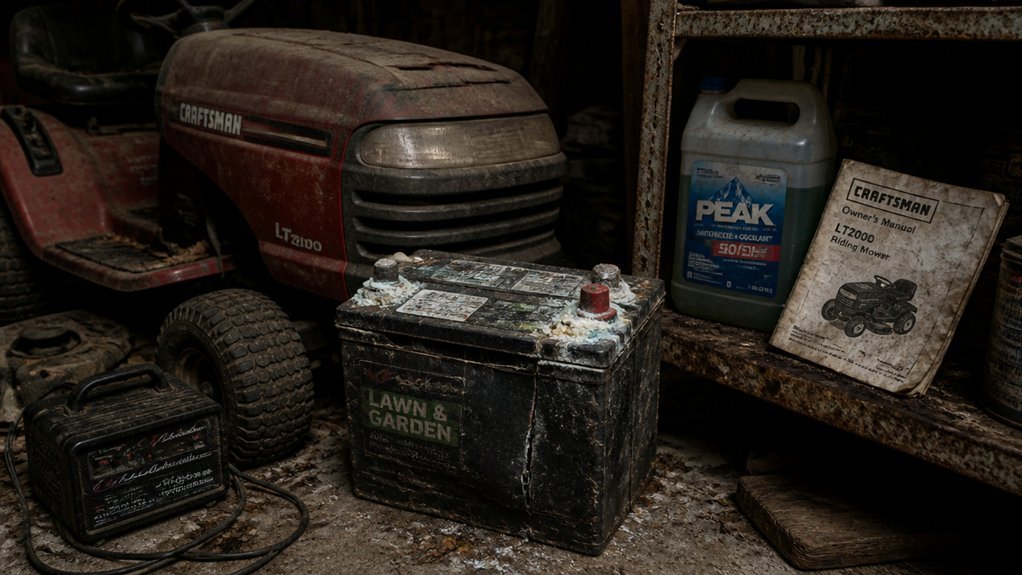
Several factors actively degrade your riding mower battery beyond normal wear. Temperature sensitivity accelerates chemical breakdown—extreme heat increases internal resistance while cold thickens electrolyte, reducing cranking power. Deep cycling, or repeated full discharge, strains plates and hastens capacity loss in your lead-acid battery. Off-season inactivity permits sulfation as sulfate crystals harden on plates, permanently diminishing charge acceptance. You compound damage through poor maintenance: frequent short trips prevent full recharge, leaving plates insufficiently conditioned. Incorrect charging rate—whether too fast or too slow—generates excess heat or fails to drive complete electrochemical reactions. You must monitor discharge depth, maintain proper electrolyte levels, and store batteries charged in moderate temperatures to mitigate these degradation mechanisms.
Recommended Products

LONGEVITY OVER 5 YEARS --- BCI Group U1 Battery Replacement, 12V 25Ah, 330A CCA Sealed Lead Acid AGM Battery. Dimensions: 7.68L x 4.92W x 6.93H inches, Maintenance Free. No spills, no leaks, and no water to check. Terminal: Left : Positive (+)-Red, Right: Negative (-)-Black.

Reliable Engine Starts: 12-volt replacement battery delivers strong, consistent cranking power to ensure your zero-turn riding lawn mower starts up dependably on every single try

CUB CADET GENUINE FACTORY PARTS OEM Part Number: 490-280-F017 Replaces: 725P17335, 725-17335
Lead-Acid or Lithium: Which Mower Battery Lasts Longer?
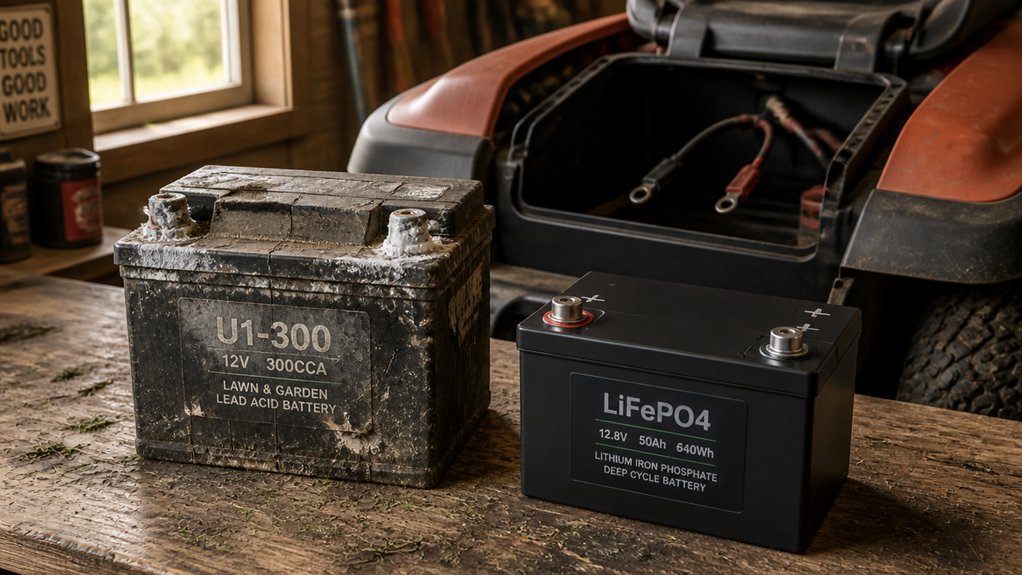
Whether you’re replacing a failing battery or upgrading equipment, you’ll want to know which chemistry delivers more years of service. Lead-acid and lithium-ion systems each present distinct lifecycle profiles for your riding mower.
You’ll typically get 3 to 5 years from a lead-acid battery, though you’ll battle sulfation during storage if you leave it discharged. Flooded variants demand regular maintenance; AGM options reduce that burden but don’t extend the range beyond 3–5 years under normal conditions.
Lithium-ion batteries give you similar calendar spans yet offer superior cycle endurance—300 to 500 full cycles with proper care. You’ll find lithium resists sulfation far better when maintained at moderate charge states. For demanding users prioritizing longevity, lithium-ion outperforms lead-acid through enhanced storage tolerance and extended cycle life.
Recommended Products

🔋—Battery is a 12V 280 Cold Cranking Amps (CCA) Sealed Lead Acid (SLA) Battery. Dimensions: 7.68 inches x 4.92 inches x 6.14 inches. Polarity: Positive on Left, Negative on Right. Listing is for the Battery and Screws only.
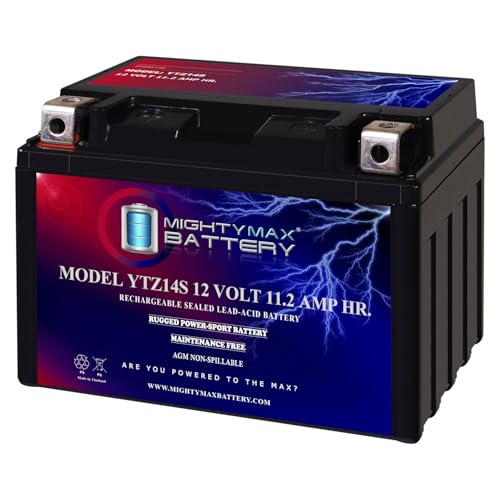
YTZ14S is a 12V 11.2AH 230 Cold Cranking Amps (CCA) Sealed Lead Acid (SLA) Battery
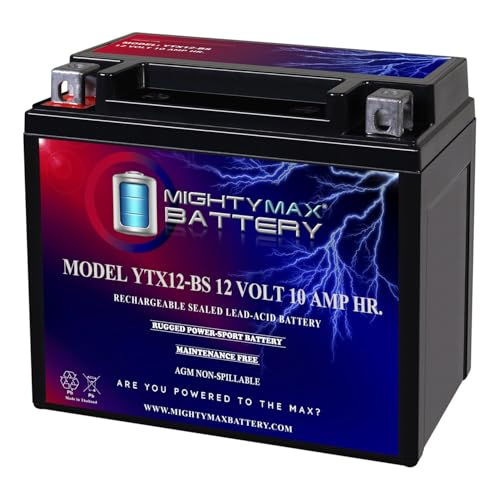
YTX12-BS is a 12V 10AH 180 Cold Cranking Amps (CCA) Sealed Lead Acid (SLA) Battery
How to Charge Your Mower Battery for Maximum Lifespan
Your battery chemistry choice determines lifespan potential, but your charging habits decide whether you actually reach it. Select a charger type that matches your specific chemistry—lead-acid batteries, AGM, or lithium—and avoid generic chargers that deliver incorrect voltage profiles.
For flooded lead-acirc batteries, you’ll check electrolyte levels and top with distilled water before charging, filling only to the indicator line to prevent overflow.
During storage maintenance, connect your battery to a battery maintainer or use float charging to maintain 13.2–13.8 volts; this prevents sulfation, the crystalline buildup that permanently reduces capacity. Charge every 30–60 days and never allow deep discharge. Warm cold batteries to room temperature before charging. Consider pulse conditioning chargers if your manufacturer recommends them to further inhibit sulfation and maximize cycle life.
Recommended Products

MEET THE GENIUS1 — Similar to our G750, just better. It's 35% smaller and delivers over 35% more power. It's the all-in-one charging solution - battery charger, battery maintainer, trickle charger, plus desulfator.

THE ALL-NEW GENIUS2: Introducing the all-new GENIUS2, making it one of our the most powerful, highest-performing, energy-efficient, and compact charger yet.

Stay Charged: Battery Tender battery chargers and maintainers provide a full charge to your powersport vehicle’s battery before switching to float mode to maintain proper voltage levels for safe, long-term storage
Clean Your Battery Terminals and Check for Hidden Damage
The terminals on your riding mower battery demand regular attention—corrosion builds silently, creating resistance that strains the starter and shortens charge cycles. You must prioritize terminal cleaning to preserve connections and extend battery lifespan.
Mix baking soda with water and scrub the terminals to neutralize acid and dissolve corrosion. For heavy buildup, use a terminal cleaning kit. Dry thoroughly, then coat terminals with petroleum jelly or protectant to block future corrosion.
During each safety check, inspect for cracks, swelling, or loose cables. These reveal hidden damage that compromises battery maintenance efforts. You can’t afford to ignore compromised terminals—poor connections force your charging system to work harder, accelerating wear.
Consistent inspection and cleaning eliminate preventable failures. You protect your investment and maximize operational reliability through disciplined attention to terminal condition.
Recommended Products

All-In-One - The ultimate battery terminal cleaning kit provides all the tools to clean and protect your battery from battery corrosion.

Quantity: comes with 10 pieces battery anti-corrosion washers(5 red & 5 green) and 2pcs Battery Terminal Cleaning Brush.

【CLEAN & PROTECT KIT】Includes 2 battery terminal cleaners and 12 anti-corrosion fiber washers (6 red, 6 green) for a complete battery terminal care set. Clean corroded connections, then add washer protection to help reduce future buildup
Should You Remove Your Battery for Winter Storage?
Where should your battery spend the off-season? You remove battery from the mower for winter storage to prevent sulfation and reduce parasitic discharge. Store your lawn mower battery in a cool, dry location away from extreme temperatures and direct sunlight.
Your battery type dictates specific preparation. For flooded lead-acid batteries, check electrolyte levels and top up with distilled water before storage. AGM battery units require no water addition—sealed construction eliminates maintenance.
Maintain charge level at 40-60% partial state of charge during inactivity. Connect a battery maintainer or float charger to preserve optimal voltage and prevent sulfation buildup. You’ll recharge fully before spring operation. This protocol applies regardless of chemistry—flooded lead-acid, AGM battery, or lithium-ion—all benefit from controlled winter storage conditions and sustained charge maintenance.
Recommended Products

ML-U1R-CCAHR is a 12V 320 Cold Cranking Amps (CCA) Sealed Lead Acid (SLA) Battery
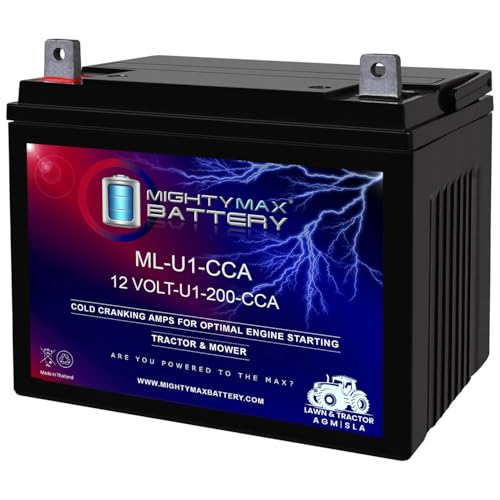
ML-U1 is a 12V 200 Cold Cranking Amps (CCA) Sealed Lead Acid (SLA) Battery

UNIVERSAL FIT DESIGN: BCI Group U1 format with compact 7.68 x 5.12 x 7.09 inch dimensions ensures perfect size compatibility with leading brands like Toro, Cub Cadet, and Craftsman
How to Store a Riding Mower Battery Properly
Proper storage begins with complete removal from the mower. You’ll eliminate parasitic drains and reduce sulfation risks by taking this step. Find a cool, dry location away from temperature extremes for your battery’s storage period.
You should store batteries at a partial state of charge—ideally 40–60%. Connect a maintainer or float charger throughout storage; you’ll prevent sulfation and maintain readiness.
For flooded lead-acid units, you’ll check and top off electrolyte with distilled water before storing. AGM batteries require no water addition, so you’re finished after inspection.
You’ll clean corrosion from terminals and ensure cable integrity before putting the unit away. Poor terminal condition causes post-storage starting failures.
Follow these protocols for any battery type. You’re protecting your investment and ensuring reliable seasonal startup.
Recommended Products

Dimensions: Length 7.68 inches, Width 5.12 inches, Height 6.22 inches, Total Height 7.09 inches; Weight: 21.45 lbs, Terminal Type: Square Hole Nut and Bolt, NB, Nut and Bolt, J; The positive terminal is on the left side of the battery; Cold Cranking Amps: 350CCA; Terminal: Left : Positive (+)-Red, Right: Negative (-)-Black.

BCI Group U1 Battery Replacement,12V 28Ah 320CCA Sealed Lead Acid AGM Battery. Dimensions:9.45L x 8.70W x 6.81H inches. The positive terminal is on the left side of the battery; Terminal:Left : Positive (+)-Red, Right: Negative (-)-Black.

Dimensions: Length 7.68 inches, Width 5.12 inches, Height 6.22 inches, Total Height 7.09 inches; Weight: 18.68 lbs, Terminal Type: Square Hole Nut and Bolt, NB, Nut and Bolt, J; The positive terminal is on the left side of the battery; Cold Cranking Amps: 300CCA;Terminal: Left : Positive (+)-Red, Right: Negative (-)-Black.
5 Signs Your Mower Battery Is Failing
How can you tell when your mower’s battery is approaching the end of its service life? You’ll notice five critical failure signs that demand attention.
First, your runtime drops drastically—you can’t complete mowing on a single charge.
Second, you experience power under load; the mower bogs down in thick or damp grass despite full charge.
Third, charging behavior becomes abnormal: the battery reaches full capacity too quickly or takes excessively long.
Fourth, physical deterioration appears—swelling, bulging, cracking, or corrosion on terminals and casing indicate internal damage.
Fifth, the battery can’t hold a charge after storage or fails to start even when fully charged.
Monitor these indicators closely. Each signals irreversible chemical degradation. Address them promptly to prevent operational failure during critical mowing windows.
Recommended Products

LONGEVITY OVER 5 YEARS --- BCI Group U1 Battery Replacement, 12V 26Ah, 360A CCA Sealed Lead Acid AGM Battery. Dimensions: 7.68L x 4.92W x 6.93H inches, Maintenance Free. No spills, no leaks, and no water to check. Terminal: Left : Positive (+)-Red, Right: Negative (-)-Black.
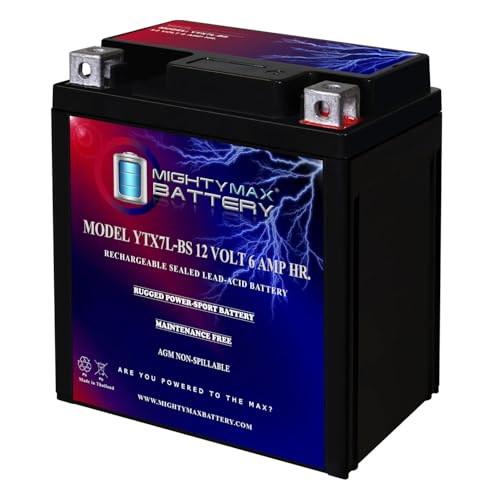
YTX7L-BS is a 12V 6AH 100 Cold Cranking Amps (CCA) Sealed Lead Acid (SLA) Battery

UNIVERSAL FIT DESIGN: BCI Group U1 format with compact 7.68 x 5.12 x 7.09 inch dimensions ensures perfect size compatibility with leading brands like Toro, Cub Cadet, and Craftsman
Fix It or Replace It? Making the Right Call
Once you’ve identified the warning signs, you face a practical decision: attempt repairs or install a replacement. You must evaluate sulfation damage, as irreversible crystallization on lead plates typically demands replacement rather than restoration. Your battery’s lifespan—usually three to five years or 300-500 cycles—guides this assessment. Poor maintenance and improper charging accelerate degradation, but you can’t reverse severe capacity loss. Extreme temperature exposure further compromises internal chemistry, shortening operational life regardless of care. Conduct a cost comparison: factor in professional diagnostics, potential downtime, and partial repair expenses against a new battery’s price. When your unit struggles post-storage or shows chronic failure, replacement proves more economical than repeated fixes. Prioritize reliable starting over marginal recovery attempts.
Recommended Products

Charger, Maintainer & Desulfator - An all-weather battery charger, battery maintainer, trickle charger, and battery desulfator. Perfect for charging and maintaining all 12-volt lead-acid, flooded or sealed maintenance free batteries (AGM and gel cell).
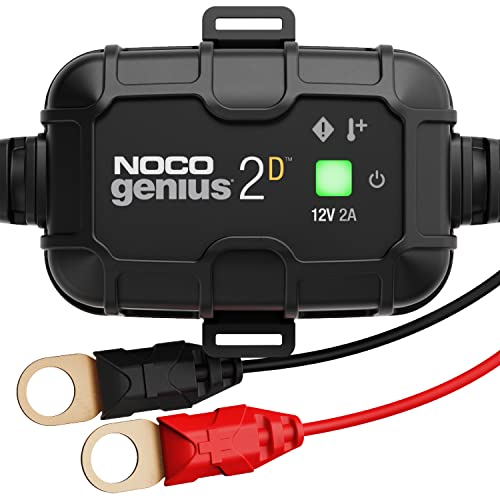
MEET THE GENIUS2D — The all-new direct-mount onboard battery charger for an under-the-hood battery charging system and year-round battery maintenance.
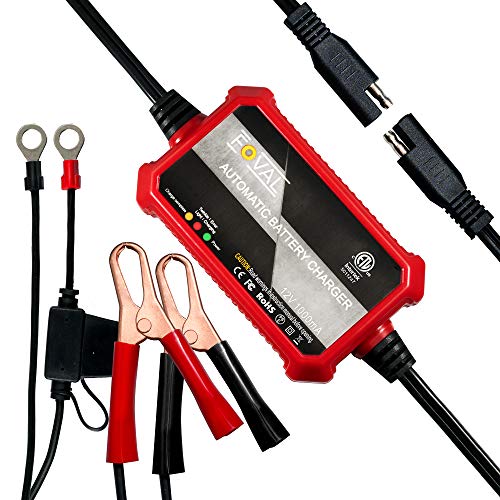
Automatic Battery Charger & Maintainer: 1A 12V smart battery charger perfect for SLA / VRLA / GEL CELL / AGM / WET lead acid batteries. It is a battery maintainer, trickle charger, float charger, and battery desulfator, also complete 4-step charging program (Initialization, Bulk Charge, Absorption Mode, Float Mode).
Conclusion
Your riding mower battery typically delivers 3–5 years of service, but your maintenance habits determine where it falls in that range. You’ll maximize lifespan by matching your charger to the battery chemistry, keeping terminals corrosion-free, and storing at 40–60% charge in moderate temperatures. When capacity drops or starting falters, replacement beats repeated repairs—aging lead-acid cells rarely recover, and unreliable starting isn’t worth the risk mid-season.
Recommended Products

Specially designed to protect battery terminals from corrosion, a leading cause of hard starting and battery failure.

Fleet and Vehicle Maintenance

【Effortlessly removes corrosion】The dual-ended battery post cleaning brush, made of stainless steel casing and with steel wire bristles, powerfully removes stubborn corrosion and oxides from battery terminals and clamps, ensuring optimal conductivity. In winter, clean terminals will help your car start more easily while reducing battery drain.