
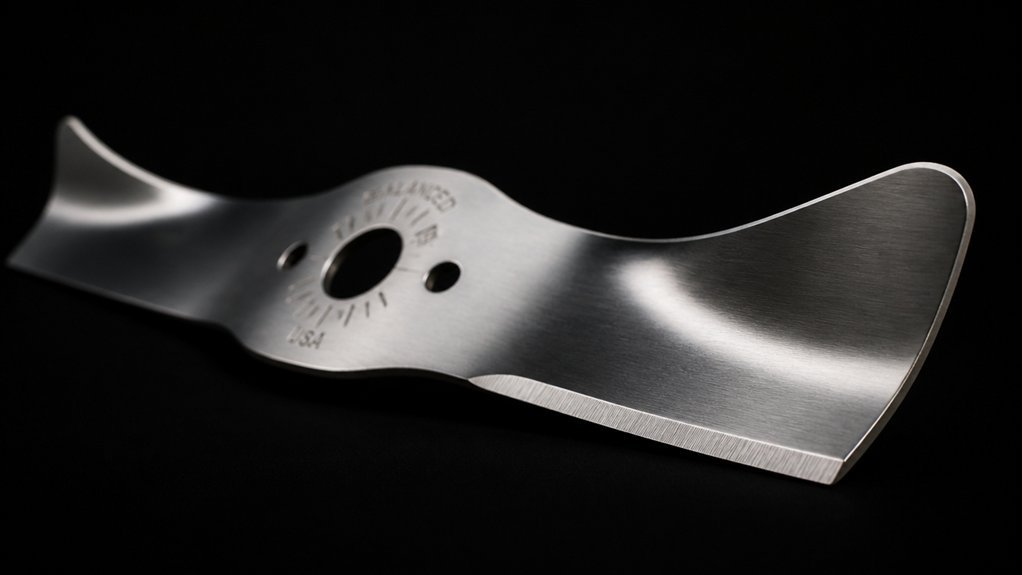
You need the right blade for the job, and a high-lift mower blade delivers distinct aerodynamic performance you won’t get from standard or mulching alternatives. Its curved, steeply angled trailing edge generates pronounced upward suction, lifting grass vertically before severance and propelling clippings forcefully toward your discharge chute or bagger. This design demands adequate horsepower and creates trade-offs you’ll want to understand before swapping out your current setup.
What High-Lift Blades Do Differently
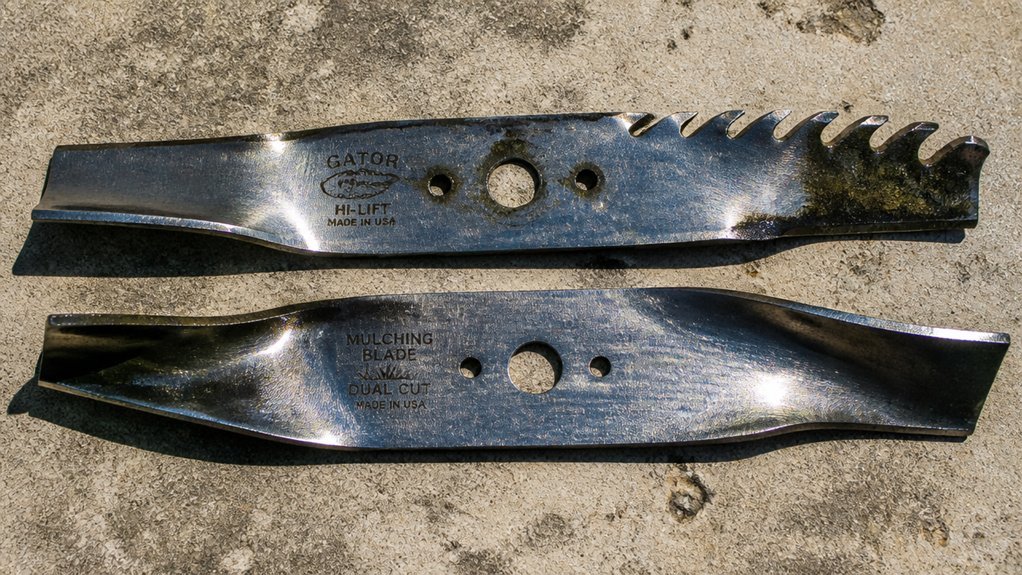
How exactly does a high-lift blade distinguish itself from standard alternatives? You’ll find the answer in its aerodynamic profile. High lift blades generate substantially stronger upward airflow than conventional designs, creating powerful suction that lifts grass blades upright before cutting. This mechanism guarantees a cleaner, more uniform cut at taller heights.
You’ll leverage this enhanced airflow for two primary operations: bagging and side discharge. The blade’s aggressive pitch accelerates clippings vertically, then propels them forcefully through the deck opening into collection systems or out the discharge chute. You’re effectively optimizing for material evacuation rather than retention.
However, you’ll pay for this performance. The intensified suction demands greater horsepower and increases fuel consumption. When your priority is rapid, complete clipping removal, you’ll select high lift blades. They’re engineered specifically for maximum airflow efficiency in discharge and bagging applications, not for alternative processing methods.
Recommended Products

Replaces OEM Part: EGO Power+ AB2102D
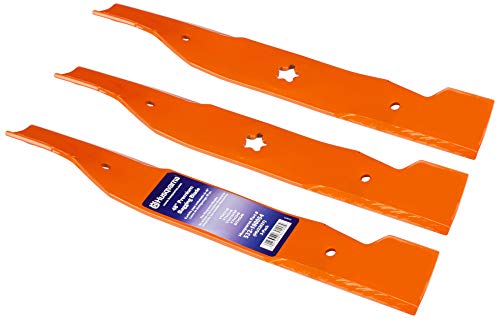
Includes three (3) Husqvarna 48-Inch High-Lift Bagging Lawn Mower Blades for Riding Mowers, compatible with models: YTH22V46, YTH24V48, TS 146X/XK/XD and TS148X/XK

High-Lift vs. Mulching: Which Blade Fits Your Lawn?
Where exactly does your grass go after the cut determines which blade architecture you’ll deploy. You must evaluate your clippings management strategy when selecting between blade options.
High-lift blades generate maximum upward airflow, lifting grass vertically for a clean shear and propelling clippings forcefully into collection bags or through discharge chutes. You’ll deploy these when bagging or side-discharging dominates your mowing routine.
Mulching blades utilize curved, multi-surface geometries to recut clippings repeatedly, reducing them to fine particulates that decompose rapidly into your turf’s root zone. You’ll select these when returning nutrients directly to the soil is your priority.
Some blade options offer 3-in-1 versatility—mulching, bagging, and discharging—but you’ll sacrifice peak discharge efficiency compared to dedicated high-lift designs. Match your blade to your dominant grass disposal method for optimal performance.
Recommended Products

LM2100SP High Lift Blade Replace number AB2101

Blades Repalce for TCU15881,M128485, M131958, M144196, M163983

【Part Numbers】The mower blade replaces for Craftsman SPM209370365; For Cub Cad et 742-04276, 942-0641, 942-0641A, 742-0641, 742-0641A, 742-04276S, 742-0741, 742-0741A, 942-04276, 942-04276S, 942-0741, 942-0741A, CC-742-3032, CC-742-0741, 01002810, 490-100-M084, 490-100-C089, CMXGZAM100067. Please double-check the models, part numbers before purchasing to ensure fitting
Can You Mulch With a High-Lift Blade?

Why exactly would you force a high-lift blade into mulching duty when its entire geometry fights against the task? You’re working against aerodynamic principles purpose-built for discharge, not particle retention. A high lift blade generates aggressive upward airflow that launches clippings vertically—ideal for bagging or side discharge, but counterproductive when you need debris recirculation beneath the deck.
Without a mulch kit, you’re sacrificing efficiency. The blade’s curvature accelerates clippings toward the exit rather than sustaining them for multiple cutting passes. You’ll observe uneven particle distribution and incomplete decomposition.
If you insist on mulching with this hardware, install a mulch kit immediately. The plug restricts discharge, forcing material back into the cutting zone. Even then, recognize you’re compromising: dedicated mulching blades feature specialized cutting edges and reduced lift angles engineered specifically for particle fracturing. Your results remain suboptimal.
Recommended Products

𝟱𝟮 𝗜𝗡𝗖𝗛 𝗟𝗔𝗪𝗡 𝗠𝗢𝗪𝗘𝗥 𝗕𝗟𝗔𝗗𝗘𝗦: Three long-lasting and heavy-duty 18-7/16 inch replacement mower blades, with superior cutting edge for enhanced mulching, fits many residential and commercial mowers

Aftermarket Replacement Set of three (3) Oregon G3 Gator Style blades that Are Compatible With 52" Simplicity mowers with 18" blades and 5/8" Center mounting holes,

Includes two (2) Husqvarna 46-Inch High-Lift Mulching Lawn Mower Blades for use on Husqvarna riding mowers
Bagging and Side Discharge Performance
When do high-lift blades justify their reputation? You achieve maximum bagging efficiency and side discharge performance when you install a High Lift blade designed for your specific mower deck blade configuration. You generate stronger horizontal and vertical airflow that propels clippings immediately toward the bagger or discharge chute, reducing deck clogging. You also ensure grass stands upright for cleaner cuts before ejection. You’ll need adequate horsepower, as rapid clipping exit demands sustained blade speed. You must verify compatibility—check your manual for deck size, center hole pattern, and part number before selecting any High Lift blades. You sacrifice mulching capability, since the curvature prioritizes airflow velocity over recutting. For pure collection or discharge tasks, you won’t find superior alternatives.
Recommended Products

[Compatibility] - Compatible with Greenworks 42” zero turns and tractors

This AM141034 blade features a 7-point star center hole — it will ONLY fit mowers with this specific mounting pattern. PLEASE remove your old blade and compare its center hole shape to the 7-point star pattern before purchasing. This blade will NOT fit mowers with round center holes. Installing the wrong blade can cause vibration, poor cutting performance, and potential damage to your mower deck. Your mower deck spindle must match this hole shape — no exceptions.
When High-Lift Blades Work Best (And When They Don’t)
How do you determine whether high-lift blades suit your mowing demands? You assess your clipping management goals and operating conditions. High-lift mowing blades generate powerful upward airflow, lifting grass erect before cutting and forcefully ejecting debris through the discharge chute. You’ll achieve optimal results when bagging or side-discharging clippings, as the design prioritizes expulsion over recirculation.
However, you should avoid these blades for mulching applications; their steep pitch and curved profile expel material too rapidly, preventing the multiple recuts necessary for fine particle decomposition. In dry, dusty environments, you’ll notice elevated debris projection and increased power draw. Select high-lift configurations exclusively for 2-in-1 or dedicated bagging setups where efficient clipping removal supersedes pulverization requirements. Match your blade choice to your discharge method.
Horsepower Needs for High-Lift Performance
Selecting the right blade type means little if your engine can’t deliver the power to drive it. High lift blades demand substantial horsepower to sustain the extreme airflow required for aggressive suction. You’ll need adequate power to maintain blade speed under load; insufficient horsepower stalls the vacuum effect, leaving clippings packed beneath the deck and crippling bagging efficiency.
When you install a high lift system, verify your engine rating against the blade’s draw. The elevated airflow taxes motors more than standard or mulching designs. Deck compatibility compounds this concern—an improperly matched housing strains the spindle, magnifying power losses. Pair your upgrade with a machine possessing sufficient horsepower output. Otherwise, you’ll sacrifice the very discharge velocity and clipping clearance that define high lift performance.
How to Spot a Genuine High-Lift Blade
Where exactly should you look to distinguish authentic high-lift blades from inferior imitations? You’ll examine the part number first—cross-reference it against your mower’s manual or OEM parts diagram to confirm it designates a high-lift blade rather than a standard or mulching variant.
Check for consistent OEM branding stamped or etched into the metal; counterfeit blades often lack crisp, permanent markings. Measure the blade length and verify the center hole pattern matches your deck specifications precisely.
Inspect the curvature and width: genuine high-lift blades feature an aggressive upward angle engineered for maximum suction. Finally, confirm discharge/bagging compatibility—authentic blades optimize vertical airflow for clipping expulsion, not mulching. Deviations in any parameter signal an inferior product unfit for your equipment.
Installing and Sharpening Your High-Lift Blade
Why risk diminished performance when installing a high-lift blade demands exacting attention to mechanical specifications? You’ll install blade components only after verifying length compatibility with your deck and confirming center hole alignment per manufacturer documentation. Blade orientation proves critical—position the curved surface upward to generate proper suction and discharge velocity.
When sharpening high-lift blades, you’ll maintain the factory bevel angle, typically 30-40 degrees, preserving the pronounced trailing edge that creates upward airflow. Remove equal material from both cutting edges to maintain rotational balance. Inspect for nicks or stress cracks before reinstalling.
You’ll verify blade orientation again upon reassembly, ensuring the lift wing faces the deck interior. Torque mounting hardware to specification. Proper sharpening and precise installation sustain the aerodynamic efficiency that defines high-lift blade performance.
Upgrading From Mulching to High-Lift: What Changes
How precisely does swapping mulching blades for high-lift components alter your mower’s performance? You’ll observe immediate changes in airflow dynamics and clipping management.
High-lift blades generate pronounced upward suction, erecting grass stems for cleaner severance and markedly improving cut quality. You’re trading recycling efficiency for expulsion performance—mulch kit compatibility diminishes since these blades prioritize discharge over particle pulverization.
Before installing, verify blade length and center hole specifications match your deck exactly; imbalance risks spindle damage. Your discharge system requires assessment—remove blocking plugs or install appropriate chutes to accommodate accelerated clippings ejection. You’ll notice faster, more aggressive material expulsion compared to mulching operation, with reduced re-cutting of debris.
Expect superior bagging results and cleaner side-discharge patterns, though you’ll sacrifice the fine particulate distribution mulching provides.
Recommended Products

[YTH22V46 Mower Blades Precise Fit]:Exact OEM replacement: Husqvarna Craftsman Poulan 405380, 532405380, 403107, 532403107, 21546611, 704425, 77405380, 594892801, 583444701, 531309715, 575937901
Conclusion
You’ll maximize cutting efficiency when you match blade aerodynamics to your discharge method. High-lift configurations excel at bagging and side discharge through pronounced upward airflow, but you’ll compromise mulching performance. Verify sufficient horsepower—typically 5+ HP per blade—to maintain RPM under load. Inspect blade geometry: aggressive pitch angles exceeding 30° and curved trailing edges indicate true high-lift design. Install with convex edge facing upward; maintain 30° bevel angles during sharpening to preserve lift characteristics.