
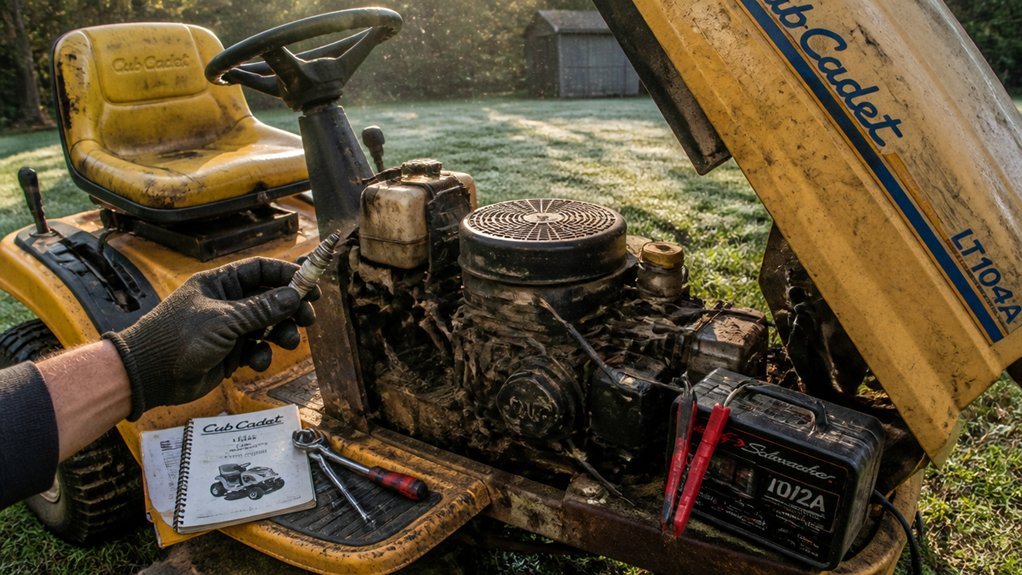
Your Cub Cadet riding mower sits silent when you turn the key, and you need to isolate whether you’re facing a fuel delivery failure, an ignition system fault, or a safety interlock preventing starter engagement. The diagnostic path depends entirely on what you observe: does the engine crank without firing, or does nothing happen at all? Each symptom points to a distinct subsystem requiring specific troubleshooting steps.
Cranks But Won’t Fire? Check Fuel and Air First
Why won’t your Cub Cadet fire even though it’s cranking? You’ve got compression, so eliminate fuel, air, and ignition variables systematically.
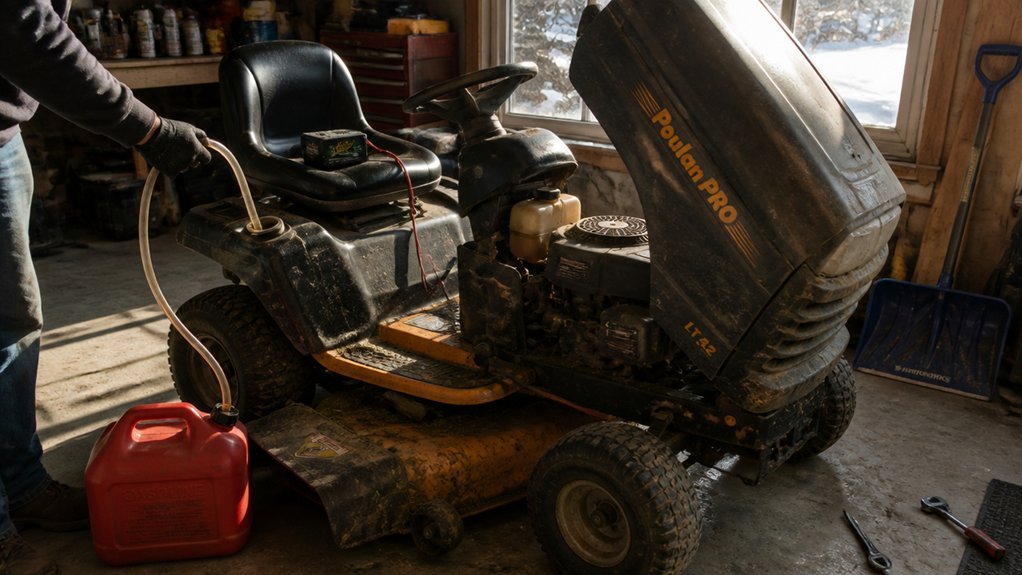
First, drain old fuel and refill with fresh gasoline; stale fuel degrades combustibility and clogs delivery. Verify adequate fuel level in the tank. Next, remove and inspect your air filter—if it’s oil-soaked or debris-loaded, replace it; restricted airflow enriches the mixture beyond ignition limits. Then pull the spark plug and examine its electrode: carbon fouling, wet-fuel saturation, or porcelain cracks indicate failure. Gap or replace the plug to restore reliable spark.
If your mower sat through off-season storage, you’ll likely resolve this through a targeted fuel system refresh and ignition tune-up. Persisting failure after these corrections signals deeper servicing requirements.
No Click or Weak Crank? Battery and Ignition Fixes

When your Cub Cadet won’t crank at all or turns over sluggishly, you’re dealing with a power delivery or starter circuit fault—not a fuel or ignition problem.
First, test your battery voltage; a reading below 12.4 volts indicates a discharged or failing battery requiring recharge or replacement. Clean corroded terminals and tighten connections, as resistance here causes voltage drop and weak crank. Verify your ignition switch energizes the solenoid circuit properly. Test the starter solenoid—if you hear a click but no crank, the solenoid or starter motor has failed. Bypass the solenoid briefly to isolate starter failure.
For newer batteries that weaken, verify alternator output to ensure charging system integrity. Replace faulty components systematically until full starter current flows.
Safety Switches and Interlocks Blocking Your Start

Where exactly does your electrical path break down when you’ve ruled out battery and starter faults? You must trace the safety interlocks guarding your Cub Cadet’s start circuit.
Your seat switch forms a critical link in this chain. When seated, you complete the circuit; rise, and it opens. Test this switch with a multimeter—continuity should appear only when depressed. Faulty contacts here stop cranking instantly.
Next, examine your PTO switch. Even when disengaged, internal contact failures or corroded terminals break the electrical path. You can’t bypass these interlocks permanently, but you can isolate them: disconnect each switch and bridge terminals temporarily to identify the culprit. Replace malfunctioning switches and repair damaged wiring. Verify brake engagement as well—multiple interlocks demand simultaneous satisfaction before your starter receives power.
Recommended Products

Universal Compatibility: Replacement seat switch designed to fit multiple brands including John Deere AM104403, AYP 121305X, MTD 925-3166, Scag 48717, Troy Bilt 1761083, Toro 740275, Murray 405015X92, and other popular lawn mower models
PTO and Brake Problems That Stop Startup
You’ve isolated the seat switch and cleared the basic interlock check, but your Cub Cadet still won’t turn over. Shift focus to the PTO and brake circuits—critical interlocks that block ignition when incomplete.
Inspect the PTO switch and clutch. A faulty PTO prevents the engine from disengaging safety interlocks, halting startup. Verify the PTO engages smoothly; a dirty or misrouted deck belt can slip, triggering the safety system to detect an anomaly.
Check brake engagement next. A worn or stretched brake cable prevents the parking brake from securing fully, causing false interlock signals that stop ignition. Ensure the brake lever holds firmly.
If the engine starts then stalls, confirm the PTO disengages post-startup and inspect for loose connections falsely triggering safety switches.
Recommended Products

Thislawn mower safety interlock switch 925-3164A is compatible with Craftsman and Husqvarna 153664 176138 925-3164A 22182 22886


Why 20 Amp? Most PTO Switches are rated at 5A/10A for circuits with a 20A or 30A Fuse. This means the 5A PTO switch is damaged or fails before the fuse blows.
When to Call a Cub Cadet Dealer for Service
Why wrestle with intermittent faults or repeated no-starts when a trained technician can isolate the root cause? If basic checks don’t restore starting, you’ll visit an authorized Cub Cadet dealer for formal diagnostics and service. Use their dealer locator to find your nearest service center and schedule maintenance.
Your Cub Cadet dealer performs OEM parts replacements—spark plugs, air filters, belts, and fuel system components. They’ll address safety interlocks, PTO/clutch issues, and internal engine or electrical problems under warranty. For persistent or intermittent problems, you’ll rely on trained technicians to run diagnostics and provide a maintenance plan tailored to your specific model. Don’t gamble with component failures; trained service eliminates guesswork and prevents cascading system damage.
Conclusion
You’ve diagnosed fuel, air, and spark systems; verified battery voltage and ignition components; and tested safety interlocks. When these procedures don’t resolve the failure, internal engine damage or complex electrical faults may exist. You’ll need specialized diagnostic equipment and factory technical specifications. Discontinue further disassembly and contact an authorized Cub Cadet service center.