
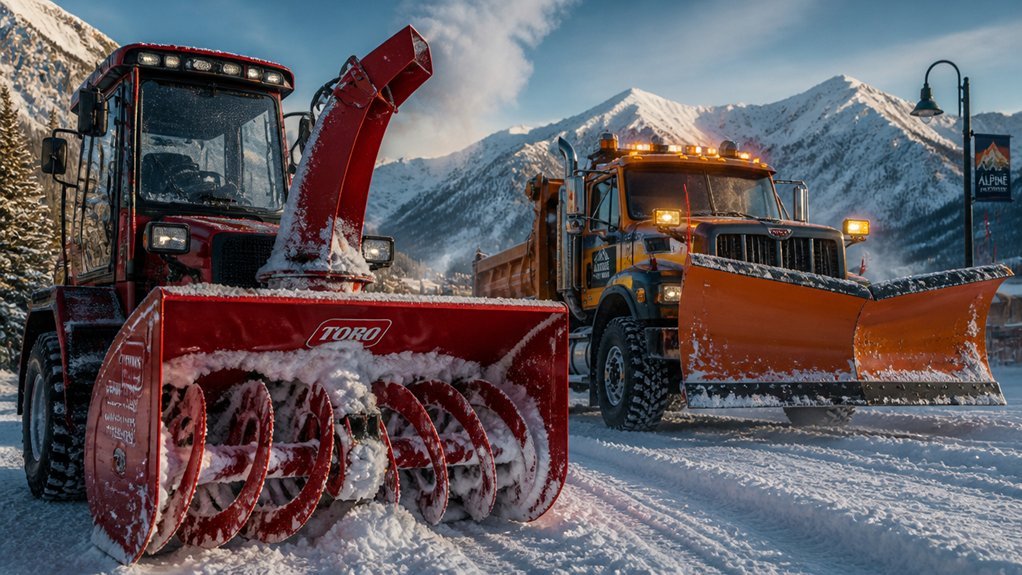
You’re weighing a snow blower against a snow plow, and the difference comes down to mechanism and output. One augers and propels snow clear of your path; the other pushes it, banking where you may not want it. Your snow type, surface area, and precision needs will dictate which machine earns its keep.
Snow Blower vs Snow Plow: How They Clear Snow Differently
How do snow blowers and snow plows fundamentally diverge in their approach to snow removal? You’ll observe a Snow blower employs a two-stage auger system: it collects and lifts snow, then propels it through a directional chute to throw snow distances exceeding fifty feet.
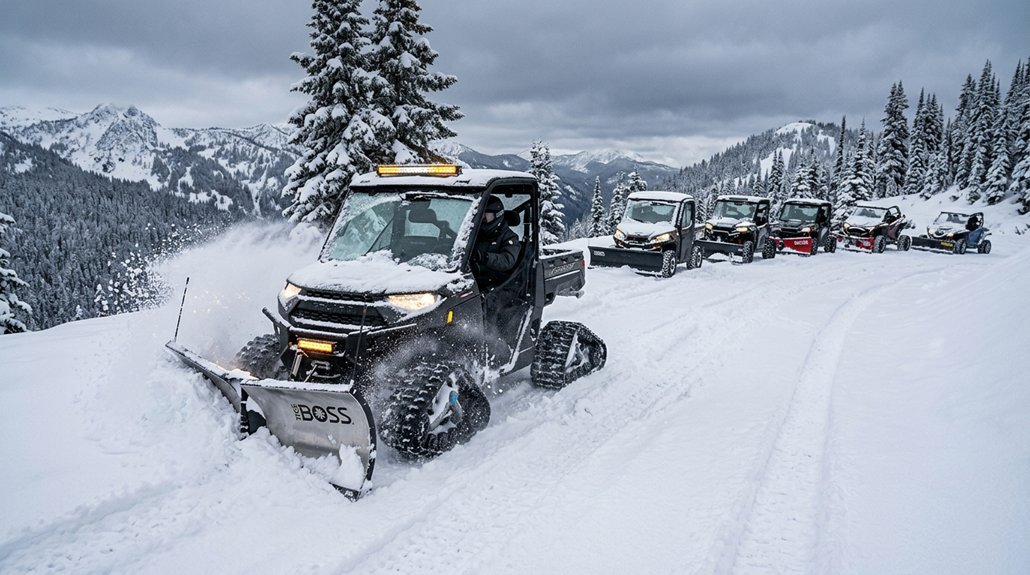
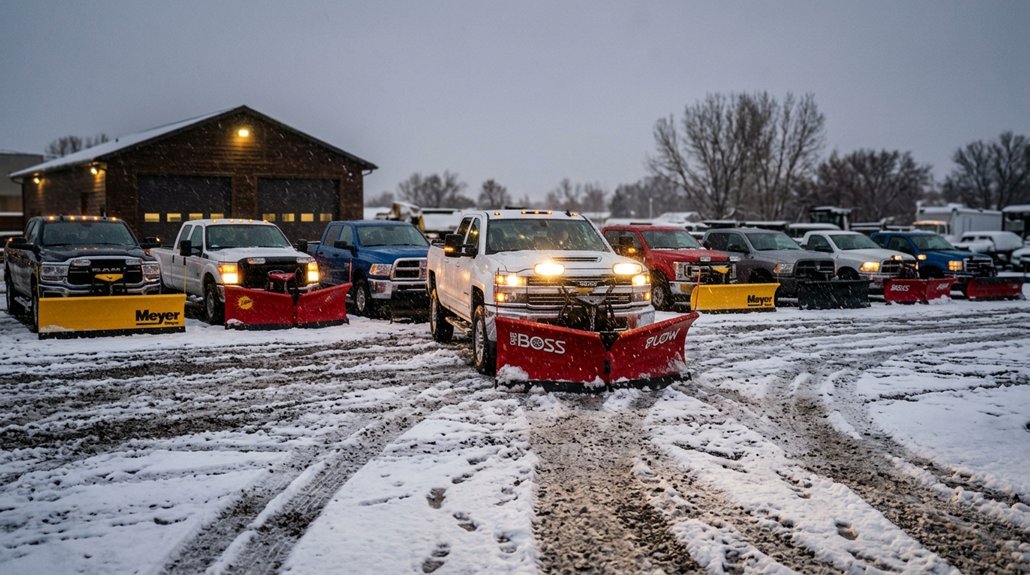
A Snow plow, by contrast, simply pushes snow aside or forward in a single, uninterrupted pass. You’re clearing snow with fundamentally different mechanics—displacement versus projection.
When tackling deep snow on paved driveways, you’ll find blowers deliver precise, targeted removal, while plows expedite coverage across expansive surfaces. Your efficiency hinges on this core distinction: blowers reduce ice buildup through meltwater management, whereas plows generate substantial banks.
You’re balancing capital intensity and maintenance against speed and terrain versatility.
Recommended Products

PREMIUM GARAGE & TOOL COVER: Fits most two-stage snow throwers with taller chutes

Universal 1/4" HD 3-Blade Impeller Kit, for Snow Blower - Modifies 2-Stage Machine

Universal 3/8" HD 3-Blade Snow Blower Impeller Kit, for Snow Blower - Modifies 2-Stage Machine
Choose by Snow Type, Depth, and Storm Frequency

Where exactly does your snow-clearing strategy break down? You analyze snow type, depth, and storm frequency to find out.
You match light, dry accumulation with a plow for rapid, wide-area clearing. You select a snow blower when wet snow or deep snow demands auger-driven lifting and directional throwing. You gauge storm frequency: repeated moderate events let a plow cycle quickly, while frequent heavy storms justify a snow blower’s thorough extraction. You recognize that packed drifts and slushy meltwater overwhelm most plows; here, a snow blower’s mechanical advantage dominates. Conversely, you deploy a plow efficiently wet snow scenarios if storms remain infrequent and depths stay moderate. You balance these variables—storm frequency against depth, snow type against available time—to optimize your investment and maintain clear passage through winter’s demands.
Recommended Products

IDEAL FOR ANY AREA: Our WSnow22 electric snow thrower has a rubber-tipped steel auger that’s perfect for safe, easy and quick snow removal from driveways, sidewalks, walkways, porches and decks
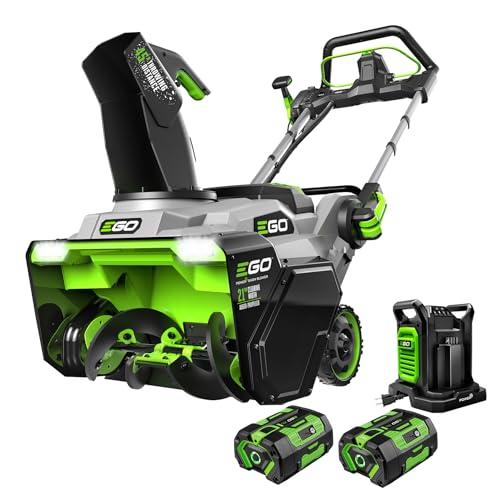
Peak Power technology combines the power of any two EGO POWER+ 56V ARC Lithium batteries
Match Your Attachment to Driveway Size and Terrain
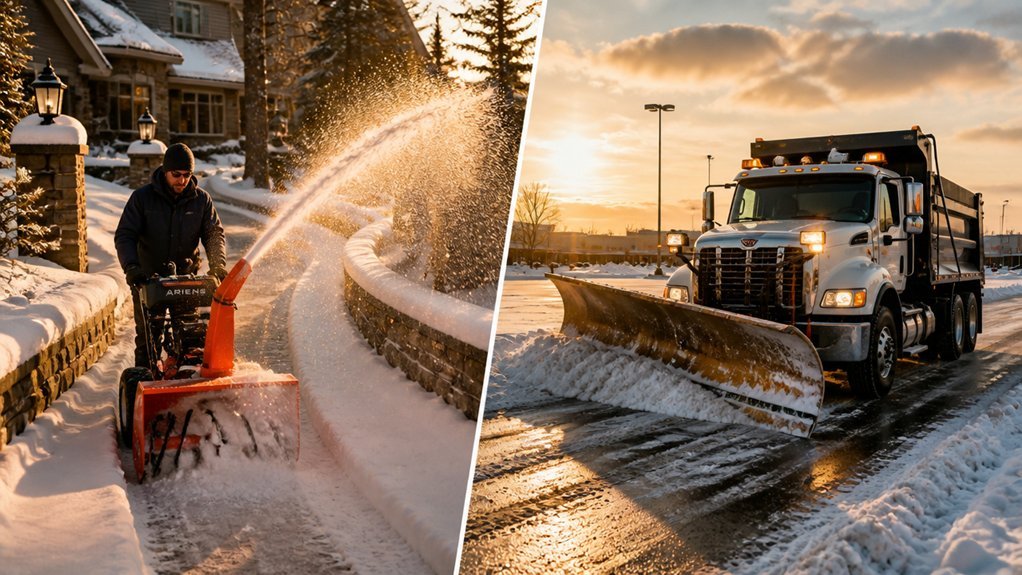
Once you’ve aligned your equipment with snow characteristics, you turn to your property’s physical constraints. Your driveway size and terrain dictate which attachment delivers optimal performance. For wide driveways, you’ll find a snow plow clears expansive areas rapidly in single passes, maximizing efficiency across open layouts.
Narrow or curved terrain requires different mechanics; here, a snow blower attachment excels by lifting and projecting snow beyond obstacles rather than relocating it sideways.
Surface composition matters equally. On gravel or slopes, you’ll adjust a snow blower’s skid shoes to minimize ground contact, preventing surface damage. While plows manage paved paths adequately, they struggle against compacted snow banks that resist displacement.
Deep drifts demand a blower’s auger mechanism to fracture and eject material. Tight corners and limited turning radius favor blowers for precise maneuvering, whereas flat, unobstructed expanses suit plows for speed.
Recommended Products
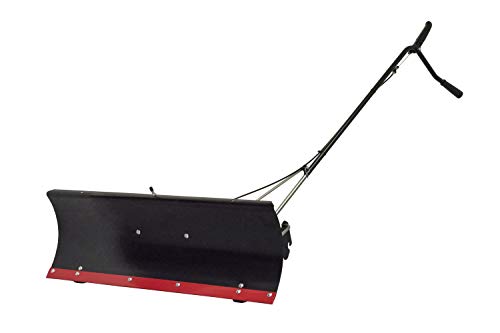
EFFICIENT SNOW REMOVAL PERFORMANCE: 42 in wide blade and 14 in blade height help clear sidewalks, driveways, and pathways during snowfalls up to 8 in deep
Speed or Clean Sweep: Pick Your Clearing Priority
Why prioritize speed when residual ice guarantees tomorrow’s headache? You face a direct trade-off when choosing between snow blowers and snow plows for your clearing needs.
Snow blowers deliver clean, bare-pavement results by throwing snow 50+ feet away, and you’ll find they handle deep snow, heavy accumulations, and wet conditions more effectively—minimizing compacted layers that become hazardous ice. They demand more passes on wide driveways but reward you with precision in tight spaces.
Conversely, snow plows maximize speed across large, open areas. You’ll cover long or wide driveways faster, though plows create sizeable banks and struggle with deep snow or drifts.
Ultimately, you choose: prioritize thorough, technical clearing with blowers, or prioritize rapid coverage with plows where surface perfection matters less.
Recommended Products

GALVANIZED STEEL BLADE: A solid steel construction provides lasting durability and strength, the perfect tool to help overcome the harsh winter months and manage heavy snowfall

THE ORIGINAL - THE SNOWPLOW "THE ORIGINAL SNOW PUSHER" is the only shovel on the market using virgin UHMW (Ultra High Molecular Weight) Polyethylene. This material is the highest wearing, impact resistant, cold weather adaptable material available.
Compare Snow Blower and Snow Plow Costs
How drastically do upfront investments diverge between these two clearing systems? You’ll find snow blowers command higher upfront cost due to augers, impellers, chutes, and hydraulic systems. Plows bypass these complexities, reducing initial expenditure.
You’ll also notice maintenance costs favor plows—they contain fewer moving parts and lack secondary engines or PTO requirements. Blowers demand dedicated power sources, amplifying recurring costs through wear-prone augers, bearings, shear bolts, and chute repairs. Plows primarily need blade edge replacements.
Your operating efficiency calculations must incorporate environment: blowers prove cost-effective in heavy snowfall and wind belts where deep accumulation demands mechanical throwing capability. Plows dominate banana belts with lighter, frequent events. Weigh these factors against your regional conditions to optimize long-term expenditure without over-engineering your solution.
Recommended Products

Part Number: 490-241-0010, 780-125, 784-50388-0637, 731-06472

CONTENT: With 2 Slide Shoes and bolts with washers & nylon lock nuts.You don't need to go to the hardware store to buy other installation hardware

Snowblower Composite Skid Shoes: Reversible 2-pack kit designed for homeowners to control scraper bar clearance, protecting driveways and sensitive walkway surfaces from deep gouges and rust streaks
Which Is Right for Your Property: Blower or Plow?
Beyond cost differentials, your particular property profile ultimately governs whether a blower or plow delivers superior value. Assess your area size first: you’ll cover large expanses faster with a snow plow, but you’ll maneuver a snow blower more efficiently in confined zones demanding precise throwing snow placement.
Evaluate snow depth and composition. You’ll tackle deep, wet accumulations and drifts effectively with a snow blower’s auger-impeller system, whereas you’ll struggle when pushed snow exceeds a plow’s practical limit.
Examine surface type carefully. You’ll clear paved drives cleanly with either unit, but you’ll risk ingesting gravel into a blower on unpaved terrain—here, a plow suits you better.
Finally, consider your tolerance for residual piles: you’ll relocate snow entirely via throwing snow, while you’ll create growing banks with pushed snow that eventually restrict passage.
Recommended Products

Universal 1/4" HD 3-Blade Snow Blower Impeller Kit, for Snow Blower - Modifies 2-Stage Machine

Universal 3/8" HD 4-Blade Impeller Kit, for Snow Blower - Modifies 2-Stage Machine

Product includs:3-Rubber Paddle , 3-Metal Straps , 9-Bolts & Lock Nuts , 3-Self-tapping Screws;Detailed in the product pictures
Conclusion
Your optimal snow-clearing solution hinges on precise operational requirements. You’ll select blowers when confronting deep, heavy accumulations, narrow geometries, or demand projection control exceeding 50 feet. You’ll deploy plows for maximizing throughput across expansive, unobstructed surfaces where rapid turnover outweighs residue precision. Analyze your storm frequency, surface composition, and capital constraints—each variable shifts the efficiency frontier. Neither attachment universally dominates; your specific topographic and meteorological conditions determine the technically superior implementation.
Recommended Products

THROWS SNOW UP TO 45 FEET – Peak Power technology combines the power of any two EGO ARC Lithium batteries to clear heavy, wet snow and throws it up to 45 feet away without the noise, mess, or fumes of a gas snow blower

Product includs:3-Rubber Paddle , 3-Metal Straps , 9-Bolts & Lock Nuts , 3-Self-tapping Screws;Premium 304 stainless steel reinforcement plate & hardware

【EFFICIENT SNOW CLEARING】Tackle winter's worst with the SENIX 2X2 40V 21" Brushless Snow Thrower Clear snow effortlessly with an impressive throwing distance of up to 33 ft and a wide 21-inch clearing path. This electric snow blower delivers powerful performance, removing up to 680 lbs of snow per minute for fast and efficient cleanup.