
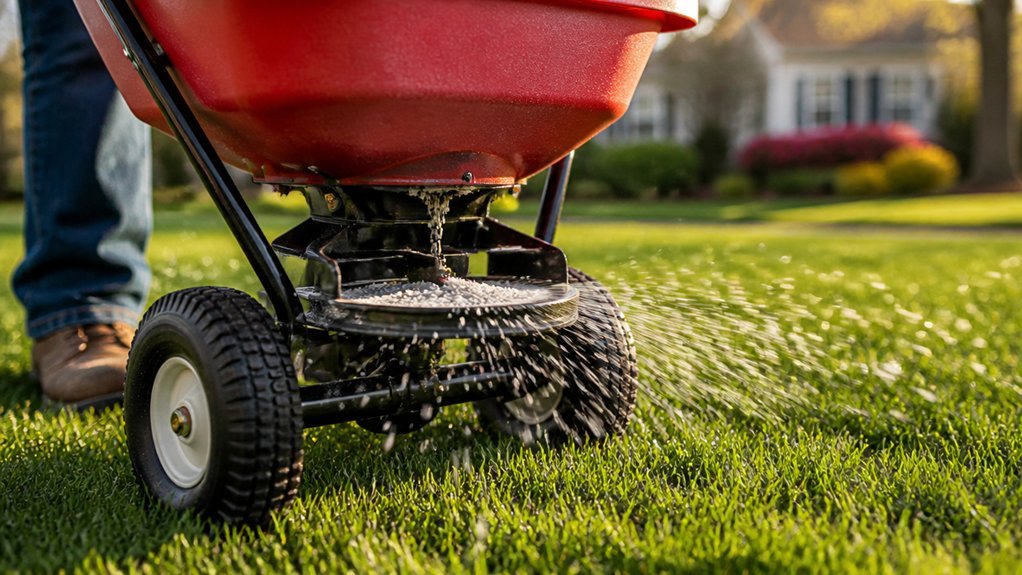
You’ve got a broadcast spreader and a lawn to treat, but you’re not sure where to start—and getting it wrong means burned grass or wasted product. The label holds critical numbers you’ll need, yet most people skip straight to cranking the dial and walking. Before you take that first step, you’ll need to understand why calibration matters more than guesswork, and what happens when your walking speed throws everything off.
Prepping Your Broadcast Spreader: Surface, Settings, and Safety
Before you begin any application, where should you look for critical guidance? You’ll find it on the product label, which specifies spreader settings and safety precautions. Review the back of the product bag for special instructions before handling any material.
You’ll set the spreader’s dial to the labeled flow rate, then fill the hopper with your selected product. Keep the spreader level on a semi-rough surface to ensure consistent distribution. Start with a conservative setting—you’re adjusting upward only after confirming label guidance matches your lawn area.
For application, you’ll execute a perimeter treatment first, then fill the interior with back-and-backward overlap passes to eliminate skipped strips. Should spills occur, you’ll sweep them immediately and return unused material to the bag, preventing waste and protecting turf from concentrated contact.
Recommended Products

NO ASSEMBLY REQUIRED: Scotts spreader comes pre-calibrated and ready-to-use; use it year-round including as an ice melt spreader or salt spreader for snow

OPERATION: Adjustable arm support on this seed, salt and fertilizer spreader helps provide maximum comfort

Calibrating Flow Rate for Your Specific Product
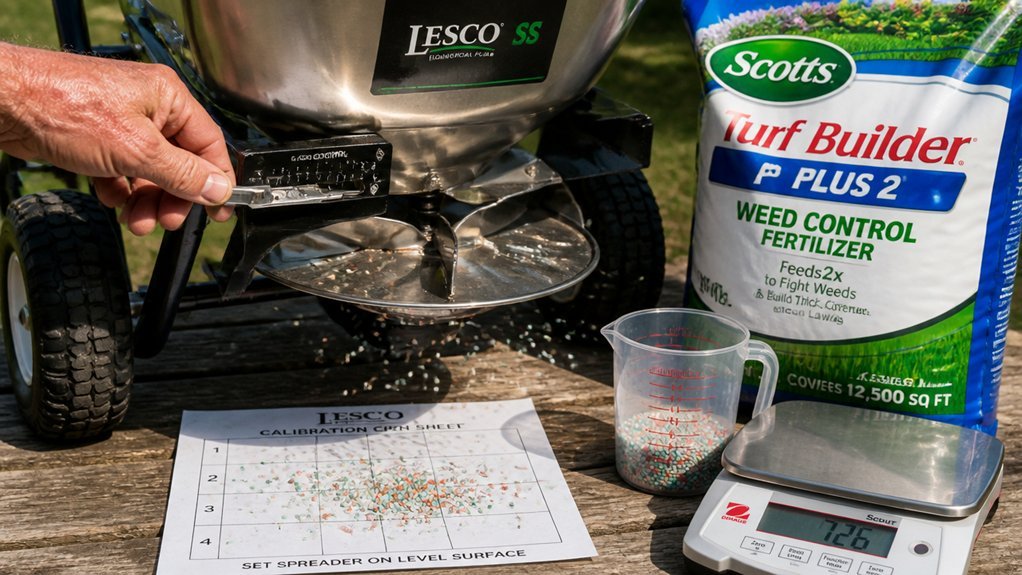
How precisely should you align your spreader’s output with your product’s specifications? You’ll achieve this through careful calibration of flow rate against your product label’s recommended spread rate measured per thousand square feet.
Begin with your spreader settings completely off. Next, set the flow rate to the exact number specified on your product label—such as 3 ½ or your manufacturer’s equivalent. If no precise setting appears, consult your owner’s manual to derive an approximate value based on the spreader’s gauge.
You’ll then execute a test pattern across a flat, unobstructed surface. This reveals your actual throw width and distribution density without compromising target areas. After observing results, you’ll adjust the flow rate incrementally, repeating the test pattern until your application density matches the product label’s prescribed rate per thousand square feet.
Recommended Products

High-capacity hopper: Extra large, rust- and dent-proof poly hopper holds 125 lb. (2. 5 cu. Ft.) of seed, fertilizer, Ice melt and more to maximize the time spent spreading vs. Refilling the hopper. Ideal size for yards 1/2 acres or larger.

45-0614 has now replaced 45-0462

Flow Plate is an Agri-Fab Replacement Part that is for 45-03153-997, 45-03154-997, 45-0388, 45-03883, 45-03883-KD, 45-03884-KD, 45-05301, 45-05301-131, 45-05301-669, 45-05302, 45-05302-131, 45-05302-669, 45-05303, 45-05304, 45-05304-131, 45-05304-669, 45-05311, 45-05312, 45-05313, 45-05314-AMZ, CMX-GZ-BF-71-24322, CMXGZBF7124322
Test Your Pattern: The Driveway Calibration Check
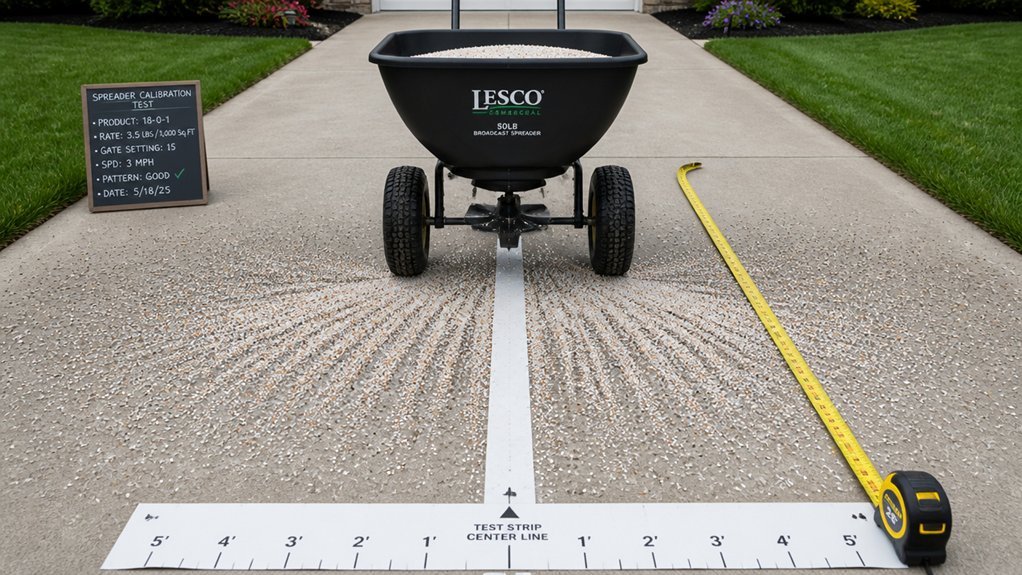
Where exactly does your broadcast spreader distribute product? You’ll determine this through a driveway calibration pattern test before treating your lawn.
Select a flat, clear test area on a smooth, windless driveway that mimics your lawn conditions. Set your hopper setting to the manufacturer’s recommended spread rate, then dispense product across the test area. Observe the throw width and particle density carefully. If the pattern’s too sparse, you’re not achieving even coverage—gradually increase the hopper opening until the distribution satisfies specifications.
Sweep all test material from the driveway and return it to the hopper; you’ll prevent waste and eliminate misapplication risk. This driveway calibration ensures your broadcast spreader’s pattern translates accurately to actual application, establishing reliable even coverage when you move onto turf. Verify, adjust, then proceed with confidence.
Recommended Products

Precise Compatibility: Designed as a direct replacement for Lesco N2320 and 030317, this impeller is fully compatible with Lesco 101186, 091186, 705699 high-wheel spreaders, and 092807 push spreaders for a hassle-free fit.

EASY TO USE: Strap into the comfort backpack-type harness, set the rate, and start spreading between 8-12 ft wide. 40 LB Hopper capacity – rustproof poly construction.
Super-duty gearbox with enclosed gears for longer-lasting wear
Walking Technique: Speed, Direction, and Overlap
What distinguishes professional-grade application from amateur results? You’ll control three variables: speed, direction, and overlap.
Maintain a steady walking pace of approximately 3 mph. At this speed, you’ll achieve consistent throw width and product density; deviations create uneven distribution. Begin by treating the perimeter first—this establishes boundaries and prevents product waste beyond lawn edges. Then execute back-and-forth passes in the opposite direction, sweeping inward.
Overlap each pass by roughly one-quarter to one-third of the throw width. This overlap ensures each zone receives product from multiple trajectories, eliminating gaps and stripes. You’ll secure uniform coverage without concentrated bands or missed strips.
When turning or stopping, close the flow lever and advance one additional step. This technique prevents excess discharge that would disrupt your uniform coverage pattern.
Recommended Products
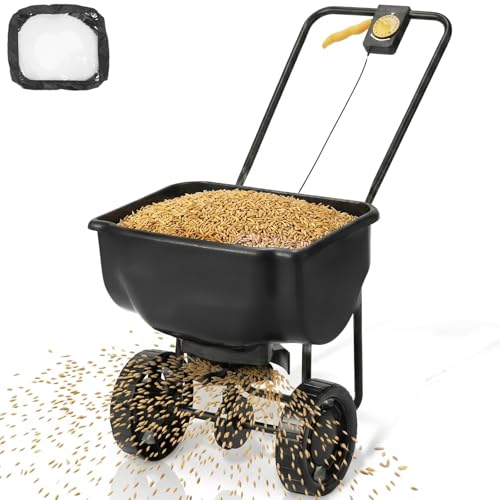
【Large Capacity & All-Season Use】This fertilizer spreader with a 70-Pound (70LBS) large-capacity hopper supports long-term continuous operation—no need for frequent refilling, saving your time and effort, suitable for sowing grass seeds in spring, fertilizing in summer, and snow melting and deicing in winter. It is a multi-purpose machine, perfectly adapted to the daily maintenance of home lawns and small farms.

64-OUNCE BOTTLE: high-capacity poly bottle with a wide opening and easy screw top, quickly remove the lid to add your preferred seed, salt, fertilizer, etc. and simply screw back into place
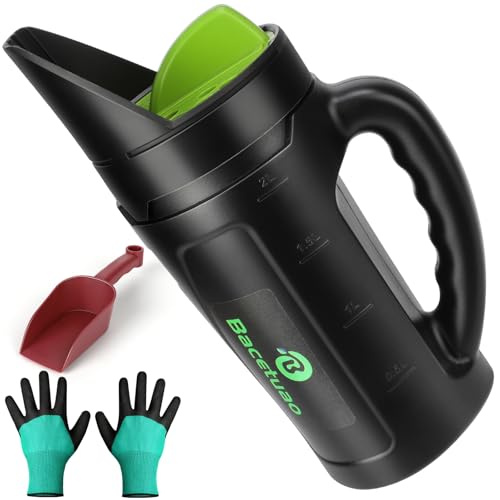
【Multi-Purpose Use】 Perfect for spreading seeds, fertilizer, salt, and ice melt. Ideal for lawn care, gardening, and winter driveway maintenance.
Coverage Strategies for Slopes, Wind, and Obstacles
Walking a flat lawn trains your fundamentals, but real-world conditions demand adapted technique.
Begin with perimeter treatment to establish controlled boundaries, then execute back-and-forth passes with calculated overlaps on slopes and uneven terrain.
On inclines, traverse horizontally first to minimize particle drift and maintain approximately 3 mph for consistent throw width. You’ll adjust for wind direction by planning passes so the bloom travels toward treated areas, never onto untreated zones or sensitive plantings. Close the flow lever before turning/stop transitions to eliminate excess discharge.
When encountering obstacles like trees or posts, drop the flow rate to zero while passing, resuming full application after clearing. Test your pattern on flat ground first, verify settings against product labels, and promptly sweep spills to prevent concentrated deposits on slopes or wind-affected sites.
Cleanup, Storage, and Spreader Maintenance
How should you finish the job once the last pass is complete?
Begin cleanup by sweeping up spills and returning spilled material to the hopper to minimize waste and prevent grass burn. Empty remaining product back into its original bag and seal it in a dry location. Next, proceed with washing the spreader thoroughly with water, then dry it completely to prevent cross-contamination and protect from rust. Open the flow rate to air out residual moisture and prevent unintended discharge during storage. For ongoing performance, integrate maintenance into your routine: inspect all moving parts, verify calibration accuracy, and address wear before it escalates. Proper storage demands a dry location away from corrosive elements. You’ll extend equipment lifespan and ensure consistent application rates through disciplined post-operation protocols.
Recommended Products

150lb Capacity & Versatility: This tow behind spreader offers a 150lb capacity, ideal for seed spreaders for lawns, lawn spreader, and compost spreader tasks. Perfect for homeowners and commercial lawn care, it also serves as a reliable broadcast spreader.

SPREADS EVENLY & EASILY - Our hand crank lawn spreader provides a convenient way to evenly distribute grass seed, fertilizer, lawn controls, and ice melt in small areas.

Tackle rough, uneven patches of lawn with ease! The 13 inch high flotation pneumatic stud tires with rustproof poly rims will glide right over your lawn making your application quick and easy.
When to Consider a Drop Spreader Instead
Where exactly should you deploy a drop spreader instead of its broadcast counterpart? When to consider this switch depends on your lawn care scenario. You’ll choose a drop spreader when you’re managing small lawns or navigating beds, sidewalks, and patios. Your coverage becomes precise and controlled, with material dropping straight down the hopper’s width, so you’ll eliminate overspray onto non-target areas.
Your broadcast spreader can’t match this accuracy in tight spots. Wind won’t disrupt your application technique, and you’ll maneuver obstacles with less hassle. However, your adjustments must account for smaller coverage per pass—expect more passes and longer completion times on expansive lawns. You’ll set the flow rate to the product label’s specification and fill over clean, easy-to-clean surfaces to prevent spills.
Recommended Products

Precision Flow Control:Features 5 adjustable discharge ports and a unique trapezoidal hopper design for consistent, even distribution. Easily regulate the flow lever to achieve 12 ft (3.7 m) spreading width, ensuring maximum lawn coverage while minimizing refill trips.

LARGE HOPPER CAPACITY: 130 lb hopper covers up to 1/2 acre or 25,000 sq ft with fewer refills, making this pull-behind spreader ideal for larger lawn projects

ALL-SEASON 2-IN-1:Versatile broadcast spreader for spreading seed, fertilizer and salt. Spreads rock salt to melt ice, or grass seed to grow a lawn. All-terrain design keeps your property looking great all year round.
Conclusion
You’ve calibrated your spreader, tested your pattern, and refined your walking technique. You’re now equipped to apply product with precision across varied terrain. Maintain your equipment regularly, store it dry, and recalibrate when switching products. Your consistency ensures uniform coverage, minimizes waste, and protects environmental health. When conditions demand it, evaluate whether a drop spreader better serves your application’s accuracy requirements.