
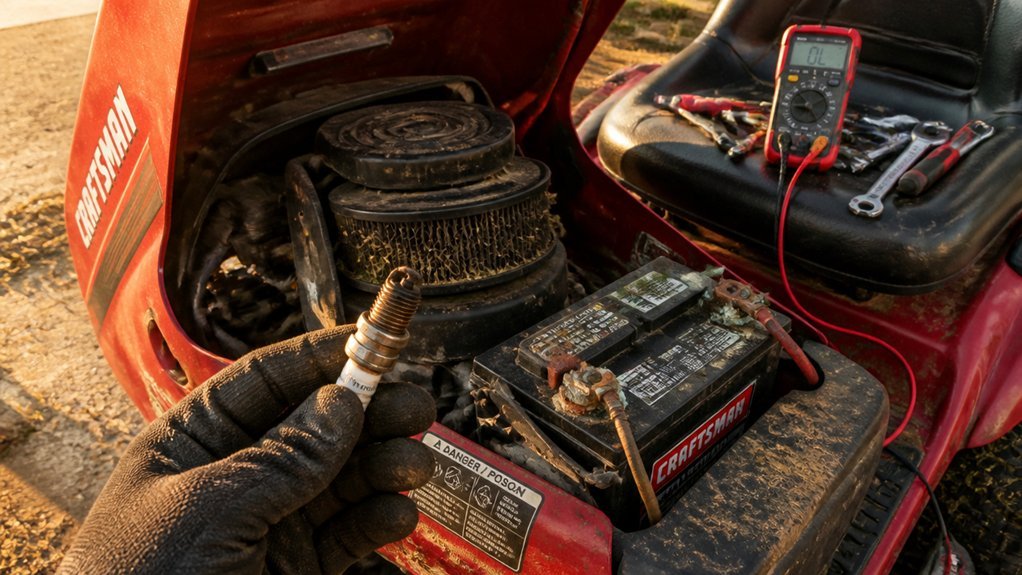
You’ve turned the key and your Craftsman riding mower sits dead, or maybe it’s clicking, cranking without firing, or dying just after you start moving. Each symptom points to a specific failure in the electrical, fuel, or ignition systems. You’ll need to move methodically through voltage tests, connection inspections, and component checks to isolate the culprit. The fix might be as simple as a loose terminal—or something requiring deeper troubleshooting.
Craftsman Mower Won’t Start? Match Your Symptoms to the Fix
Why won’t your Craftsman riding mower fire up? You’ll need to isolate whether you’re facing an electrical or mechanical failure.
If you hear a click but the engine won’t crank, grab your multimeter and test the starter solenoid. Verify power reaches the red terminal with the ignition switch in the start position. A weak battery or corroded cables can trigger solenoid activation without cranking. When power’s present at the solenoid input yet engagement fails, you’ve likely got a blown fuse, failing solenoid, or faulty interlock switches.
Jump across the solenoid terminals to confirm the engine turns over. If it does, your problem’s electrical—trace the fuse and interlock switches. If the engine fires briefly with starter fluid then dies, you’ve eliminated electrical causes; shift your focus to fuel delivery issues like carburetor blockages or vent problems.
Recommended Products

【Starter Solenoid】12V Starter relay solenoid for John Deere, Cub Cadet, MTD, Troy-Bilt Trombetta riding lawn mower tractor. Replace part number: 725-04439 725-04439B GY22476 AUC15346 AM138068 862-1211-211-16.
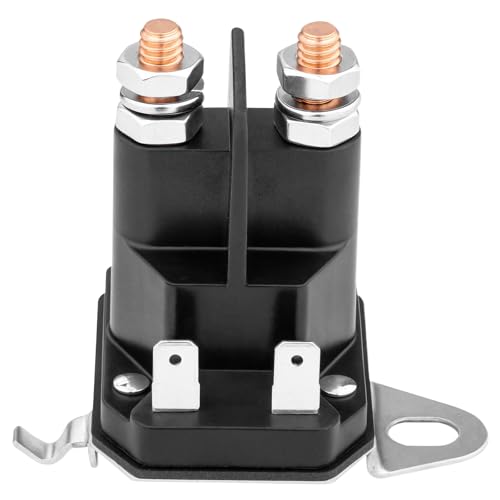
Compatible Models: 12V Starter solenoid relay compatible with Husqvarna Craftsman Poulan AYP 192507 532192507 582042802 582042801 Trombetta 862-1241-211-12 Ariens 21546294 435-325 Snapper 705055 riding lawn mower tractor. It is suitable for riding mowers powered by Kohler, Briggs and Stratton, and Tecu-mseh engines. Compatible with Husqvarna yth1842 yth22v46. Compatible with Craftsman LT, YT, & YS series, such as LT2000 YS4500 YT3000 lawn mower parts.
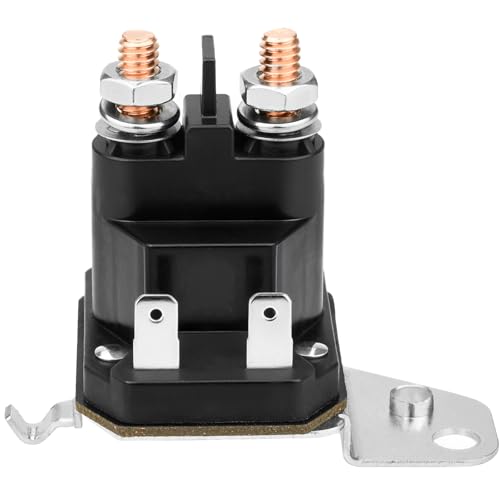
Compatible Models: 12V starter relay solenoid compatible with Cub Cadet XT1 XT2 Enduro RZT LT1 ZT1 ZT2 MTD Troy Bilt Yard Man Husky Yard Machines Craftsman Zero Turn riding lawn mower tractor. Compatible with Cub Cadet MTD Troy Bilt 725-06153A 725-06153 762-1261-211-50 762-1261-211-51.
Completely Silent or Weak Click? Battery and Connection Tests

When you turn the key and hear nothing—or just a faint, single click—your battery and connections are the prime suspects. Perform a voltage test across the battery terminals; you’ll need at least 12 volts. Anything less signals a weak battery requiring recharge or replacement.
Inspect your connections closely. Corroded or loose battery cables create voltage drop and prevent proper current flow. Clean all terminals and retighten clamps securely.
Attempt a jump-start to isolate the fault. If the engine cranks, your battery or charging system is failing. You’ll then verify power at the starter solenoid’s red post with the key in the start position. No click there indicates a faulty starter solenoid or broken coil circuit requiring further diagnosis.
Recommended Products

Easy To Identity - Amplifier rating is clearly indicated in white, allowing you to easily read the amp rating, and their transparent housing ensures easy inspection.

Package includes 80pcs 20A standard fuse. *** Please check the fuse size before order ***

Product Details - Size: Standard, Current rating: 20A, Voltage:32V(12V/24V), Pack of 25 pcs
Loud Click But No Crank? Solenoid and 20-Amp Fuse Checks
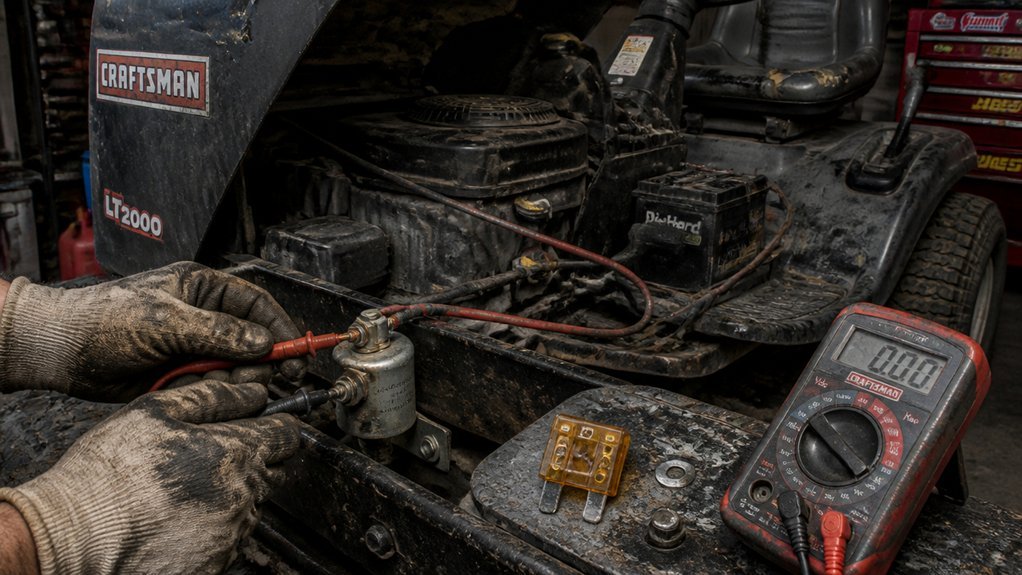
A loud click from your Craftsman riding mower but no engine crank points directly to the starter solenoid or its supporting circuit. You hear the loud click because the solenoid attempts engagement but fails to transfer power to the starter motor.
First, inspect the 20-amp fuse near the solenoid. Remove it and check for a blown filament or corroded terminals. Replace it if suspect.
Next, verify battery terminals and solenoid connections are tight and corrosion-free. Test voltage at the solenoid input terminal; expect battery voltage. Then measure coil voltage while turning the key. Zero volts indicates a break in ignition/interlock wiring or faulty safety interlocks—brake, blade, or seat switches.
If coil voltage reads normal but no crank occurs, jump across the solenoid with insulated pliers. Successful starting confirms solenoid failure. Replace it.
Recommended Products

ML-U1-CCAHR is a 12V 320 Cold Cranking Amps (CCA) Sealed Lead Acid (SLA) Battery.

✅【Car Battery Tester】 BR502 can test all 6V/12V/24V 100-2000CCA batteries including regular flooded, AGM flat plate, AGM spiral, or gel batteries, compatible with cars, SUVs, Pickups, Boats, Motorcycles and etc. Provide overall analysis of batteries’ health and help you know its status in advance before it dies.

Catch Battery Problems Early: Featured in two videos by Project Farm, a popular YouTube channel with millions of subscribers, the ANCEL BA101 helps you quickly spot battery issues before they leave you stranded. It provides easy-to-understand readings for State of Health (SOH), State of Charge (SOC), voltage, current, CCA, plus cranking and charging system tests, so you can better understand your battery and help avoid unexpected breakdowns
Craftsman Mower Cranks But Won’t Fire? Test Fuel and Spark First
Your Craftsman mower’s starter motor engages and cranks the engine, but the engine won’t fire—now you’re troubleshooting ignition and fuel systems.
First, remove the spark plug and verify the cylinder isn’t seized. Spray starter fluid into the intake and crank. A brief fire indicates spark and compression are good; you’ve narrowed it to a fuel system problem—check for carburetor flooding, clogged jets, or restricted fuel flow.
If there’s no fire with starter fluid, test the ignition coil. Verify you’re receiving voltage at the coil; trace back through the ignition switch, safety interlocks, and solenoid circuit to confirm power delivery.
Restore operation with fresh gasoline, a cleaned or rebuilt carburetor, and clear fuel lines. Install a shut-off valve to prevent future flooding.
Recommended Products

【FITMENT】Compatible with Husqvarna YTA YTH series riding lawn mower 2042 LS, 2246 LS, 2346 XLS, GTH 2754 , LGT 2654, YTH 20 K 46, YTH 2042, GTH 2648, GTH 2654, YTH 2246, YTH 2348, YTH 2448, YTH 2454 Ride Mower

【FITMENT】 Compatible with Husqvarna YTH1542XP, YTH1848XP, YTH 2046, YTH 2148, YTH 2242, LTH1342, LTH1342A, LTH 2042, LTH 18542, LTH 1742, LT 18542, GTH 2554, YTH1542XPG, YTHP1542 Ride Mower
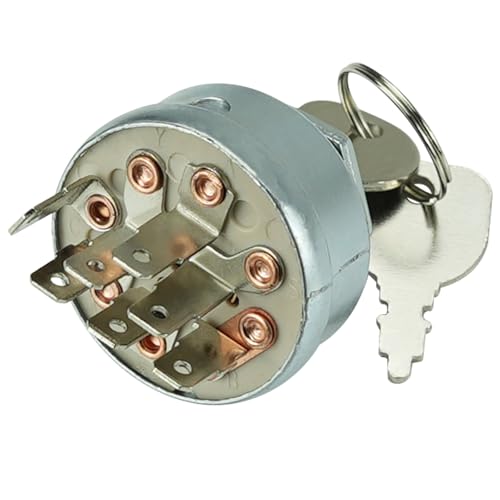
Replaces OEM Part Numbers: 532140301, 574455401, 725-1717, 925-1717, 140301,092556, 092556MA, 5412H, 5412K, BS54124
Starts Then Dies After 10 Feet? Cap, Vent, and Carburetor Fixes
Why does your Craftsman mower fire up, run briefly, then sputter and die after cutting just a few feet? You’ve got a fuel delivery problem, not spark.
Check the vented cap first. Remove it, reseal, and restart. If it runs again, replace that cap—it’s creating vacuum lock.
Next, inspect fuel flow: drain old fuel and replace with fresh gasoline treated with fuel stabilization. Stale gas causes quick stalls.
Pull the carburetor and examine the float valve and needle valve. Sticking components flood the engine, mimicking ignition failure. After restarting, reseat ignition wires firmly. Finally, verify consistent carburetor airflow. Intermittent restrictions here can duplicate fuel symptoms. Address venting, fuel quality, and carburetor function systematically—you’ll isolate the culprit fast.
Recommended Products

Thislawn mower safety interlock switch 925-3164A is compatible with Craftsman and Husqvarna 153664 176138 925-3164A 22182 22886

Part Number: GY20094 532197802 99-7408 725-05113 K3011-62211 094136MA 094136MA 721249 430-550

Conclusion
You’ll isolate your Craftsman mower’s failure by systematically testing systems. Start at the battery—clean terminals, check voltage, verify grounds. Move to the solenoid when you hear clicks without cranking. Test for spark and fuel delivery when the starter engages but the engine won’t fire. Address caps, vents, and carburetor float valves if stalling occurs shortly after starting. Document your findings, replace defective components, and retest before returning the machine to service.
Recommended Products

【117-1197 Starter Solenoid】12V 4-Terminal starter solenoid Compatible with Toro TimeCutter Exmark Zero Turn lawn mower. Replace Part # 117-1197 784-1221-210 104-3189 E513075 1-513075 212655 28-4210 47-1910.

532192507 Starter Solenoid replaces part #: Husqvrana Solenoid Part Number: 582042802, 192507, 5321925-07, 532192507, 582042801. Check Shape: 4-terminal design (2 top studs + 2 bottom spades). Different bracket/terminal = wrong purchase.
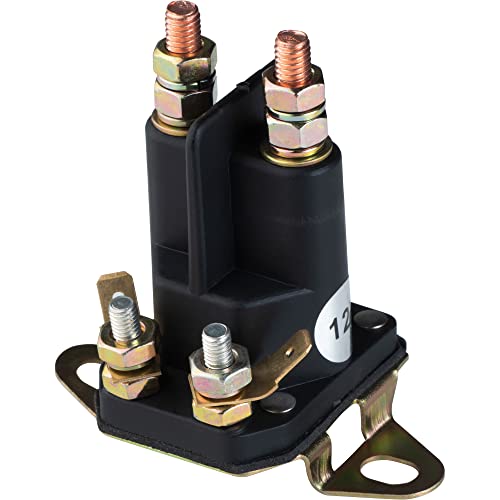
WIDE COMPATIBILITY: Husqvarna 532 10 90-81, 532 10 99-46, 532 14 61-54, 532 14 56-73; Craftsman 145673, 146154, 175141, 178861, 168327; Poulan 532145673, 145673, 146154; Gravely 044766, 045071; Simplicity 1685290, 1685291, 1686981, 1700751; Toro 110167, 28-4210, 47-1910; Troy Bilt 1752137, 1752137P, 1753539; Woods 03551000; Castle Garden 1873610010; Countax 4481480100