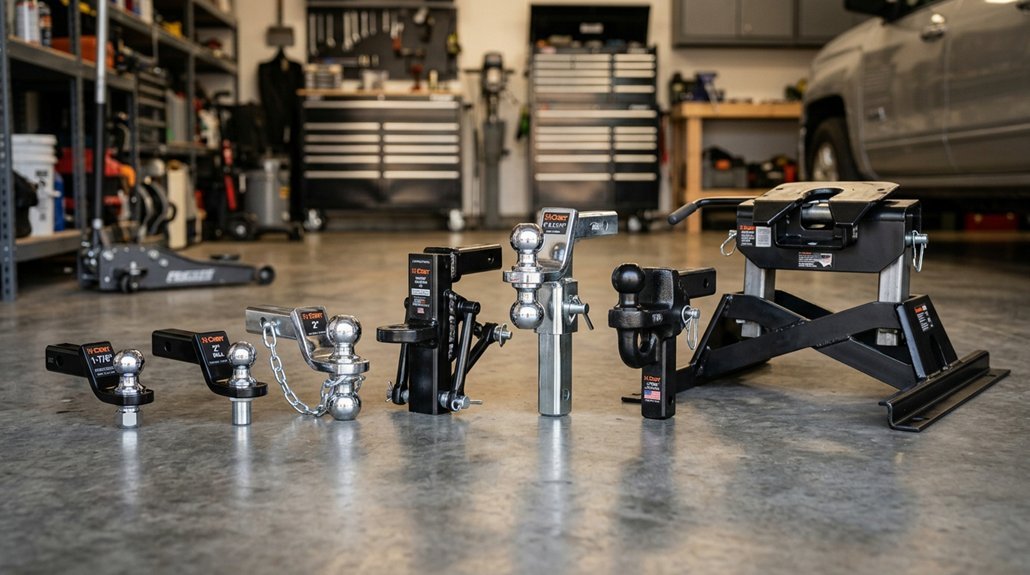


You need a half-ton truck that can actually handle your trailer, but that max tow rating on the window sticker isn’t the number you should trust. Your real limit shrinks fast once you load passengers, gear, and calculate tongue weight. Before you hitch up, you’ll need to run the math on payload and GCWR—because getting it wrong costs more than you think.
How Much Can a Half-Ton Truck Tow in 2025?
Exactly how much can you tow with a 2025 half-ton truck? You’ll find tow capacity ranges from 5,000 to 14,000 pounds, depending on your configuration.
The 2024 Ford F-150 shows this spread clearly, maxing at 14,000 lb with weight distribution hitches, lower without them. Popular 2025 options include the Ford F-150, Ram 1500, Chevrolet Silverado 1500, and GMC Sierra 1500, each offering different capabilities.
Your engine choice, drivetrain, and cab/bed configuration directly impact your numbers. Optional towing packages raise your GCWR and trailer limits significantly.
Remember: tongue weight consumes payload. At roughly 10% of trailer weight, it subtracts from your available payload and must stay within GVWR and GCWR boundaries to maintain safe handling.
Recommended Products

Allows for easy leveraging of weight distribution hookup brackets

WEIGHT DISTRIBUTION: Hardened steel chains connect the hitch arms to your trailer frame for improved load distribution. The result is improved steering, braking control, and helping to reduce stressful towing situations.

LEVEL TOWING — Distributes trailer tongue weight across the tow vehicle and trailer to help level the load, improve control and smooth the ride; includes sway control kit #17200 to help reduce trailer sway.
Why Your Real Tow Limit Is Lower Than the Sticker
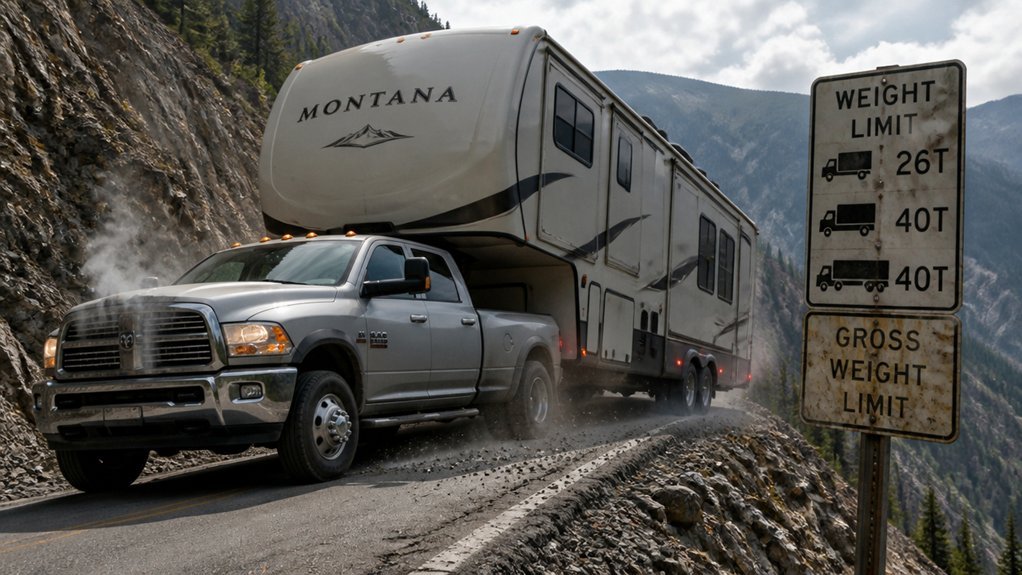
Why does your truck struggle with a trailer well below its rated capacity? Your sticker tow rating reflects ideal conditions—empty cab, base configuration, flat terrain. Real-world towing rarely matches this scenario.
Your payload includes passengers, gear, and tongue weight. Since tongue weight typically demands 10–15% of your loaded trailer’s mass, you’re consuming payload before you’ve added cargo or occupants. Your GVWR caps how much your truck itself can weigh, while GCWR governs the combined mass of truck and trailer. Exceed either, and you’re overloaded even if your trailer sits below the manufacturer’s tow rating.
Specialized packages may advertise impressive figures, but your practical limit drops when payload fills and balance shifts. A weight distribution hitch helps stability, yet doesn’t override these hard constraints. Your real ceiling depends on these interacting limits, not the sticker alone.
Recommended Products

[2-IN-1 SMART WEIGHING SYSTEM] – Combines a durable trailer tongue jack with a high-precision integrated digital scale. Monitor tongue weight in real time up to 1800lbs/816.5 kg (±25 lbs/±11.3 kg ) to maintain proper load balance and help reduce trailer sway for safer towing.

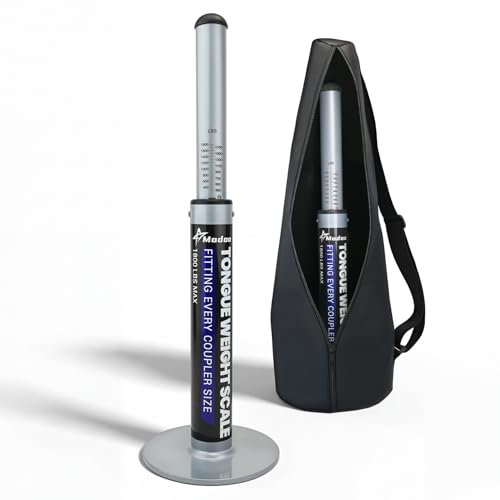
【Upgraded Large Base Trailer Tongue Weight Scale】Our tongue weight scale for RV features an upgraded 6.2-inch large base for extra stability. It effectively prevents the tongue weight scale from tipping, wobbling, or sinking into mud during use, ensuring a safer and more reliable experience
Payload First: Calculate Your Actual Capacity
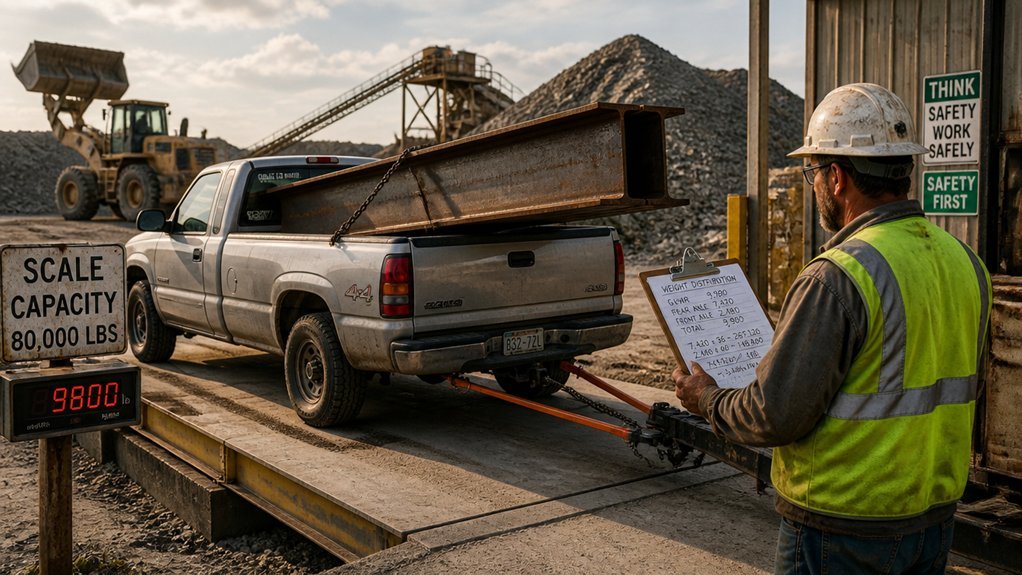
Those ideal-condition sticker ratings don’t match what you’re working with once you’re loaded for the road. You need to calculate your actual payload capacity before trusting that towing capacity figure.
Take a Ram 1500: its 10,000-pound towing capacity sounds impressive, but with roughly 1,300 pounds of payload, you’re working with limited reserves. Add a 1,000-pound tongue weight—about ten percent of a loaded trailer’s weight—and you’ve burned through most of your budget. That leaves perhaps 300 pounds for passengers and gear.
Heavier trailers demand more tongue weight, which devours more payload. You can’t escape this math: every pound pressing on the hitch subtracts from what you can carry inside the truck.
Always verify that your combined tongue weight, passengers, and cargo stay within your GVWR and the lowest-rated component’s payload limits.
Recommended Products

【Wide Application】: fit for 2-inch x 2-inch receiver tube openings with 5/8-inch hitch pin hole, and is compatible with any CURT weight distribution hitch.

Provides an adjustable mount for any CURT weight distribution hitch

Allows for easier installation of TruTrack spring bars
GCWR Explained With Half-Ton Examples
What determines whether your half-ton can actually handle that loaded trailer? The answer lies in your GCWR, or Gross Combined Weight Rating—the maximum allowable total weight of your loaded truck plus your fully loaded trailer.
Your half-ton’s GCWR typically ranges from about 9,400 lb to 19,500 lb depending on engine, axle ratio, and configuration. You can’t simply match trailer GVWR to your tow rating alone. Your trailer’s tongue weight—usually 10% of loaded trailer weight—directly consumes your payload capacity. That means a 7,000-lb trailer adds roughly 700 lb to your axle before you’ve loaded passengers or cargo.
A weight distribution hitch helps you approach your GCWR more safely by redistributing that tongue weight and stabilizing your rig. Always verify that your combined GVWR, trailer GVWR, tongue weight, and GCWR stay within manufacturer limits.
Recommended Products

【Professional-Grade Accuracy & Durability】Engineered for professionals and meticulous owners, this scale combines an industrial Q235 steel structure with a military-grade spring mechanism for lab-like precision up to 1800 lbs. Its finish undergoes a rigorous 300-hour salt spray test, offering exceptional corrosion and abrasion resistance for use in marinas, construction sites, farms, or frequent highway travel.

ZEROLOCK True-Zero Accuracy: Recalibrate the trailer tongue scale back to true zero with the integrated adjustment screw, restoring factory accuracy and preventing the drift found in other scales

Evenly Distributes Weight: Evenly distributes your trailer’s tongue weight over a large, sturdy base
Weight-Distribution Hitch: When Is It Required?
How much difference can a single piece of equipment make when you’re pushing your half-ton’s limits? A weight-distribution hitch substantially alters your capabilities by enabling front-axle weight transfer, restoring steering response and braking efficiency.
Without one, you’re typically restricted to roughly 5,000 lb on an F-150; with proper weight distribution, that towing capacity climbs to 14,000 lb. The mechanism distributes tongue weight across both axles of your truck and trailer, reducing rear sag and enhancing stability.
However, you’ll still need to verify that your GVWR/GCWR isn’t exceeded, and the trailer tongue weight must remain within manufacturer specifications.
Install a weight-distribution hitch when you’re nearing rated limits, but always follow OEM guidelines—it isn’t universally required, and improper application won’t override your truck’s hard ratings.
Recommended Products

Best-In-Class Sway Control Design: Camco’s Eaz-Lift ReCurve R3 Weight Distribution Hitches keep your RV towing setup safe and level, giving you superior control and a smoother, more stable driving experience.

Weight Distribution Hitch with bolt-together ball mount/shank assembly and sway control
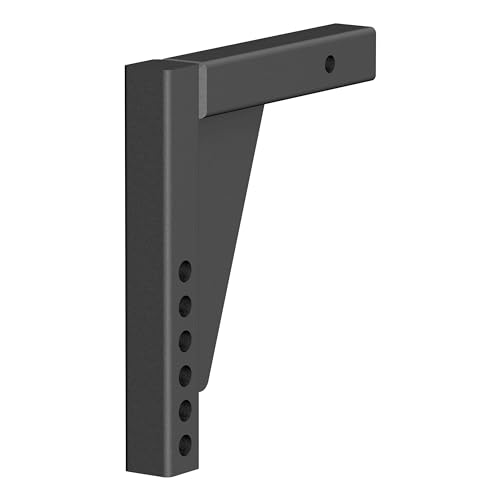
Provides an adjustable mount for any CURT weight distribution hitch
Top Half-Ton Trucks by Maximum Tow Rating
Why limit yourself to guessing when manufacturers publish hard numbers? You’ll find the 2024 Ford F-150 leads half-ton trucks with maximum towing capacity reaching 13,500 pounds. The Chevrolet Silverado 1500 follows closely at 13,400 pounds, offering turbocharged diesel Duramax options alongside its TurboMax variants. You’ll get nearly identical capability from the GMC Sierra 1500 at 13,300 pounds, sharing platforms but differing in trim hierarchy. Toyota’s Tundra delivers 12,000 pounds with robust safety tech. Remember, these figures assume proper GVWR compliance and specific configurations. The Ram 1500 Tradesman provides more modest 7,760-pound towing for lighter demands. Always verify your exact build’s rating, as axle ratios, cab styles, and drivetrains markedly alter real-world capability.
Recommended Products

1800 lbs Heavy-Duty Capacity, built with strong carbon steel to handle your toughest loads with reliability

1800 lbs Heavy-Duty Capacity, built with strong carbon steel to handle your toughest loads with reliability
Engine and Axle Combos for 10,000-Plus Pounds
If you’re pushing past 10,000 pounds, you’ll need to match your engine and axle combo deliberately, since raw horsepower won’t compensate for a mismatched drivetrain. You’ll want a V8 or turbocharged engine delivering ample torque at low RPMs, paired with reinforced axles and upgraded cooling systems.
The F-150 reaches about 14,000 pounds with proper weight distribution, while the Silverado 1500 hits 13,400 pounds through high-output configurations.
You’ll maximize your Gross Combined Weight Rating by selecting packages that strengthen your trailer hitch and suspension. Remember that your payload includes passengers, cargo, and tongue weight—verify you’re not exceeding individual component limits.
Your towing capacity depends on this complete integration, not just engine specs.
Recommended Products
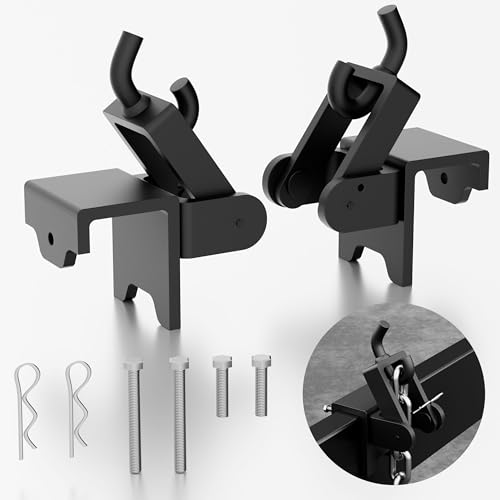
Stronger, Safer Towing: This replacement weight distribution hitch hookup bracket provides a stronger and more stable connection for the spring bars of your weight...
Tongue Weight Math: Stay Under 15 Percent
Matching your engine and axle combo gets you the raw capacity, but you’ll squander it fast if you ignore how that weight actually sits on your hitch. You must calculate tongue weight as a percentage of your total trailer weight, typically 10–15%. For an 8,000 lb trailer, you’re looking at 800–960 lb of tongue weight—load that counts directly against your payload.
Take a RAM 1500 with 10,000 lb towing capacity and 1,300 lb payload. That payload must cover passengers, gear, and tongue weight. At 13%, your 1,000–1,300 lb tongue weight fits, but you’re cutting it close. Exceed the 15 percent rule and you’ll compromise steering response, braking stability, and hitch durability. Always verify your actual tongue weight stays within your payload limit—not just your towing capacity.
Configure Your Half Ton for Safe Towing
How do you bridge the gap between raw towing capacity and real-world stability? You start by understanding that equipment choices directly determine safe performance limits.
Install a weight distribution hitch. On an F-150, this single upgrade can raise your capacity from roughly 5,000 lb to 14,000 lb by redistributing tongue load across the truck’s frame and axles. Remember: tongue weight consumes payload, so calculate carefully—10% of loaded trailer weight comes straight from your available cabin and bed capacity.
Verify your GCWR. Add your truck’s GVWR, trailer GVWR, and tongue weight; the total mustn’t exceed this combined rating. For demanding loads, select a towing package with integrated brake controllers and trailer sway control. These systems automatically apply selective braking to counter lateral movement, maintaining stability when conditions deteriorate.
Conclusion
Your half-ton truck’s advertised tow rating sets the ceiling, but you’re actually limited by payload capacity, passenger weight, and gear. Calculate your available payload first, then verify GCWR and aim for 10–15% tongue weight. Match engine, axle ratio, and towing package to your real needs. You’ll tow safer and avoid warranty headaches when you respect these numbers.