
You’ve probably heard that trailer tires don’t need balancing, but that assumption could cost you. Unbalanced tires generate harmful vibrations, accelerate bearing wear, and reduce fuel efficiency—especially at highway speeds. The real question isn’t whether to balance, but which method suits your setup and how you’ll spot trouble before it escalates.
Why Trailer Tire Balancing Matters (Even When Shops Say It Doesn’t)
Why do some shops insist trailer tires don’t need balancing when the physics clearly disagree? You understand that an unbalanced assembly generates centrifugal forces, creating uneven wear and parasitic drag. You must recognize that weight distribution flaws compound at highway speeds, forcing your suspension to compensate cyclically.
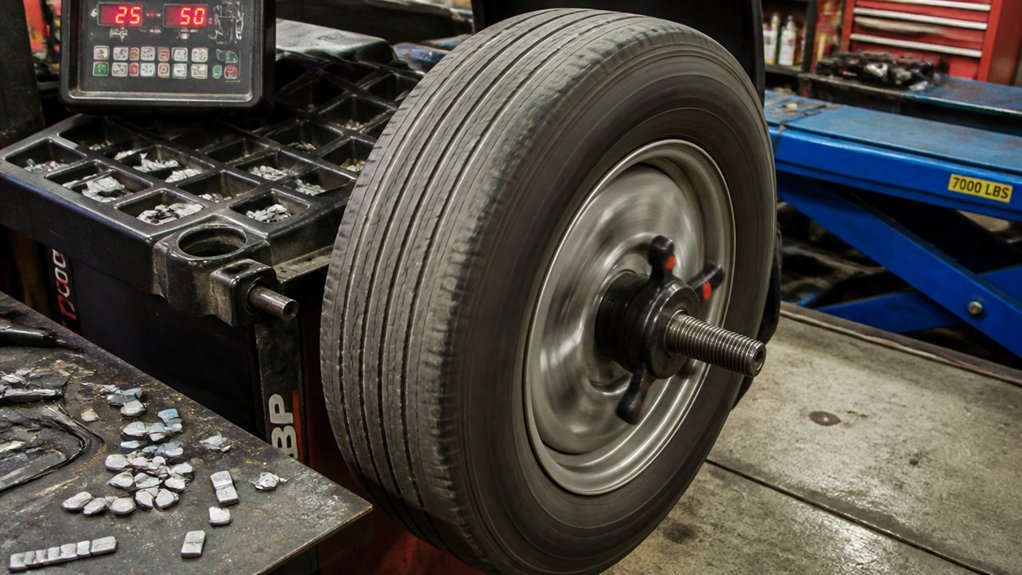
You achieve a balanced tire-wheel assembly by countering heavy spots with precisely placed weights. You reduce rolling resistance, preserve fuel economy, and protect wheel bearings from premature fatigue. You notice improved tow stability immediately, particularly with heavy, tall-profile tires or dual-axle configurations where oscillations amplify.
You schedule professional balancing during mounting, rotation, or replacement—you don’t rely on DIY guesswork. You integrate this into annual maintenance, ensuring sustained performance. When you keep your trailer tires balanced, you’re actively preventing vibration-induced damage and maintaining predictable handling characteristics mile after mile.
Recommended Products

EXTENDED TIRE LIFE: Prolong tire durability with our adaptive beads that adjust to changing driving conditions, reducing wear and extending tire life for motorcycles, semi-trucks, and trailer tires.

VERSATILE APPLICATION: Suitable for buses, motorcycles, off-road vehicles, ATVs, and light/medium truck tires for improved balance and performance

EXTENDED TIRE LIFESPAN: Increase tire life significantly with cores and caps. Our ceramic balancing beads provide precise internal balance, perfect for enhancing the durability of semi and medium-duty truck tires.
What Happens When Trailer Tires Go Unbalanced?
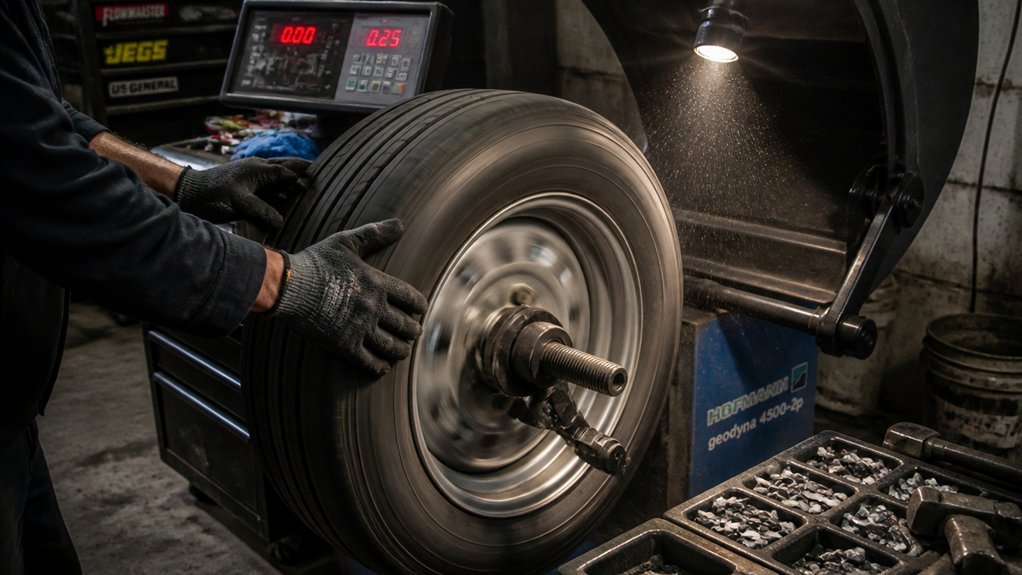
Where does the damage begin when you tow unbalanced trailer tires? You’ll notice vibrations and wobbling first, especially as you increase speed. These oscillations transmit directly through the axle assembly, stressing wheel bearings and suspension components beyond their design tolerances.
You’ll observe uneven tire wear patterns developing rapidly across the tread face. Manufacturing variances, wear differences between duals, and mounting imperfections create these imbalances that you can’t correct without professional intervention. Your fuel economy drops measurably because unbalanced trailer tires increase rolling resistance, forcing the tow vehicle to work harder.
At highway speeds, you’ll hear rattling and detect resonant noise through the hitch. You’re compromising safety and component longevity simultaneously. When you mount, rotate, or replace tires, you must balance them immediately. Skip this step, and you’re accelerating bearing failure and tire degradation unnecessarily.
Recommended Products

Desgined for true TRAILER use only, good for highway use, not cheap one-time use mobile home tires
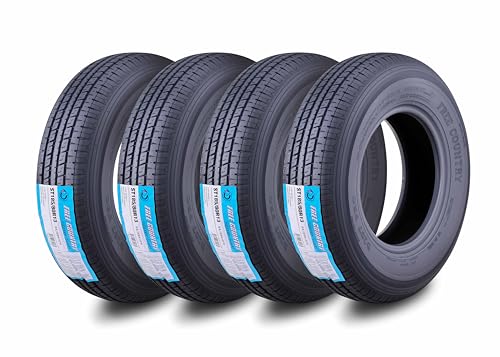
Set of 4 Premium Quality FREE COUNTRY ST185/80R13 Radial Tires,

Premium Free Country Heavy Duty 10 PR, load Range E, 2400LBS capacity!
Which Tires and Trailers Need Balancing Most
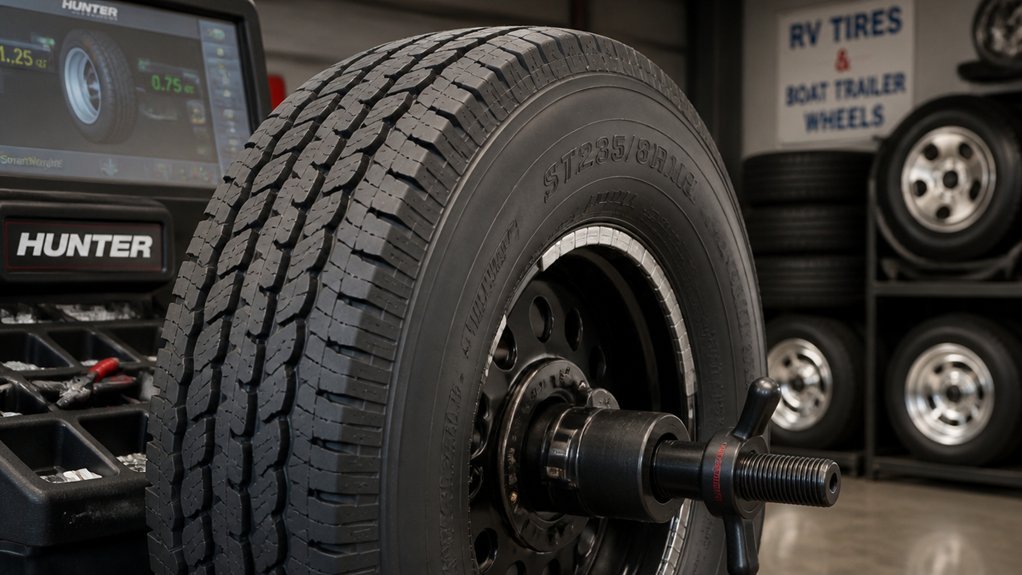
How severely imbalance affects your setup depends on tire size, construction, and how you’re using the trailer. Heavier assemblies—14-ply tires, 31-inch tall configurations, and substantial alloy rims—amplify vibration forces and bearing stress. You’ll notice this most on high-speed, long-distance hauls where rotational forces compound.
You’ll need trailer tires balanced most urgently on equipment trailers, car haulers, and fifth-wheels running at highway speeds. These applications transmit imbalance directly into your tow vehicle’s handling and suspension.
Conversely, you can defer balancing on small utility trailers with sub-15-inch tires doing localized, low-speed work—though you still risk uneven wear over time.
Whenever you mount new rubber, rotate positions, or annually inspect your rig, you must have trailer tires balanced professionally. Precision equipment ensures correct weight placement, protecting your bearings, improving fuel economy, and maintaining stable towing dynamics.
Recommended Products

Product Overview: The Roundrule Xtra is a 225/75R15 124/121M G 14 Ply Rated Highway All Steel Tire Manufactured For Trailers
Product Overview: The Roundrule Xtra is a 235/85R16 132/127M G 14 Ply Rated Highway All Steel Tire Manufactured For Trailers

Product Overview: The Transeagle ST Radial is a 225/75R15 123/119L G 14 Ply Rated Highway All Steel Tire Manufactured For Trailers
How to Tell If Your Trailer Tires Need Balancing
Now that you know which setups demand balancing most, you’ll need to recognize when your specific tires actually require it. Inspect your tires for uneven wear patterns—cupping, scalloping, or feathered edges indicate poor trailer balance. You’ll feel vibrations through the steering wheel or tow vehicle chassis, particularly at highway speeds above 55 mph. Listen for rhythmic thumping or humming that increases with velocity. Heavier 14-ply tires amplify these symptoms due to greater rotating mass. Check for loose wheel hardware or damaged rims, as these compound imbalance effects. Schedule trailer balance maintenance when you mount new tires, rotate positions, or annually during routine service. Address symptoms immediately; prolonged operation degrades suspension components and bearing assemblies. Monitor tread depth differential across the axle pair—variations exceeding 2/32 inch suggest imbalance requiring correction.
Recommended Products

Use for Travel Trailers, Campers, Class A Moto Home, Fifth Wheel Trailers, Heavy Duty Trucks, Toy Hauler, etc

REDUCE SWAY THE EASY WAY: Lock the Maxchock x chocks wheel stabilizer between tandem tires on your camper or RV to keep your travel trailers stable, comfortable and secure

Ample Lift for Easy Tire Changing: Featuring an impressive 5 1/2" lift, this Trailer Aid tandem tire changing ramp provides extra clearance, making it ideal for routine maintenance tasks on trailers and RVs.
Balancing Methods Compared: Shop Weights vs. Beads vs. Liquid
Three primary approaches exist for correcting trailer tire imbalance, each employing distinct physics to achieve smooth rotation. You can select traditional external wheel weights, bead balancing with microbeads, or liquid balance additives.
External weights attach directly to the rim, offering precise, static correction but requiring accessible mounting surfaces. You’ll find bead balancing particularly useful when rim access proves difficult; microbeads distribute dynamically, continuously adjusting to tire rotation and wear patterns. Liquid additives function similarly, flowing to counterbalance heavy spots automatically.
Among trailer tires balancing methods, beads and liquid suit applications where conventional weights detach or corrode. Heavier, taller tires—such as 14-ply, 60-pound, 31-inch variants—demand these solutions due to amplified inertial effects. You must engage professional service with appropriate equipment, ensuring accurate measurement and simultaneous rim and valve inspection.
Recommended Products

【FUNCTION】Installing the trailer wheel bearings 3500 lb kit on your trailer axle,which can help reduce friction and make rotation smoother, protect the parts that support rotation and maintain the correct position of the rotation axis and provide excellent support for the spindle.

High-Quality Rubber Construction: Our 2 pack trailer bearing dust cap is crafted from premium rubber material, providing unmatched durability for your trailer bearing cap. This robust construction ensures that the trailer hub cap rubber plug stands up to tough conditions, effectively protecting your trailer bearings.
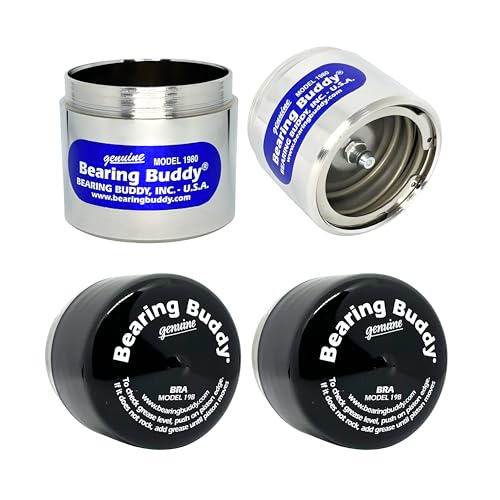
BE SAFE AND PROTECT YOUR INVESTMENT – If your trailers are used in saltwater environment or you have to drive a lot on highway, these buddy bearings for trailers are essential for protecting the bearings; Changing bearings is always a pain and these buddies are cheap but great insurance of your investment; No more taking the bearings out every year to pack
Conclusion
You should balance your trailer tires. Skip the shop’s dismissive advice—unbalanced assemblies generate destructive centrifugal forces at highway speeds, accelerating wear and bearing fatigue. Match your method to your application: clip-on weights for standard loads, internal beads or liquids for demanding or corrosion-sensitive environments. Inspect during every rotation and mounting. Your trailer’s handling, fuel economy, and tire lifespan depend on this precision. Don’t overlook it.
Recommended Products

Motorcycle Wheel Balancer for Static and Dynamic Balancing Designed for motorcycle wheel maintenance, this balancing stand supports both static and dynamic balancing to help identify wheel imbalance and achieve more accurate balancing results for motorcycle wheels

Trail-Ready Trainers: The Fresh Foam Arishi Trail running shoe delivers on both style and substance with versatile performance features designed to help you hit the trail with comfort and confidence

EXTENDED TIRE LIFE: Made In The USA these prolong tire durability with our adaptive beads that adjust to changing driving conditions, reducing wear and extending tire life for motorcycles, semi-trucks, and trailer tires.