

You want greener grass, but you’re probably guessing about fertilizer. Don’t. A soil test reveals exactly what your lawn lacks, and skipping this step wastes money while runoff pollutes waterways. You’ll match species to your climate zone, water precisely one inch weekly, and feed with compost—not synthetic nitrogen. The biological mechanisms behind these choices determine whether your turf thrives or merely survives, and understanding them changes everything about how you’ll maintain your yard.
Test Your Soil Before Buying Fertilizer
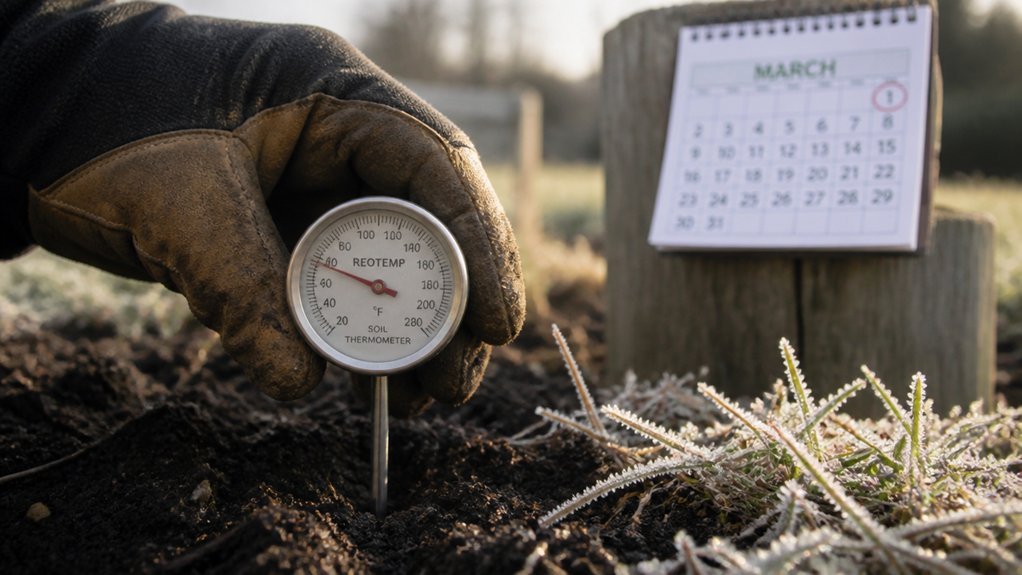
Why guess what your lawn needs when a soil test tells you exactly? A soil test measures nitrogen, phosphorus, and soil pH, revealing deficiencies that standard visual inspection can’t detect. You’ll identify whether your lawn lacks nutrients or maintains adequate levels, preventing unnecessary applications.
Test results enable precise nutrient management. You tailor nitrogen and micronutrient inputs to improve color and growth without over-fertilizing. The soil test also exposes pH imbalances—either acidic or alkaline conditions—that lock out nutrients despite their presence in soil. You’ll apply lime or sulfur only when data confirms the need.
Conduct this analysis before purchasing any product. Accurate fertilizer selection depends on knowing type, rate, and timing specific to your conditions. You eliminate guesswork, optimize inputs, and achieve greener turf through evidence-based decisions rather than routine assumptions.
Recommended Products

Quick, at home results for Soil pH, Nitrogen, Phosphorous and Potash Innovative and inexpensive soil test kit features an easy-to-use capsule system and patented color comparators

Complete 4-in-1 Soil Test Kit (pH, N, P, K) – This garden soil test kit measures soil pH, Nitrogen, Phosphorus, and Potassium, giving you a full picture of your soil condition to improve fertilization and plant growth.

4-In-1 Soil Test Kit For Comprehensive Gardening Insights: Test your soil for pH, Nitrogen, Phosphorus, and Potassium. These soil test provide the critical data you need to make informed gardening decisions.
Match Your Grass Species to Your Climate Zone

Where you live determines which grass species will actually thrive in your yard. Not all grasses tolerate every climate, so you’ll improve color, health, and resilience by selecting varieties matched to your local zone.
In Houston, you’ll find St. Augustine handles heat and maintains color year-round. In the American Northeast, you’ll choose cool-season grasses that thrive through mild summers and cold winters. If you select the wrong species, you’ll see poor color, dead spots, and heightened susceptibility to temperature stress.
Match species carefully to climate zone because this directly influences mowing frequency, water demands, and disease or pest pressure. You’ll make sure your lawn receives the nutrients it needs through appropriate fertilization schedules—typically applied multiple times per week during active growth phases. This precision drives overall lawn performance and sustained green coloration.
Recommended Products

Kindly NOTE: This soil tester can not be applied to test pH value of any other liquid. If the soil is too dry the indicator will not move, and water it before testing.

Quick, at home results for Soil pH

Quick, at home results for Soil pH, Nitrogen, Phosphrous and Potash
Water Deeply: The 1-Inch Weekly Rule
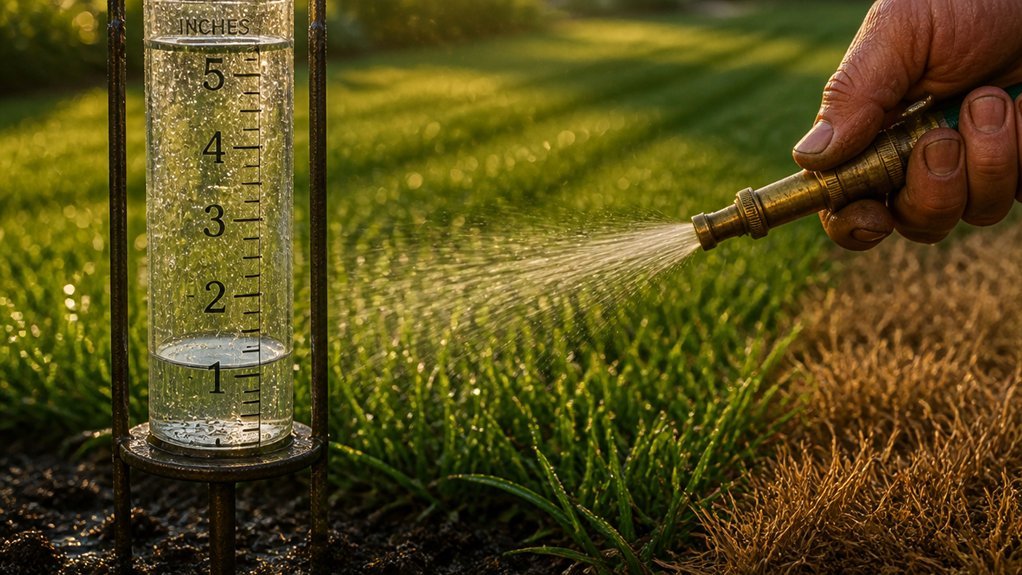
How much water does your lawn actually need? During dry months, you’ll provide approximately one inch of water weekly to promote deep root growth. You’ll place a straight-sided can within the watering zone to measure depth and verify even coverage across the entire area.
Deep watering penetrates the root zone, enhancing drought tolerance and structural resilience. You’ll water infrequently but thoroughly—overwatering compromises long-term efficiency and root health. If drought conditions persist, your lawn may enter dormancy and survive up to four weeks without irrigation. During this period, you’ll suspend fertilization and minimize foot traffic to prevent permanent damage. This measured approach builds robust root systems capable of sustaining your grass through seasonal stress without dependency on excessive moisture inputs.
Recommended Products

1️⃣ 30" Wide Coverage & 26 Gal Large Capacity for Efficient Spreading : This 30-inch peat moss spreader features a heavy-duty metal mesh basket with a 26 gallon (99L) large capacity, covering up to 375 sq. ft. per load. Compared with standard 24-inch compost spreaders, it speeds up lawn top dressing work, saving time and effort for both small backyards and large lawn care projects.

Material: High-quality steel structure and powder-coated surface, strong and durable. The surface is thermally sprayed to prevent rust and corrosion. Equipped with upgraded T-shaped rubber handle, non-slip, comfortable and ergonomic.

NATURAL INGREDIENTS: Wholly Cow Compost and Manure features natural peat and composted animal manure mixed together
Feed With Compost, Not Synthetic Fertilizer
Once you’ve established strong root systems through proper watering, you’ll build on that foundation by nourishing the soil itself. Apply a thin layer of weed-free compost across your lawn in spring and fall. This delivers nutrients directly to soil microorganisms that enhance nutrient availability for your grass.
Water gently immediately after application. This assists beneficial microbes and nutrients in migrating downward, simultaneously improving soil structure through organic matter integration.
You’ll observe improved moisture retention and enhanced drought resistance as organic matter increases. Your compost-rich soil develops robust microbial activity, producing measurably greener, healthier grass over successive growing seasons.
Mulch with composted material during maintenance. This returns nutrients to the soil profile and eliminates your dependence on synthetic fertilizer, creating a self-sustaining nutrient cycle.
Recommended Products

SUN AND SHADE GRASS SEED: This combination lawn seed, grass fertilizer, and soil improver thrives in a variety of conditions

INCLUDES TWO 3.75 LB CONTAINERS - Bundle includes two containers of lawn repair mulch and fertilizer, providing coverage for up to 170 sq ft of lawn repair areas.
The redesigned Scotts Turf Builder Grass Seed Bermudagrass is drought-tolerant to stand up to scorching heat and features Root-Building Nutrition for a stronger lawn
Aerate and Overseed Thin, Patchy Areas
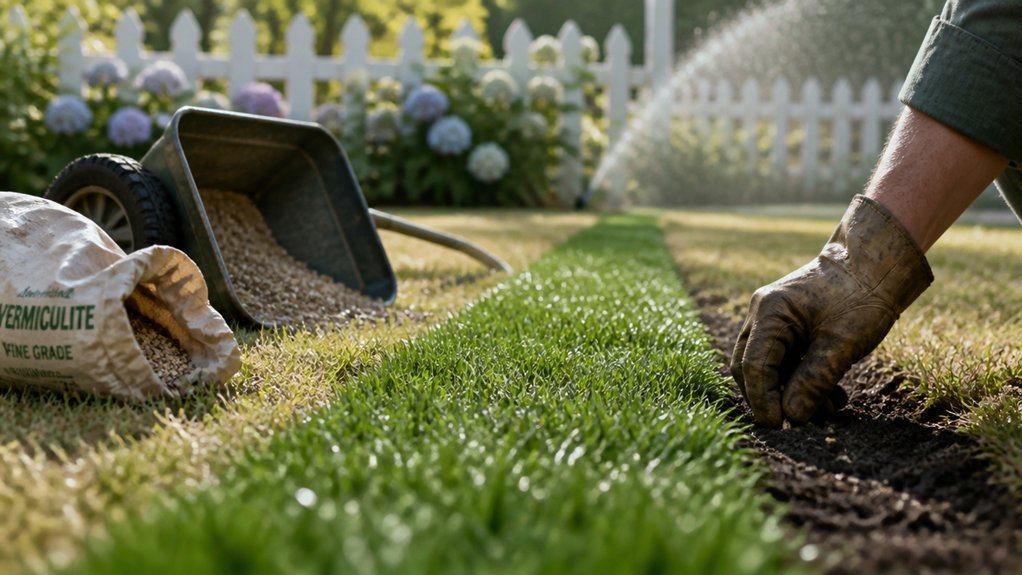
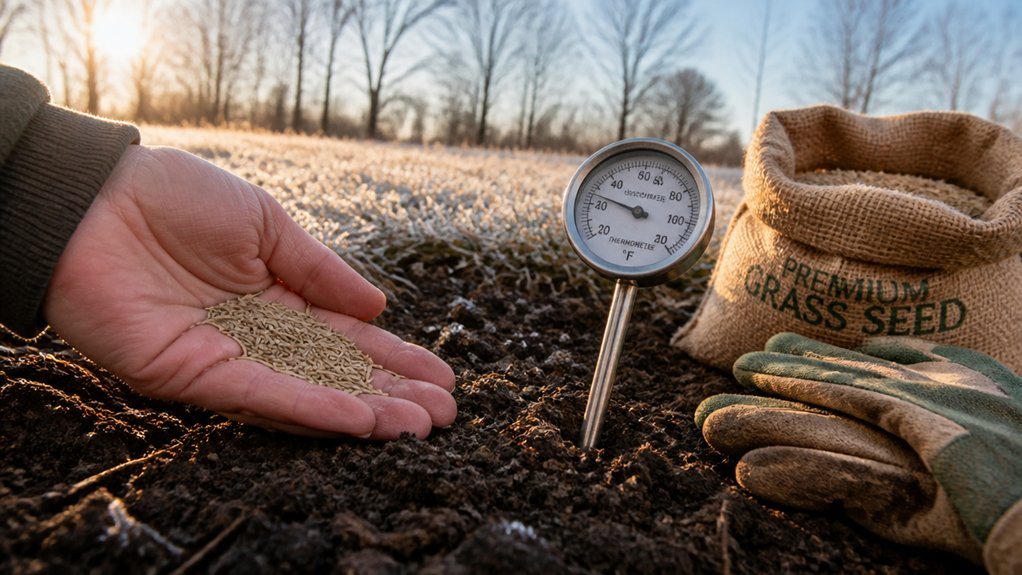
Why struggle with thin, struggling patches when aeration and overseeding rebuild density from the ground up? You’ll aerate in spring or fall to fracture compacted soil, creating channels that improve air, water, and nutrient penetration to grassroots. If thatch measures ¼ to ½ inch, you’ll remove the excess first to maximize seed-to-soil contact and water infiltration. After pulling cores, you’ll top-dress with a thin compost layer to elevate organic matter and anchor seed. You’ll broadcast a climate-suited grass mix across thin or bare zones to increase turf density and suppress weed encroachment. You’ll maintain consistent moisture through germination, then transition gradually to deep, infrequent irrigations that drive root elongation and drought resilience.
Recommended Products

Comprehensive Soil Analysis: Liquid soil test kits offer a comprehensive analysis of essential soil parameters, including pH, ammonia, nitrogen, phosphorus, and potassium. Having all these measurements in one kit provides a holistic understanding of the soil's fertility and health.

Professional Soil Test Kit: All soil test kits on the market can not accurately detect soil chemical elements, the soil must be sent to the laboratory to test in order to obtain accurate data; NewTest Labs to solve this pain point, after a long period of in-depth research, the development of this professional soil testing kit; beginners can also accurately detect the chemical elements in the soil

KNOW BEFORE YOU GROW | Grow the healthiest, sustainable lawn and garden with the most accurate and easy to use professional soil test kit on the market
Conclusion
You’ve optimized your lawn’s biology through soil testing, climate-appropriate species selection, deep weekly irrigation, compost application, and mechanical renovation. Monitor soil pH annually and adjust with lime or sulfur only when test results dictate. Maintain sharp mower blades at proper cutting heights for your species. You’re building self-sustaining turfgrass ecology—reduce inputs gradually as soil health improves and thatch layers stabilize.
Recommended Products

PROFESSIONAL-GRADE ACCURACY: Engineered specifically for soil pH testing, delivering results quickly (in about 60 seconds). With a 3rd Generation, 3-pad ph tester strips design, our soil ph test kit ensures consistent, repeatable results for all your lawn, landscape and garden needs.

Scientific maintenance: The 7 in one soil testing kit is more suitable for beginners, and can help you comprehensively understand the soil conditions of gardens and lawns, solving your confusion. You can adjust soil moisture and pH according to the values, and you can also clearly see the air temperature and humidity as well as soil temperature through the LCD display to improve plant growing conditions in time and scientifically nurture seedlings to help you make your plants flourish

INTUITIVE INSIGHTS PLANTS: 2-in-1 soil tester includes soil moisture meter and soil pH meter, allows you to effectively and accurately measure critical soil moisture levels and soil pH results. No longer finger-touch the dirt and no worry about overwatering. This soil tester takes the guesswork out of taking care of your plants and elevates your planting experience to the next level.