
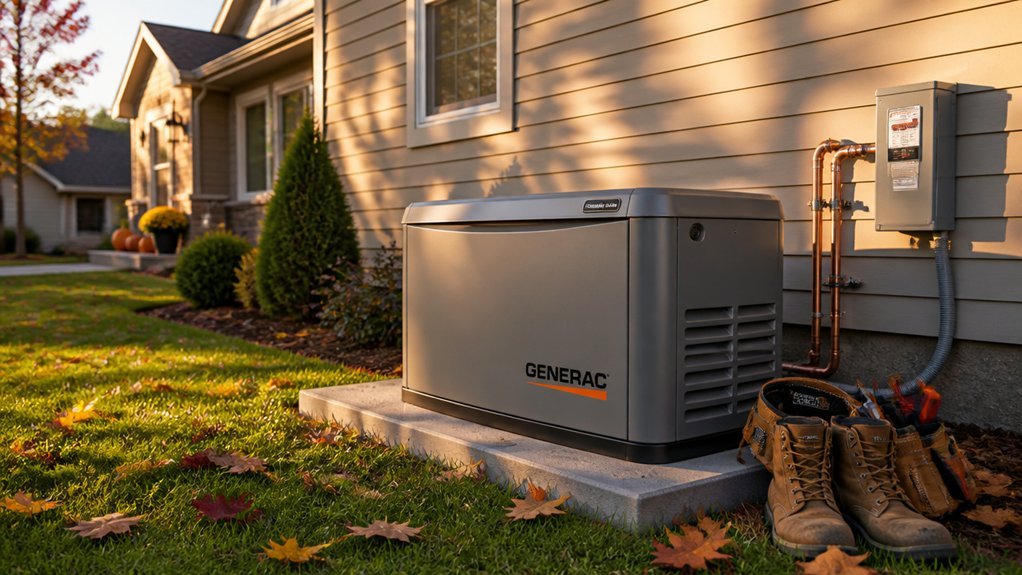
You’re looking at roughly $10,000 to $23,000 for the generator itself, plus another $2,000 to $10,000 for NEC-compliant installation—though your actual cost hinges on load calculations, fuel type, and existing service equipment. Capacity requirements often surprise homeowners when HVAC starting wattage enters the equation.
Whole-House Generator Cost: $10K–$23K and Why Yours May Differ
Why might your neighbor pay $12,000 while you’re quoted $20,000 for the same peace of mind? Your total installed cost hinges on variables unique to your property.
You’ll encounter installation costs ranging from $2,000 to $10,000 above equipment pricing, driven by your kW rating and fuel type selection. A 20kW natural gas unit demands different infrastructure than a 22kW propane system, affecting both material and labor requirements.
Your panel setup determines whether transfer switches integrate seamlessly or require extensive electrical upgrades. Aging service entrances, inadequate clearances, or suboptimal grounding necessitate code-compliant modifications before your whole-house generator achieves safe operation.
You can’t receive accurate pricing without an on-site evaluation. An electrical advisor must assess your load calculations, existing infrastructure, and local permitting requirements. This inspection ensures your system meets NEC standards and manufacturer specifications for reliable automatic operation during outages.
Recommended Products

PrecisionPower Technology delivers best-in-class power quality with less than 5 percent total harmonic distortion for clean, smooth operation of sensitive electronics and appliances

Whole House Protection: Keep your family comfortable and connected during power outages. Avoid the disruption of losing refrigeration, heating/cooling, lights and connectivity of your devices with a Home Standby Generator that automatically detects an outage and delivers backup power to your home.

Automatically restore power in just 10 seconds with the premium power of a Kohler generator that delivers advanced voltage and frequency regulation while still protecting valuable electronics
Size, Fuel, Location: The Three Factors That Change Your Price
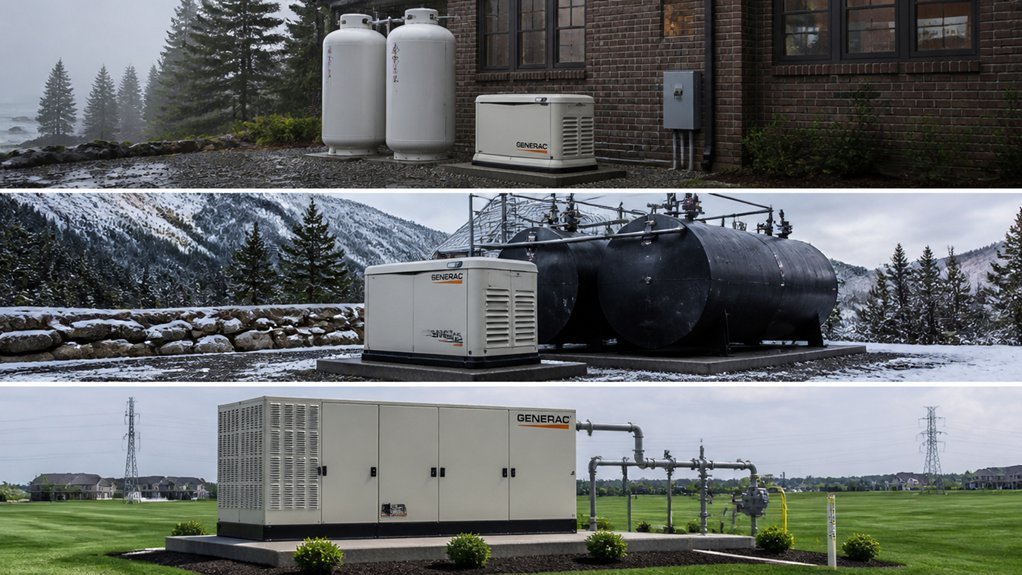
How precisely does your installation total climb from baseline estimates to your final invoice? Your whole-house generator cost hinges on three variables you must evaluate.
First, size: you select capacity (kW) based on load calculations. In San Bernardino and Riverside, you’ll typically need 10–26 kW. Higher output demands larger components, increasing your cost.
Second, fuel: your choice affects installation complexity. Diesel often raises upfront labor costs due to tank requirements, while natural gas may reduce initial install expenses.
Third, location: distance from utility meters, foundation prep, and electrical panel upgrades directly inflate labor costs. Grounding, ventilation, and transfer switch placement must meet NEC codes.
You can’t finalize pricing without an on-site assessment. An electrical advisor measures running and starting wattage, evaluates your panel, and determines transfer switch specifications—ensuring code-compliant, safe installation.
Recommended Products

Whole House Protection: Keep your family comfortable and connected during power outages. Avoid the disruption of losing refrigeration, heating/cooling, lights and connectivity of your devices with a Home Standby Generator that automatically detects an outage and delivers backup power to your home.

【CONVERSION FUNCTION】: The automatic transfer switch seamlessly transitions between power sources, ensuring continuous power supply during power outages, thereby protecting your appliances and eliminating downtime

Remote Monitoring Anywhere: With Generac 7225 14kW Mobile Link Wi-Fi connectivity, effortlessly track generator performance from anywhere. Stay updated on status and maintenance alerts, ensuring peace of mind even when you’re away
Natural Gas vs. Propane vs. Diesel: Which Saves Money Long-Term?
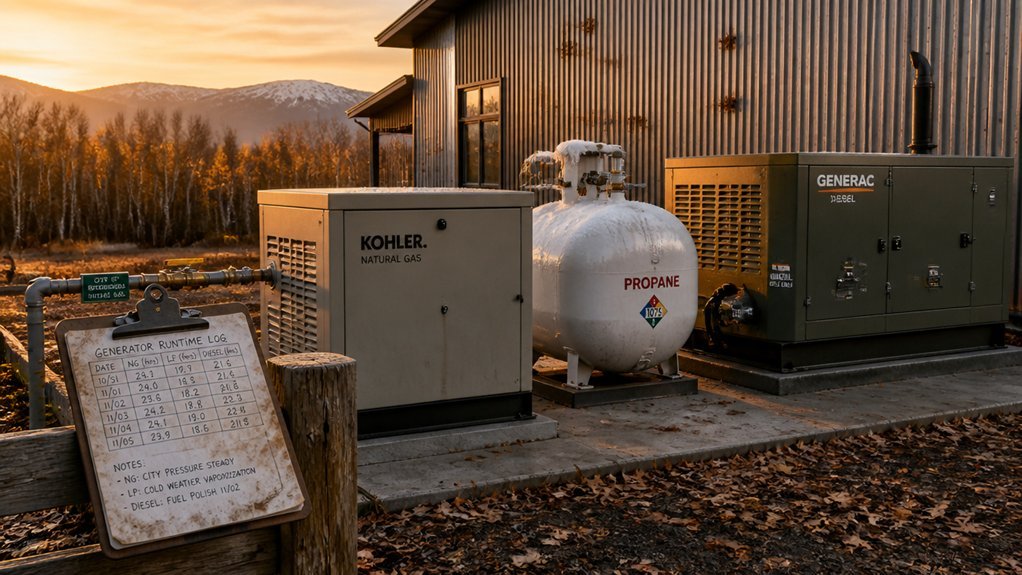
Your fuel choice locks in both your upfront installation budget and your long-term operating economics.
You’ll find natural gas delivers the lowest installation cost for your standby generator, but you’ll pay higher ongoing fuel costs through utility rates. You’ll see diesel imposes the highest installation cost due to fuel storage and ventilation requirements, yet you’ll benefit from the lowest long-term operating costs—provided you maintain contaminant-free fuel per NFPA 110. You’ll evaluate propane as your fuel type for its indefinite shelf life and cleaner combustion; however, you’ll calculate varying ongoing fuel costs based on delivery fees and tank ownership.
You must weigh total cost of ownership across your whole-house generator’s lifespan. You’ll install diesel where utility gas isn’t available, you’ll specify natural gas for cost-effective standby power, and you’ll select propane when code restricts other fuels.
Recommended Products

Brand New High Quality Universal 4 Gallon Fuel Tank Fits Most Open Frame 5-7KW Diesel Generators

【Size】Nut threading 16mm x 1.5mm, 22mm hex nut, On / Off 90 degree----Please confirm the size carefully before purchasing

ONLY USE - FOR GS-0795 FUEL TANKS. Not for use as a replacement for any other part numbers or any other applications!
Tax Credits, Rebates, and Timing: How to Actually Pay Less
Where can you realistically trim the bottom line on a standby generator installation without cutting corners on NEC 702 compliance or equipment safety? You leverage timing, stack incentives, and structure payments strategically.
You claim federal tax credits only when powering qualifying medical equipment—eligibility’s narrow, so verify specifics. You capture manufacturer rebates and seasonal promotions to offset upfront installation cost directly. You explore financing options that spread expenditures without compromising UL 2200-rated equipment selection. You bundle maintenance plans at purchase for locked-in cost savings and prioritized service response. You monitor local tax incentives and utility rebates, since availability shifts by jurisdiction and policy cycle. You Schedule installation during promotional windows. You’re maximizing legitimate cost reductions while preserving code-compliant transfer switching, proper grounding, and safe fuel system installation—never sacrificing safety for savings.
Recommended Products

【100 Amp Generator Transfer Switch】This transfer switch is perfect for shifting power from the utility grid to an auxiliary source (e.g., a gas generator or solar setup). Just a quick flick of its lever guarantees seamless power management. With a max capacity of 100 amps and a 24,000 - watt power rating, it can effortlessly power your whole home, even high - demand appliances like dryers and stoves

This is the original, authentic, and patented EZ Generator Switch

This 100 amp generator transfer switch perfect to switch the power from the electric company to an auxiliary power (gas generator, solar). A simple movement of the transfer switch lever ensures seamless power management. With a maximum handling capacity of 100amps and a power capability of 24000W, it effortlessly powers your entire household, including high-demand appliances like dryers and stoves.
Is a Whole-House Generator Worth It? Breaking Down the Real Value
Why sink $7,000 to $23,000+ into a permanently installed standby unit when portable alternatives exist?
You’ll evaluate generator cost against critical loads, uptime requirements, and code-mandated safety systems that portables lack.
A whole-house generator delivers seamless backup power through automatic transfer switches, eliminating manual hookups and backfeeding hazards.
Your total generator cost hinges on kW size—higher capacity demands larger transfer switches and heavier gauge wiring, inflating installation labor.
Fuel options shape both upfront pricing and ongoing costs; you’ll weigh natural gas convenience against propane shelf stability.
Installation labor ranges $2,000–$10,000 depending on panel upgrades and conduit runs.
Schedule an on-site evaluation to assess your home’s electrical layout, verify load calculations, and ensure code-compliant siting before committing.
Recommended Products
Whole House Protection: Keep your family comfortable and connected during power outages. Avoid the disruption of losing refrigeration, heating/cooling, lights and connectivity of your devices with a Home Standby Generator that automatically detects an outage and delivers backup power to your home.

Remote Monitoring Anywhere: With Generac 7172 10kW Mobile Link Wi-Fi connectivity, effortlessly track generator performance from anywhere. Stay updated on status and maintenance alerts, ensuring peace of mind even when you’re away

Remote Monitoring Anywhere: With Generac 7228 18kW Mobile Link Wi-Fi connectivity, effortlessly track generator performance from anywhere. Stay updated on status and maintenance alerts, ensuring peace of mind even when you’re away
Conclusion
You’re looking at $10,000–$23,000 for the unit plus $2,000–$10,000 for NEC-compliant installation, but your actual cost hinges on proper load calculations, fuel availability, and local AHJ requirements. Don’t guess on sizing—an electrical advisor’s on-site assessment determines running and starting wattage, transfer switch specifications, and grounding electrode compliance. Factor in potential tax credits and utility rebates, then weigh that against outage risks. When installed correctly with automatic transfer switching and proper ventilation, a code-compliant generator protects life safety and property value for years.
Recommended Products
Whole House Protection: Keep your family comfortable and connected during power outages. Avoid the disruption of losing refrigeration, heating/cooling, lights and connectivity of your devices with a Home Standby Generator that automatically detects an outage and delivers backup power to your home.
Whole Home Backup Power: Delivers 18kW of reliable, automatic backup power to keep essentials running during outages.

Up to 20% more fuel efficient than leading competitors, this 22-kilowatt generator provides 22,000 watts of continuous power on propane and 19,800 watts on natural gas, with no refueling, no manual operation, and no extension cords needed