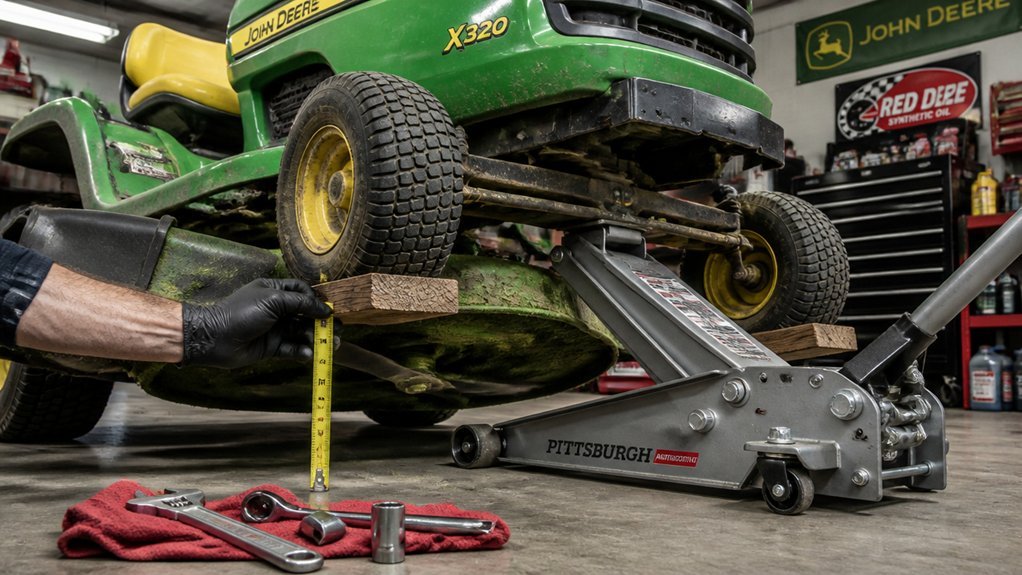

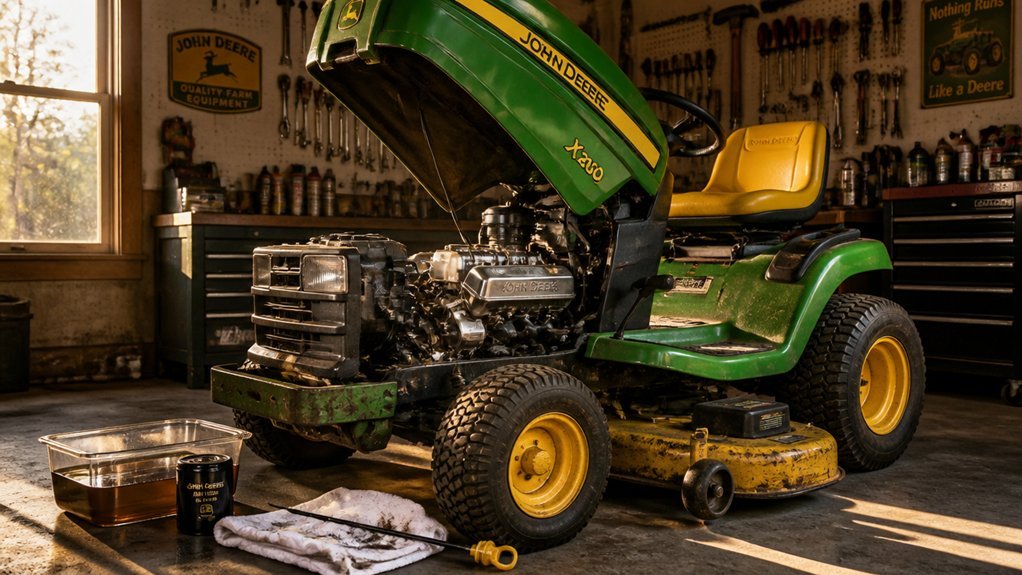
You’ll want to get this right before you pour. Grab the wrong oil or misjudge capacity, and you’re risking premature wear or outright failure. Your Deere’s engine demands specific viscosity, detergent properties, and fill volume—details that vary by model more than most owners realize. The consequences of guessing aren’t immediate, but they’re expensive.
Which Oil Type for Your John Deere Riding Mower?
Which oil does your John Deere riding mower actually need? You’ll find SAE 10W-30 specified in the John Deere Turf-Gard oil kit, which includes two quarts of oil and a filter (AM125424). This kit provides TY22029 oil that’s compatible with many Deere riding models, including the D100 series, X300 series, and Z-series, provided your model matches the compatibility notes. The included oil isn’t synthetic by default.
Deere riding mowers typically use 10W-30 or 30-weight oils depending on temperature and model. When selecting oil, ensure it meets SAE J300 classification and uses a high-quality detergent oil approved for small engines. You can use synthetic oil across temperature ranges if preferred.
Recommended Products

OEM John Deere Part Number: TY22029

Great tools at a great price

HIGH-ZINC FORMULA: Contains 2X the zinc of OEM and competitor oils, delivering unmatched wear protection for small engines
How Much Oil Does Your Deere Actually Need?
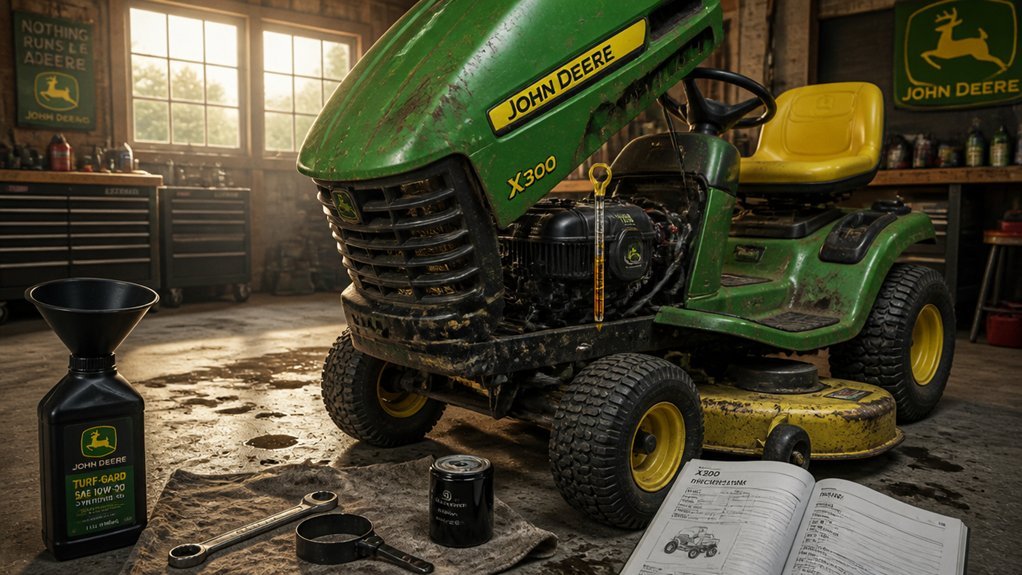
How many ounces does your John Deere riding mower actually hold? Your riding mower’s oil capacity typically ranges from 48 to 64 ounces, noticeably exceeding walk-behind models. You’ll find this variance stems from engine displacement and cooling requirements specific to your unit.
The John Deere oil kit provides 2 quarts (64 ounces) plus filter AM125424, but don’t assume this fits your machine. Verify your exact oil capacity by checking the owner manual or engine model number stamped on the housing. Operating with insufficient oil damages bearings and cylinder walls; overfilling causes seal failure and frothing.
If documentation’s unavailable, use John Deere’s Oil Finder tool. Input your engine series, equipment model, and operating temperature range. This confirms precise oil capacity and confirms you’ve selected the correct grade before draining your crankcase.
Recommended Products

SAE 10W-30 MOTOR OIL FOR SMALL ENGINES: One 32 fl oz bottle of STP Premium Synthetic Blend 4 Cycle Small Engine Oil SAE 10W-30, formulated for small engines in lawnmowers, generators, tractors, snow blowers, and other outdoor power equipment
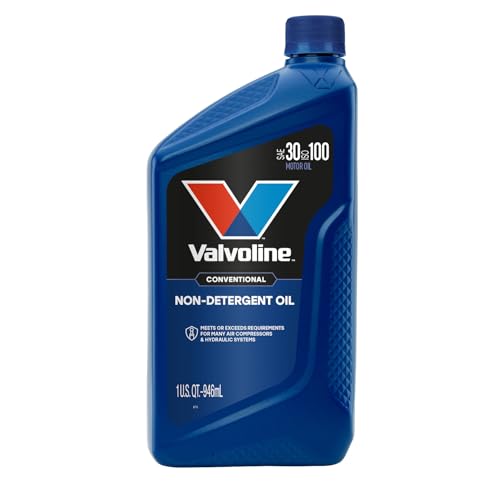
Helps prevent deposit formation throughout the engine and critical components

HIGH-ZINC FORMULA: Contains 2X the zinc of OEM and competitor oils, delivering unmatched wear protection for small engines
Synthetic Vs. Conventional Oil in Deere Engines
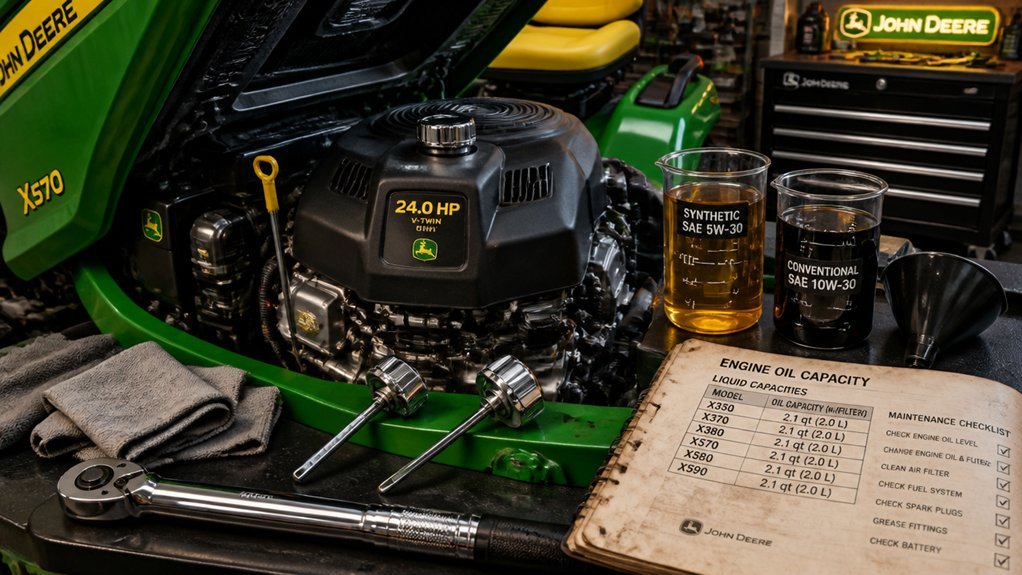
What separates synthetic from conventional oil in your Deere engine? Synthetic oil delivers superior molecular consistency, providing enhanced cold-start protection and elevated temperature stability across operating conditions. You can deploy synthetic oils such as 5W-30 or 15W-50 throughout all temperature ranges without modifying break-in procedures.
However, switching to synthetic oil won’t extend your oil change intervals—Deere maintains identical maintenance schedules regardless of oil type. For warranty compliance, you must ensure your synthetic oil meets SF/SG/SH/SJ or higher detergent classifications and adheres to your engine’s specific oil specification. Neither oil type requires supplemental additives. Both demand proper classification adherence. Your choice depends on operational demands: synthetic oil excels in extreme temperatures, while conventional oil satisfies standard conditions when specifications align.
Recommended Products

100% Synthetic Formula: Provides superior performance and protection for air-cooled 4-cycle engines

Semi-Synthetic 5W-30 4-Stroke Oil

Phosphorus Replacement Technology to help extend the life of the emission system
How to Check Oil Level Without Overfilling
Where exactly should you check your John Deere’s oil to avoid costly overfill mistakes? Park on a level surface and let the engine cool for several minutes to allow oil to drain back. Remove the dipstick, wipe it clean, then reinstall fully before removing again to check the oil level. You’re looking for oil between the full and add marks; if it’s near add, you’ll need more oil. Add small amounts gradually using a clean funnel to prevent contamination. After each addition, reinsert the dipstick completely, wait momentarily for settling, then recheck. Repeat until you’ve hit the full mark without exceeding it. Never rush this process—overfilling strains seals and reduces engine performance. Precise measurement protects your investment.
Recommended Products


2-18oz Briggs and Stratton 30W Oil
How Often to Change Deere Riding Mower Oil
You should change your John Deere riding mower’s oil every 100 operating hours or once per year, whichever milestone hits first—this interval isn’t arbitrary, it’s engineered to remove combustion byproducts and suspended contaminants before they accelerate engine wear. You’ll want to track hours on your hour meter; seasonal mowers often hit the annual limit before the hours do. When executing this oil change interval, drain the crankcase completely, replace the filter, and refill with the specified capacity—typically SAE 10W-30 for balanced protection. Synthetic oils work across all temperatures but don’t extend your interval. Always verify level with the dipstick on level ground, then recheck after running and settling to confirm proper fill.
Recommended Products

【Replacement Part】 Part Number AM125424 Replaces AM125424c AM39687 AM119567 AM125424 LG4153 LG492932S GY20577

【Replacement Part】 Part Number AM125424 Replaces AM125424c AM39687 AM119567 AM125424 LG4153 LG492932S GY20577

FITS MANY MODELS OF JOHN DEERE
John Deere Oil Kits: Worth It or Buy Separate?
Once you’ve marked your calendar for that 100-hour or annual oil change, you’ll need to decide whether to grab a John Deere Turf-Gard kit or source oil and filter separately.
John Deere oil kits package two quarts of SAE 10W-30 Turf-Gard oil with the AM125424 filter, which fits D100–D170, X-series, Z-series (serial 100,001+), and LA/LT/LX variants plus select Scotts/Sabre mowers. You’ll verify your model and serial number against the kit’s compatibility list—some Z-series units carry serial cutoffs—before purchasing.
The kit guarantees matched OEM specifications in one transaction, eliminating guesswork and separate sourcing. However, if your mower falls outside listed compatibility or you’re uncertain about serial number thresholds, you’ll cross-reference specifications independently.
Buying components separately works when you’ve confirmed exact filter and oil requirements, but the kit delivers convenience and verified fitment for supported machines.
Recommended Products


Please check Service Manual for Fitment Information

John Deere Part Number: TY22029
Conclusion
You’ll get years of reliable cutting from your Deere when you match the oil to your conditions and stick to the maintenance schedule. Use 10W-30 or 30-weight detergent oil, verify capacity in your manual, and change it every 100 hours or annually—whichever comes first. Synthetic blends improve cold starts but won’t buy you extra miles between changes. Skip the guesswork with a Turf-Gard kit if it fits your model.
Recommended Products

Conventional formula provides everyday protection against wear, deposits and sludge – key causes of engine failure

Engineered for High-Output 4-Cycle Engines: Formulated with cutting edge bio-synthetic base stocks and a professional additive package for exceptional wear protection in high-performance engines.
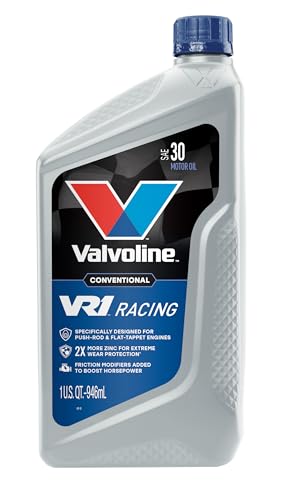
Valvoline VR1 Conventional Racing Oil is formulated with high levels of ZDDP (zinc dialkyldithiophosphate), combining phosphorus and 2X more zinc for superior film strength and extreme anti-wear protection on pistons, cams, and bearings