

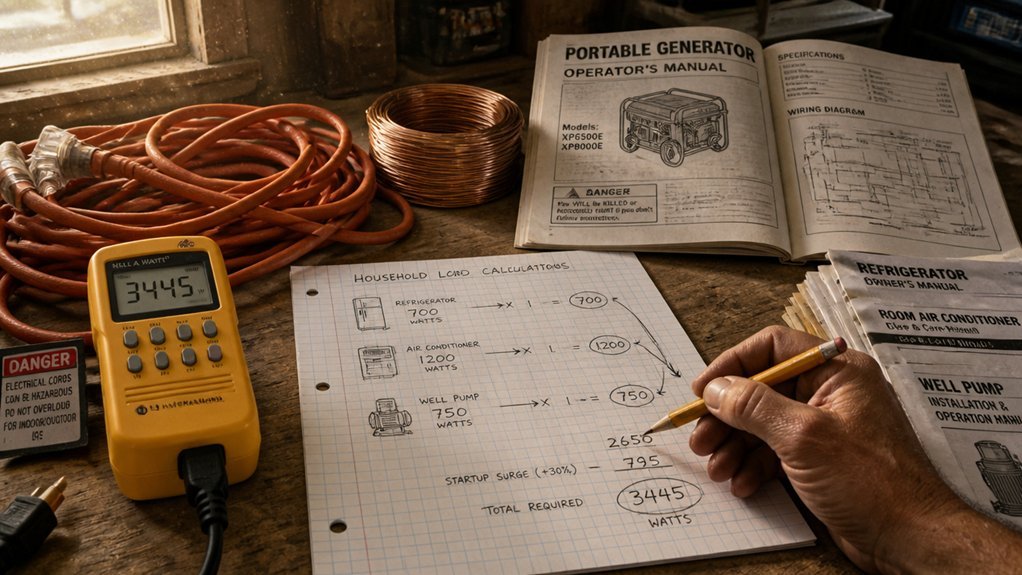
You’ll need to size your generator precisely—underestimate and you’ll overload the system; overestimate and you’ll waste capital on unused capacity. A proper calculator accounts for real power (kW), apparent power (kVA), and your specific load characteristics, but your inputs must be accurate. Before you trust any automated result, you should understand exactly what variables you’re working with.
Start Here: How to Use the Generator Size Calculator
Is your home’s power suddenly out? You’ll begin generator sizing by identifying every essential load requiring backup power. List each device’s wattage, then perform watt-to-kilowatt conversion by dividing by 1,000. Sum these values to establish your baseline kilowatt requirement.
Apply a 20% power safety margin to this total. This margin prevents generator overload when motors start or when you add future loads. You’ll input these figures into the calculator, which automates the arithmetic and applies the safety factor.
The tool yields a capacity estimate, but don’t treat this as definitive. You’ll balance essential loads against efficiency targets, recognizing that calculators provide rough approximations. For optimized reliability and cost-effectiveness, you’ll consult a specialist who can refine your selection based on site-specific electrical standards and load characteristics.
Recommended Products

Calculate kVA from kW Calculate kVA to kW Convert kW from kVA Convert kW to kVA Calculate kVA from Amps
What Specs You’ll Need: Volts, Amps, and Power Factor
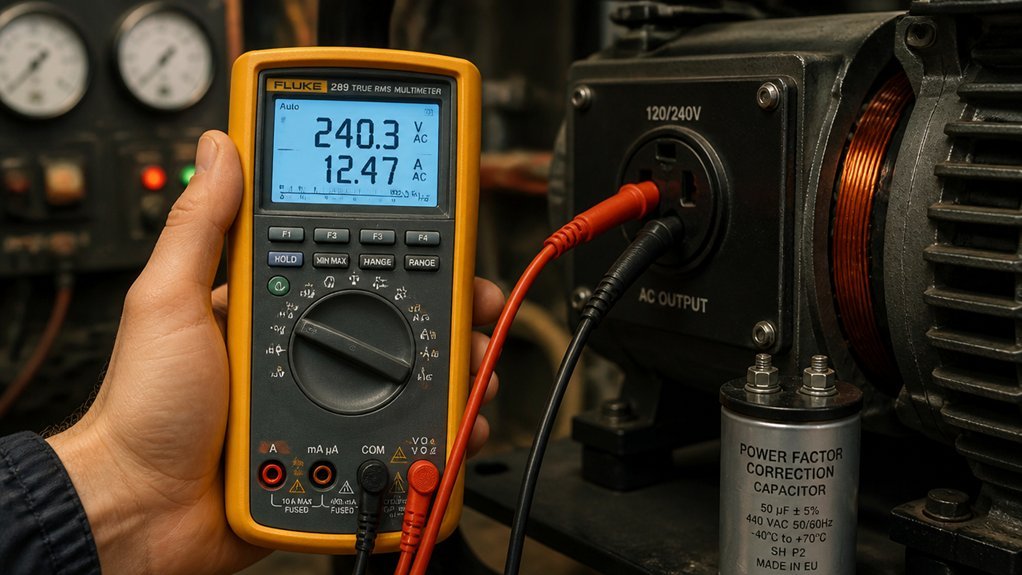
Once you’ve established your baseline kilowatt requirement and safety margin, you’ll need to input the electrical specifications that define your actual load profile. Enter your system’s volts and amps directly into the calculator. These values determine your apparent power demand. Next, specify your power factor—typically 0.8 for inductive loads or 1.0 for resistive loads—to convert apparent power into real power accurately. The calculator supports both single-phase and three-phase inputs; you’ll select your configuration based on your service type. After entering volts, amps, and power factor, choose your output mode: total kW or total kVA. While the calculator delivers precise results for standard applications, complex installations demand professional verification due to site-specific conditions and code requirements.
Recommended Products

5300 Running Watts and 6600 Peak Watts; Recoil Start; 4.7 Gallon Fuel Tank with Fuel Gauge; Up to 14. 5 Hours of Run Time Per Tank with 120/240V Volt Selector Switch

Provides 4,000 peak watts and 3,200 rated watts of power

2550 peak watts and 1900 rated watts at less than 3% THD – weighs only 43 lb. – gas powered – one RV ready TT-30r outlet, two 120v 20 amp outlets, and two USB outlets
Read Your Results: Converting kVA to kW

How do you interpret the numbers the calculator gives you? You’ll apply the standard kVA to kW conversion using a power factor of 0.8, multiplying the calculated kVA by 0.8 to derive actual usable kilowatts. This conversion yields your generator’s running wattage capacity—the continuous power available for sustained operation under nominal conditions.
You’ll verify that this running wattage meets your load requirements after accounting for motor starting demands, which substantially exceed steady-state consumption. The 0.8 power factor reflects typical inductive loading; however, you’ll recognize its limitation where loads exhibit leading power factors or non-standard electrical characteristics. Under such conditions, you’ll consult a qualified engineer rather than rely on simplified conversion factors. Your calculator results establish preliminary sizing parameters, but you’ll validate them against manufacturer specifications and applicable standards before finalizing equipment selection.
Recommended Products

Operate your 11,000-watt portable generator right out of the box on either gasoline or propane, plus features CO Shield carbon monoxide auto shutoff system

Start and stop with ease from up to 80 feet away with the included wireless remote key fob, plus, features CO Shield carbon monoxide auto shutoff system

Remote Monitoring Anywhere: With Generac 7172 10kW Mobile Link Wi-Fi connectivity, effortlessly track generator performance from anywhere. Stay updated on status and maintenance alerts, ensuring peace of mind even when you’re away
How Accurate Is Your Result? Key Limitations to Know
Where exactly do generator sizing calculators fall short? Calculator accuracy depends on standard assumptions that don’t capture your specific conditions. Limitations include altitude derating, site temperature, power factor variations, iron losses in transformers, and motor efficiencies that deviate from nameplate ratings. You’ll get general estimations, not exact specifications.
The tool won’t account for harmonic distortion, starting surge sequences, or concurrent load factors in your installation. When your system involves variable frequency drives, soft starters, or multiple motors with overlapping start cycles, professional input becomes essential. You’ll need a certified electrician to perform compliant load calculations per NEC Article 220 or IEEE 446 standards. Use these results as rough guidance only. If voltage stability or selective coordination matters for your application, contact Generator Source for expert confirmation.
Recommended Products
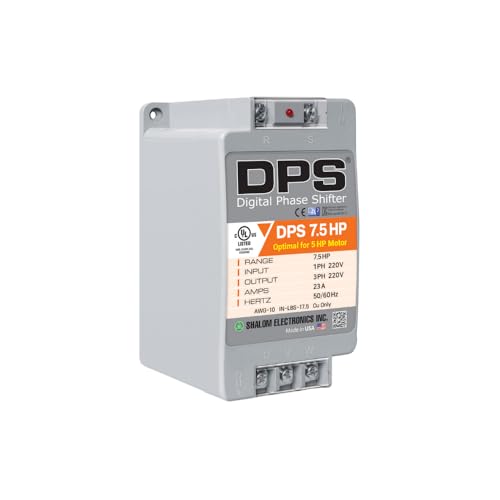
Single phase 200V-240V to 3 phase 200V-240V

[ Easy Installation ] Simply wire single-phase input (L/N) and three-phase motor output (U/V/W). No programming or complex setup required. This single phase to 3 phase converter can plug-and-play.

Voltage: Rated Voltage: 208 to 480VAC universal, 50/60Hz. Powered by the measuring circuit, no additional auxiliary power required.
When to Call an Electrician: 5 Scenarios That Need Pros
Why risk a code violation or equipment failure when a licensed electrician can assure your installation meets NEC standards?
You encounter buzzing, overheating, or tripped breakers during power outages—call an electrician to diagnose underlying faults.
You face unfamiliar wiring, unknown panels, or warm outlets and breaker boxes; these scenarios demand immediate professional evaluation.
You’re adding high-load devices such as central AC or EV chargers; an electrician must size conductors and upgrade your service for safe capacity.
You experience persistent shocks, exposed conductors, or breakers tripping below rated loads—contact a qualified electrician without delay.
Complex generator sizing, panel upgrades, or transfer-switch installations require code-compliant execution; only a licensed electrician ensures proper coordination with utility interconnection standards.
Don’t compromise safety.
Get a Professional Generator Sizing Assessment
What exact load profile does your home require during an outage? You can’t determine that through guesswork alone. A professional generator sizing assessment delivers precise load calculations based on your specific circuits, starting wattages, running watts, and essential demand factors. You’ll identify whether your backup power requirements mandate Whole Home coverage or Select Circuits priority. The assessment incorporates your heating type, EV charging loads, and projected capacity growth, then applies a mandatory 20% safety margin to prevent undersizing. You’re avoiding both costly over-sizing and dangerous under-sizing by balancing efficiency with reliability per established standards. Contact support@generatormator.com to schedule your personalized evaluation and secure properly rated standby power.
Recommended Products

Switch between gasoline (4750 surge watts, 3800 running watt) and propane (4350 surge, 3500 running) with the simple turn of the selection dial
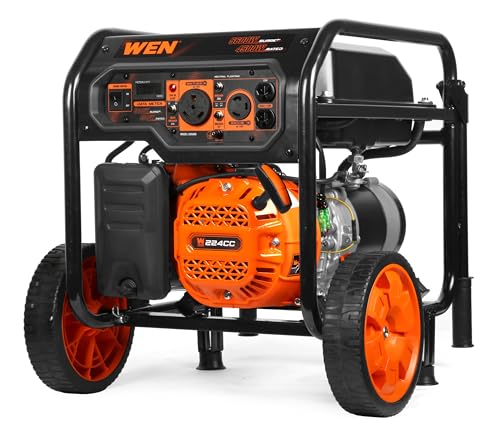
Keep your family safe with 5600 starting watts and 4500 running watts of power
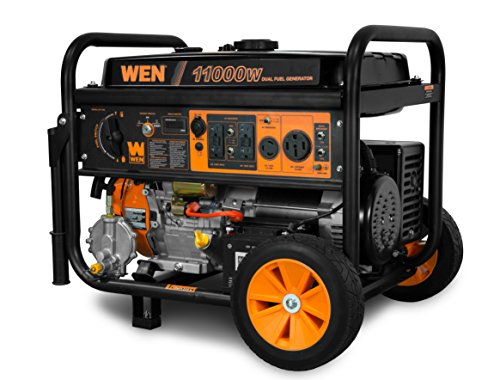
Switch between gasoline (11,000 surge watts, 8,300 running watt) and propane (9,500 surge, 7,500 running) with the simple turn of the selection dial
Conclusion
You’ve sized your generator using NEC-aligned calculations: summing essential loads, applying the 1.2 safety multiplier, and converting between kW and kVA at 0.8 PF. Your result provides a baseline estimate, but IEEE 446 and NEC 702.5 mandate professional validation for motor loads, harmonic distortion, or multi-phase imbalances. Submit your load analysis to a licensed electrician before finalizing procurement.
Recommended Products

Remote Monitoring Anywhere: With Generac 7228 18kW Mobile Link Wi-Fi connectivity, effortlessly track generator performance from anywhere. Stay updated on status and maintenance alerts, ensuring peace of mind even when you’re away

Dual Fuel: Operate your 7500-watt portable generator right out of the box on either gasoline or propane, plus features CO Shield carbon monoxide auto shutoff system
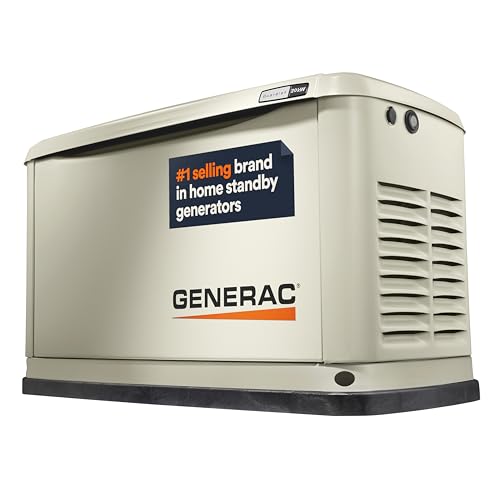
Remote Monitoring Anywhere: With Generac 7077 20kW Mobile Link Wi-Fi connectivity, effortlessly track generator performance from anywhere. Stay updated on status and maintenance alerts, ensuring peace of mind even when you’re away