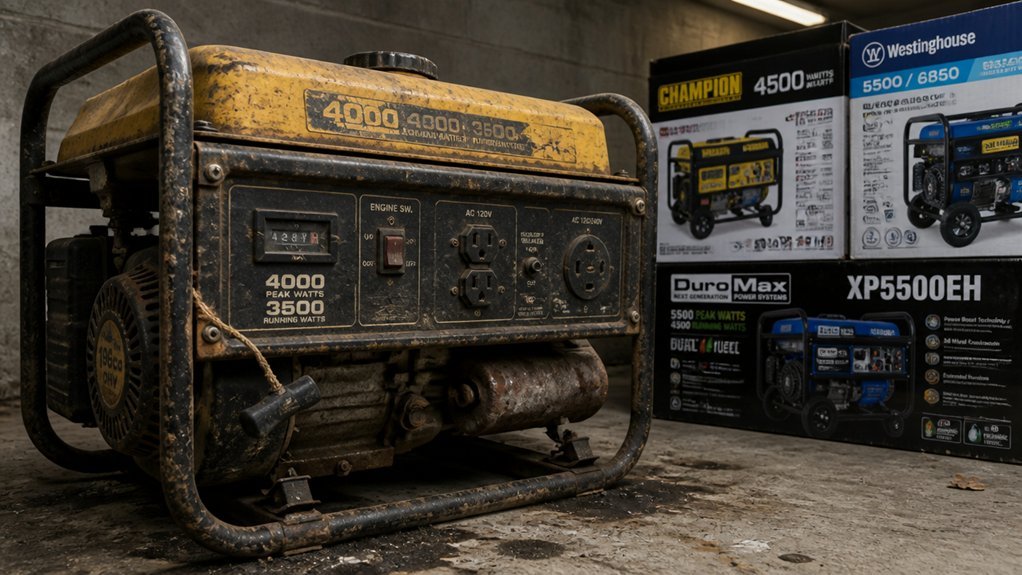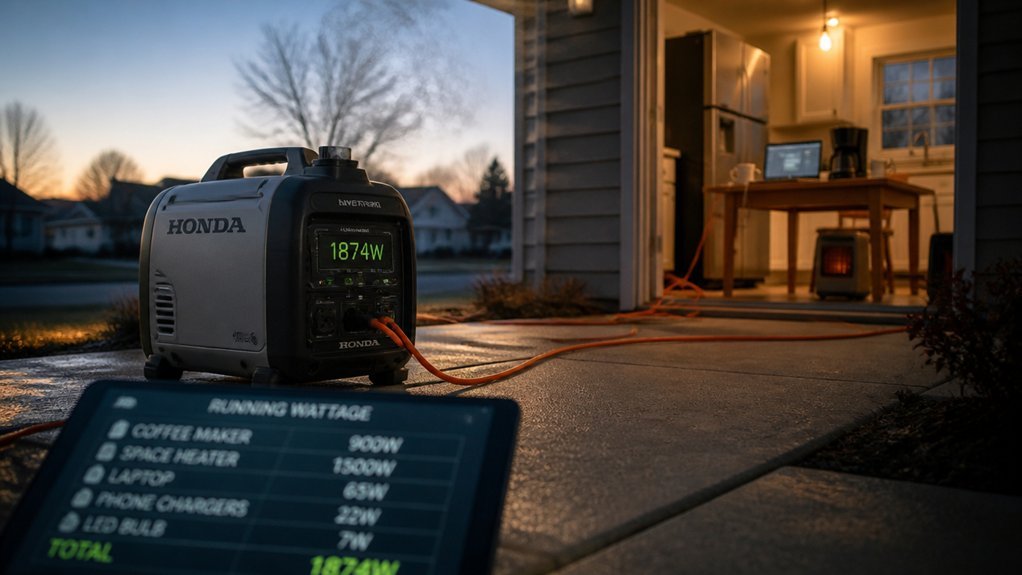

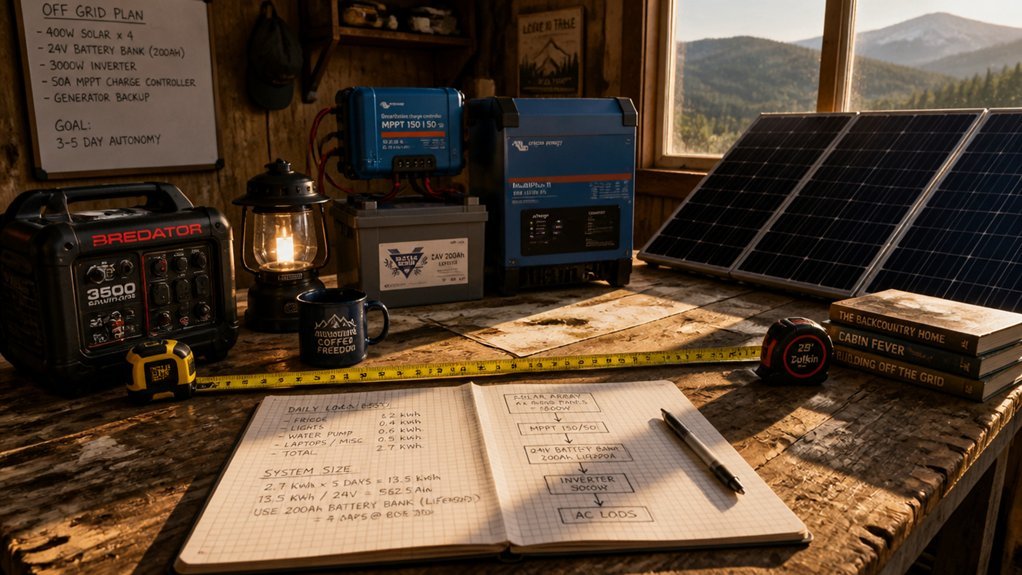
You’re sizing a solar generator, but the number on the box rarely tells the full story. Your fridge’s label says 150 watts, yet its compressor draws 1,200 at startup. You’ll need to match continuous output to your running load and surge capacity to your worst-case motor startup—then account for simultaneity. Miss either figure, and you’ll trip the inverter when it matters most. The math isn’t complex, but the consequences of getting it wrong are.
Add Up What You’re Actually Powering
How do you avoid buying a solar generator that’s either cripplingly undersized or wastefully oversized? You quantify your load profile precisely by cataloging every appliance you’ll connect, distinguishing running watts from surge watts for each device.
First, list your appliances: laptops (~50W running), coffee makers (~1000W), hairdryers (~1500W), and air conditioners (~1500W running, 3000W+ starting). Record running and starting watts separately. Continuous power—the inverter’s steady output—must exceed your summed running watts. Surge watts determine peak demand tolerance.
Calculate total surge by adding total running watts to the highest single starting wattage. A 2000W running load with one 3000W compressor startup requires 5000W surge capacity. Your power station needs energy storage matching runtime requirements at this draw. Size backup power systems at 300–500W for small electronics, 2000–3000W+ for home backup.
Recommended Products

【POWERFUL DC to AC CONVERTER】: This solar inverter delivers 2000W of continuous battery DC 12V to AC 110V 120V power and up to 4000W of peak surge power when the load is started. The 12V inverter has a conversion efficiency of greater than 93% during normal working and low no-load losses

【POWERFUL DC to AC CONVERTER】: This solar inverter delivers 1000W of continuous battery DC 12V to AC 110V 120V power and up to 2000W of peak surge power when the load is started. The 12V inverter has a conversion efficiency of greater than 90% during normal working and low no-load losses

【𝟐𝟎𝟎𝟎 𝐖𝐚𝐭𝐭 𝐈𝐧𝐯𝐞𝐫𝐭𝐞𝐫】--- This pure sine wave inverter can provide 2000W continuous clean DC to AC power (4000W surge) with >91% efficiency, which strongly and effectively reduces conversion loss and protecting sensitive electronics (Microwave Oven, Laptops, CPAPs, LEDs) from damage. Handles heavy startups (Window AC, Power Tools) effortlessly. For RV, Home, Solar, Emergencies.
Why Peak Power Matters More Than Your Appliance Label Says
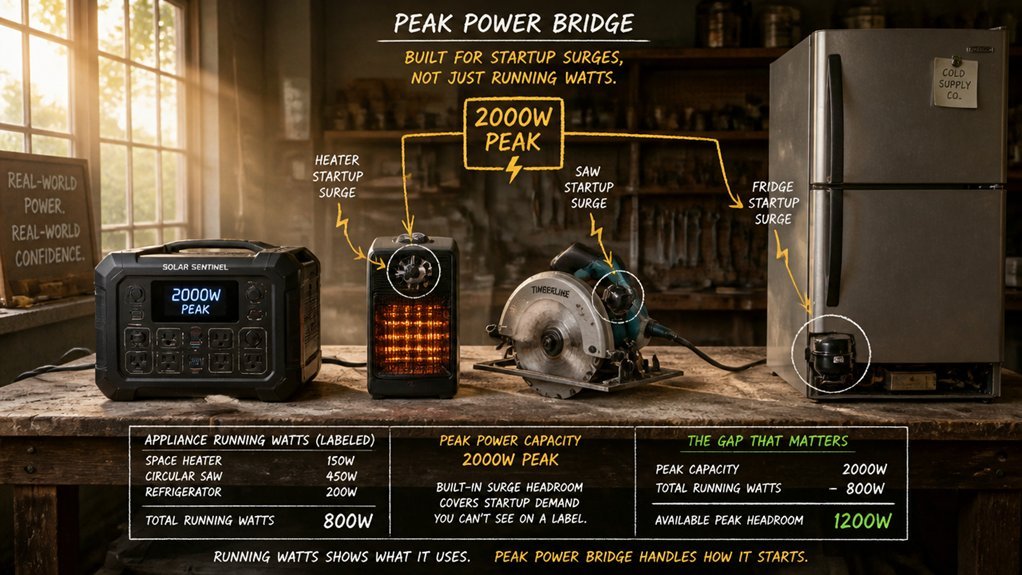
Why do solar generators fail when you need them most? You sized by running watts, ignoring surge watts. Your refrigerator demands 800W continuous power but draws 1800W starting watts. Your inverter capacity trips, overload protection engages, and critical loads go dark.
Peak power isn’t optional—it’s engineering reality. Motor-driven equipment exhibits startup demand 2-3× greater than steady-state operation. Your solar generator must deliver brief surges without voltage collapse. When you stagger device activation through load management, you reduce simultaneous surge exposure. However, worst-case alignment—AC compressor, refrigerator pump, and power tool—demands headroom. Undersized systems compromise energy storage longevity through repeated thermal cycling. Precise calculation separates reliable operation from catastrophic failure. You can’t negotiate physics; you engineer for it.
Recommended Products

Efficient Cooling for Small Spaces: This 5200 BTU portable air conditioner is designed for small rooms, helping maintain a comfortable temperature in bedrooms, offices, dorms, apartments, and enclosed spaces

6-outlet Surge Protector/Power Strip with Audio Filtration 9' Power Cable
AIR CONDITIONER FOR RVS AND CAMPERS | Powerful 6,500 BTU Air Conditioner, Fan & Dehumidifier Maintains a Cool, Dry & Comfortable Climate Inside Your Motorhome, Caravan, Converted Van, Travel Trailer, Truck & Similar Confined Vehicles & Interior Spaces | Innovative Saddle Mounting on Windowsill Keeps Out Loud Noise, While the Unit’s Shockproof Dampers Absorb Vibration for the Quietest, Most Peaceful Operation Possible
Size Your Solar Generator in 3 Steps
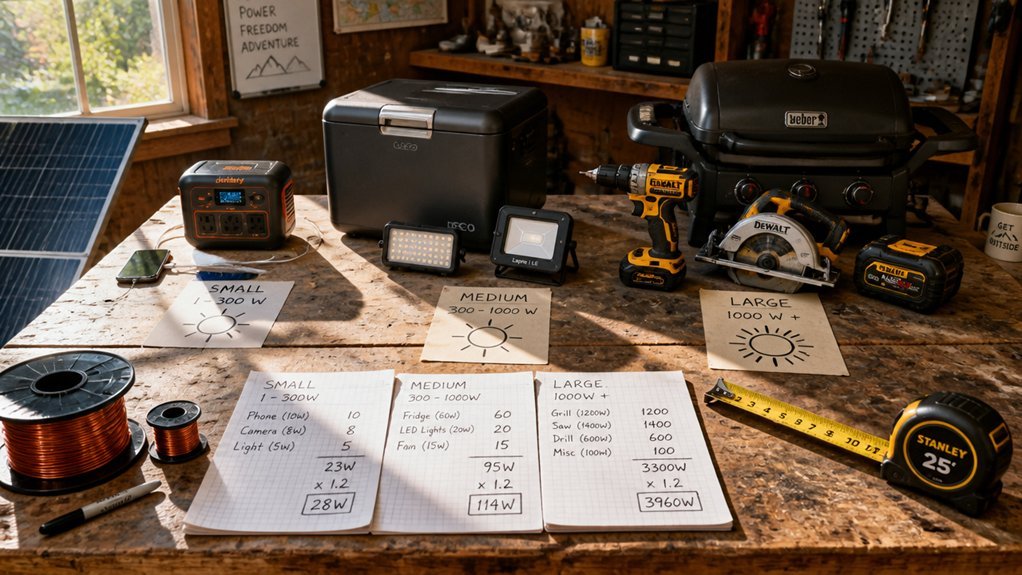
Where do you begin with solar generator sizing? You’ll follow a three-step calculation method to determine your backup power requirements.
First, list every device you intend to power simultaneously. Practical scenarios include laptops, phones, coffee makers, hairdryers, and air conditioning units.
Second, record each device’s running watts and surge watts. Running watts measure continuous power draw, while surge watts capture startup spikes. Consult manufacturer manuals or standardized wattage charts for accurate data.
Third, perform your calculations: sum all running watts, then add the highest single surge value from your devices. This yields your total load profile. Select a power station exceeding both figures—adequate surge watts for motor starts and sufficient continuous power for sustained operation. Your solar generator must handle both demands without compromise.
Recommended Products

Provides 4,000 peak watts and 3,200 rated watts of power

Unique Glass Cover Design: Tempered glass upper cover with big 6.25 inch LCD display and touchable buttons, cool look with high transparency, more clear to see real-time data of your inverter

224cc dual-fuel engine runs on both gasoline (6800 surge watts, 5100 rated watts) and propane (6000 surge watts, 4500 rated watts)
What Your Wattage Number Actually Buys You: Camping to Home Backup
Once you’ve sized your load profile, you’ll need to match those wattage figures to real-world performance across different use cases. Your energy calculation determines what battery storage and inverter size you’ll actually require.
For camping, you’ll get 288–518 watt-hours (Wh) in compact units—enough for lights and phones with 500–600 W surge watts handling startup surges. You’ll step up to 1000–2000 Wh for mini-fridges, where running watts and surge watts demand more headroom. RV setups need 800–2000 W arrays; you’ll scale to 2,000–4,000+ W for heavier daily energy needs.
For backup power, you’ll calculate 25–40 kWh battery storage with 6,000–8,000 W inverters to sustain essential appliances through extended outages. You’ll always verify that surge watts cover refrigerator compressors and motor loads, or you’ll risk system failure.
Recommended Products

【Broad Compatibility】This XT60 power cable allows you to connect portable refrigerators or coolers to a solar generator. It is compatible with most brands of fridge-freezers and compressor coolers. Note: Please verify that the plug shape matches your fridge's port. XT60 is Female port. This cable is not suitable for mini-fridges

New Upgrade Car battery charger jump starter --- The peak current of jump starter is 1800A It is suitable for 12V vehicles such as cars, SUVs, business cars, trucks, pickups, and motorcycles (up to 8.0L gasoline or 8.0L diesel engine). This battery power group provides up to 30 jump startups at a time, which can safely start the battery that is running safely within a few seconds.

HEAVY DUTY 12V/24V CIGARETTE LIGHTER SOCKET ADAPTER — Convert your battery into a reliable 12V power source in seconds. This female cigarette lighter socket to alligator clips harness is perfect for powering tire inflators, air compressors, portable fridges, coolers, camping gear, RV accessories, and other 12V/24V devices wherever you need portable power access.
Pick the Right Solar Generator Size for Your Setup
How do you translate raw wattage figures into a solar generator that won’t quit mid-use? You calculate running watts and surge watts for every device, then match your peak demand to a unit’s output and storage capacity.
Start by listing essential appliances. Note each item’s running watts and startup surge watts. Sum these to define your power needs and required surge allowance. For home backup, you’ll need 2000–3000W; whole-house systems demand 5000–7000W or more. A refrigerator alone draws ~1600W continuous with up to 3600W surge—factor 6 kWh battery capacity and 1 kW solar as practical margin.
For camping, 500–1000W covers lights and small electronics. RVs require 800–2000W panels with expanded storage capacity. Your optimal solar generator size equals total running watts plus surge headroom, ensuring you’ve sized for real-world peaks, not just averages.
Recommended Products

Portable Generator with 60W Solar Panel Included: with a big battery pack, ZeroKor 300W solar powered generator are powerful enough to charge smartphones,tablets,laptops,headphones or other outdoor small camping supplies(Tips:Using electrical appliances over 300W may damage the portable solar generator, especially some devices that are prone to heat or built-in air compressor such as coffee maker,Hair dryer, water pump etc )
【230.88Wh Capacity, 330W Output】330W (600W surge) pure sine wave supports most laptops, tablets, phones, lights, fans, CPAP medical devices, projectors, TV, mini-refrigerator, speaker, camera (rated power less than 330W). 230.88Wh huge capacity but light weight makes it compact and perfect for camping, car trips and other family outings.

Go Expandable: Portable Solar Generators That Scale Up
Why lock yourself into fixed capacity when your power demands inevitably shift? You need expandable portable solar generators that scale up alongside your requirements. You stack B230/B300 battery modules to reach 8,192Wh or 12,288Wh total battery capacity, transforming a base unit into a whole-home solution.
You pair this infrastructure with PV200 panels—six units deliver 1,200W solar input via 23.4% efficient monocrystalline cells. You monitor running wattage and starting wattage carefully; a 3,000W continuous inverter with 6,000W surge handles heavy loads.
You verify compatibility across every module before expanding. You start compact for weekend camping, then incrementally scale up PV200 panels and batteries for off-grid independence. You future-proof your investment through modular architecture.
Recommended Products

[288Wh On-the-Go Power] - Only 9.4 lbs lightweight, carry it anywhere during storms! 288Wh capacity meets daily & outdoor needs—camping, road trips, beach visits, or home emergencies. Extend your smart green energy life to every corner of your ideal lifestyle with this compact entry-level power station.

【PURE SINE WAVE INVERTER】: The power inverter output waveform is consistent with the AC waveform of the utility grid and is suitable for inductive and capacitive loads. It extends the service life of the equipment and reduces the fault rate. Can be used with electrical equipment such as televisions, home theaters and other sensitive loads for a long time

【 Newly Upgraded Powerful Inverter 】 TOPBULL 5000W Inverter can convert 12V to 110V/120V DC power into AC power, providing a continuous AC power supply of 5000W, with a 10000W peak power. The inverter is equipped with 4 high-power 20A AC power sockets, 2 3.4A USB fast charging interfaces, a 30W Type-C interface, and 3 AC Terminal Blocks, fully meeting your safety and convenient electricity needs. Compatible with all 12V or 12.8V batteries.
Conclusion
You’ve mapped your loads, accounted for surge demands, and matched inverter specs to real-world wattage. Your solar generator’s continuous rating must exceed your summed running watts, while its surge capacity handles peak in-rush—typically 3-5x for motors. Size with 20% headroom minimum. Expandable battery systems future-proof against load growth. Spec correctly, and you’ll avoid inverter shutdowns and premature battery degradation. Your data determines your hardware—no guesswork required.
Recommended Products

FAST, EFFECTIVE COOLING FOR SMALL ROOMS: Cool bedrooms, offices, and studio apartments up to 150 sq ft with 5,000 BTU DOE SACC cooling power. Ideal for small spaces that need targeted comfort where a window unit or central air isn’t practical.

SURGE PROTECTION EXPERT FOR HVAC SYSTEMS: This high-performance surge protector absorbs up to 20kA of surge, effectively shielding your HVAC systems and home appliances from lightning strikes, power fluctuations, and other sudden high-voltage spikes, preventing costly repairs or replacements

【UP TO 550 Sq. Ft】 Our 12,000 BTU (ASHRAE) compact portable air conditioner will keep you cool in the summer.