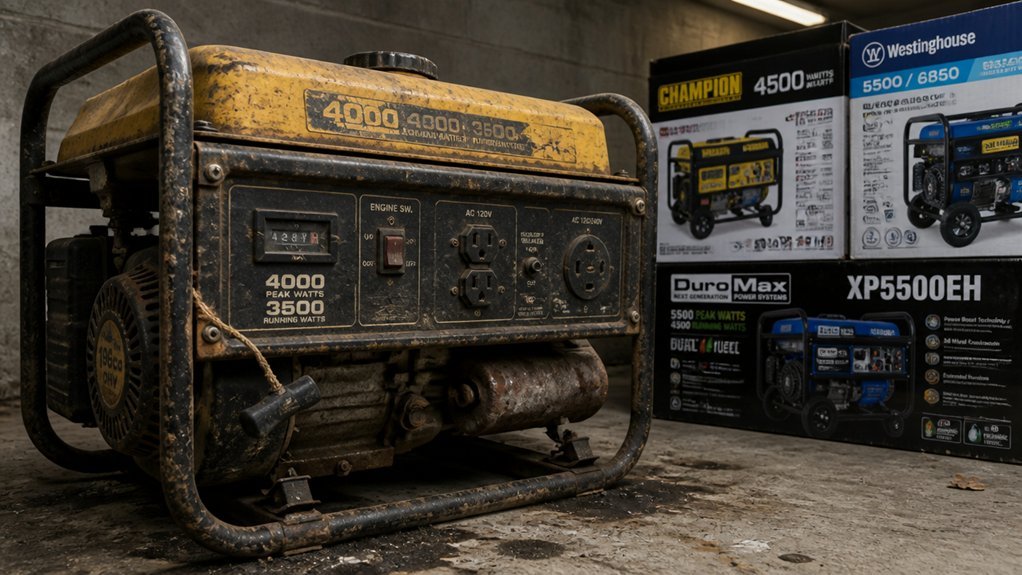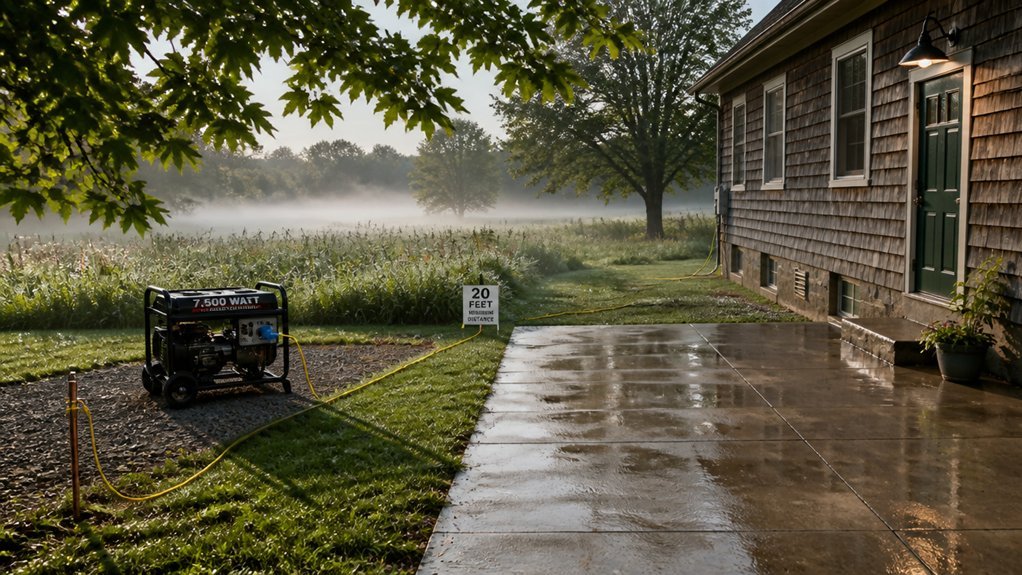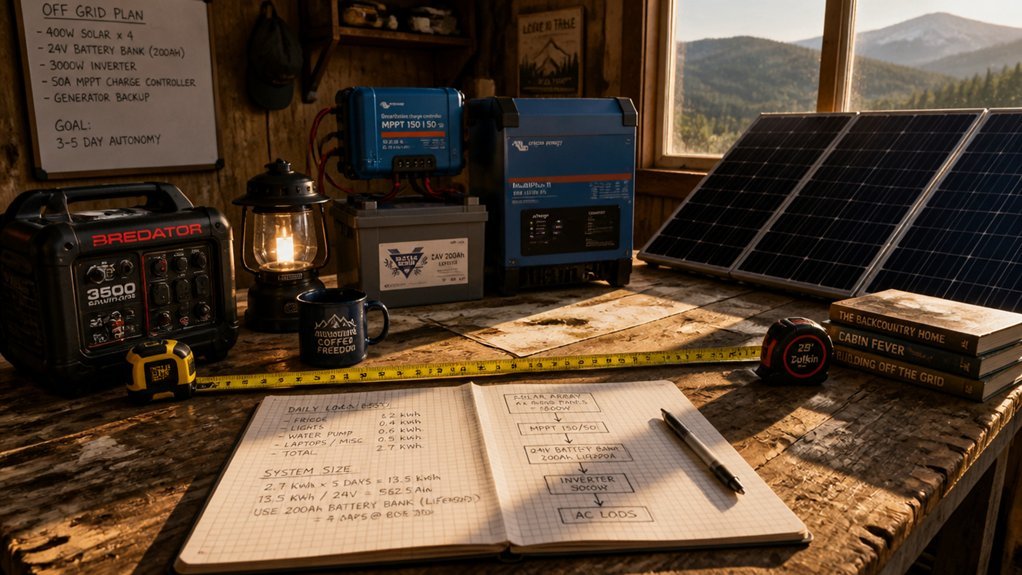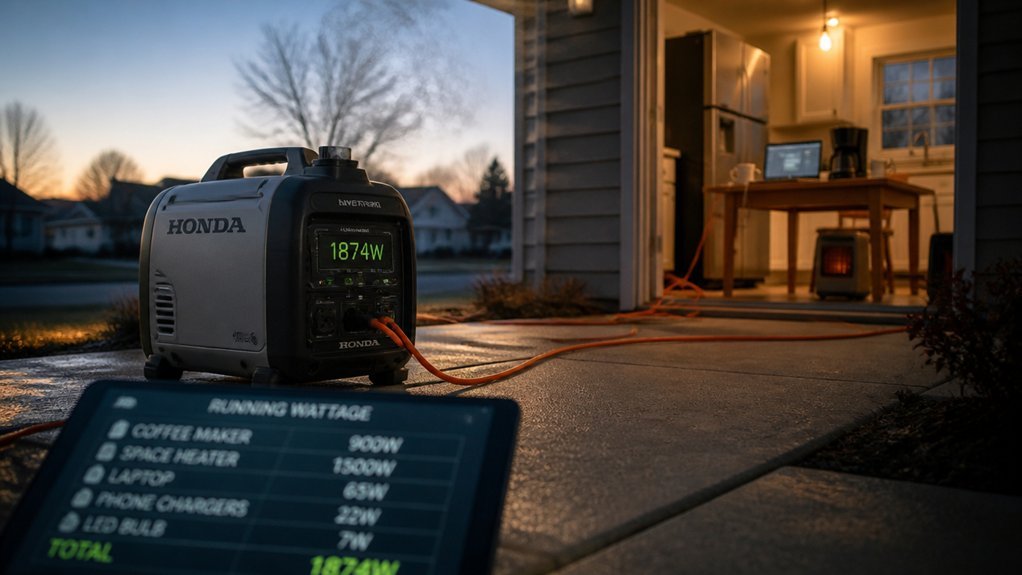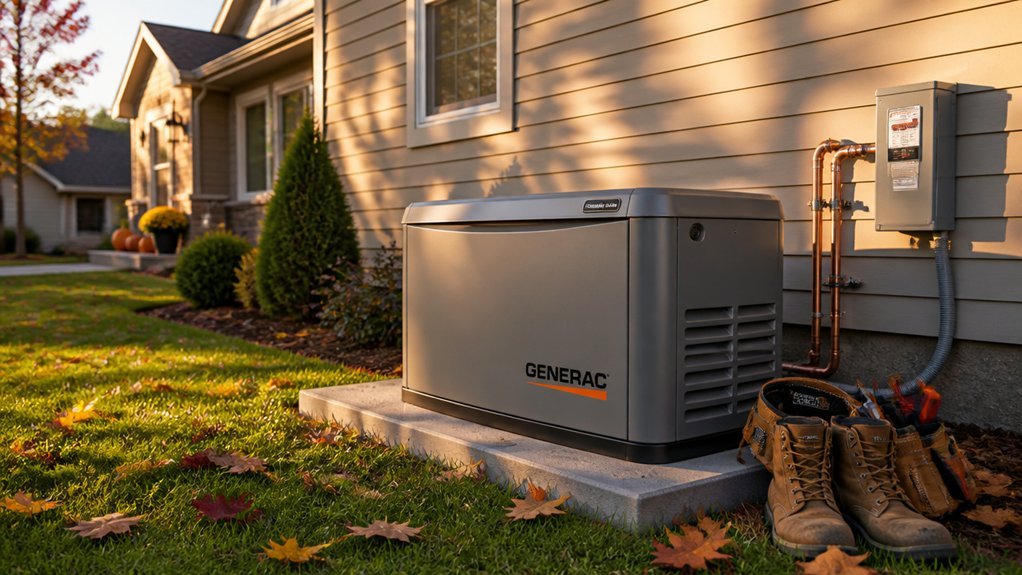


You’re standing in your basement with a flashlight, counting breakers and wondering which generator won’t let you down—or cost too much. The math isn’t simple: your furnace blower surges at startup, your heat pump demands clean sine waves, and that car charger in your garage pulls steady kilowatts for hours. Size it wrong, and you’ll either stall your essentials or burn fuel you didn’t need to buy.
How to Quickly Estimate Your Generator Size
How exactly do you determine your generator size without drowning in electrical calculations? You use a square-footage-based tool that correlates home size directly to running watts in kilowatts. You’ll select from brackets: under 1,500 sq. ft., 1,501–2,500 sq. ft., 2,501–3,500 sq. ft., or 3,501+ sq. ft. Each tier scales capacity proportionally to typical electrical demand.
This method doesn’t ignore startup wattage entirely—you’re accounting for it through standardized load assumptions built into the estimation. However, you must recognize that this yields approximations. You’ll risk appliance stalls and breaker trips if you undersize; you’ll waste fuel and capital if you oversize.
You need professional load analysis to refine these estimates. An electrician measures actual running watts and startup wattage requirements across your specific circuits, ensuring precise generator-to-load matching for your outage scenarios.
Recommended Products

BESTEK 300W Pure Sine Inverter (Patent Number US D818,853 S): Designed for your devices that require careful protection, provide 300W continuous DC to AC power and 700W of peak power featuring 2 AC outlets and 2 USB charging ports, great for Christmas gift, charging string lights, laptop, speakers, camera, nebulizer, game console, kindle, iPad and other

400W continuous power with 800W peak power for devices needing additional ramp-up power

【POWERFUL DC to AC CONVERTER】: This solar inverter delivers 1000W of continuous battery DC 12V to AC 110V 120V power and up to 2000W of peak surge power when the load is started. The 12V inverter has a conversion efficiency of greater than 90% during normal working and low no-load losses
What Home Size and Heating Type Do to Your Generator Size

Why does a 2,000-square-foot home with a gas furnace demand radically different backup power than an identical footprint running heat pumps? Your home size determines whether you target essential circuits or full-house coverage, directly shaping required running wattage and starting capacity. Your heating type alters energy load profiles dramatically: gas, propane, or oil systems impose minimal electrical demand, while heat pumps and resistance heating extract substantial power. You’re sizing for worst-case scenarios—outages during peak heating demand.
The tool correlates square footage with heating methodology, outputting specifications that account for simultaneous startup surges and sustained loads. Larger homes with electric heating compound these requirements. You must match generator capacity to both spatial scale and thermal energy source, ensuring your backup system handles calculated running wattage without compromise.
Recommended Products

Current rating 50 Amps,operating voltage 240 volts,need some basic knowledge on electrical circuits

Upgrade Unique Design: Our 15 Amp 120V Manual Generator Transfer Switch provides a safe. Compatible with EZ Generator Switch, uninterrupted power supply to critical circuits such as refrigerators, heating systems, home outlets, and lighting fixtures during power outages, ensuring that important home systems continue to operate normally.

🏡 100% Universal Compatibility with Most Generator on The Market: Our changeover switch works flawlessly with all generator types: gasoline, diesel, propane/LPG dual-fuel generators, lithium battery portable power stations, all-in-one solar generators, mini wind turbines & micro hydro generators. No extra adapter or modification needed, fit for home backup, camping, RV, workshop and off-grid living.
Why EV Charging Forces a Bigger Generator Size
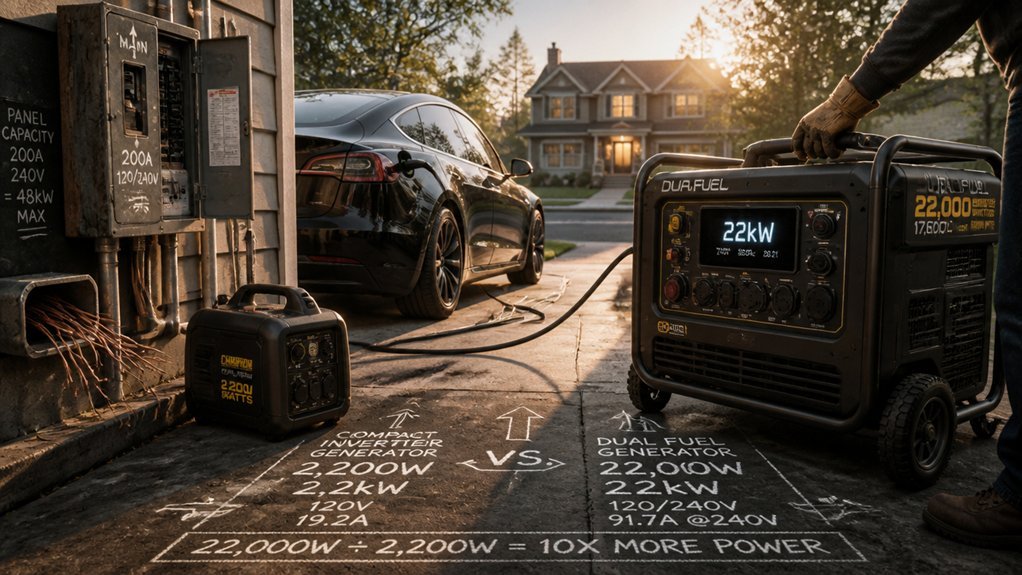
Once you’ve matched your generator to home size and heating load, plug-in vehicle charging introduces another power-hungry variable.
EV charging through a Level 2 charger draws 6–9 kW continuously, which reshapes your generator sizing calculations markedly. You’ll need to model this as an additional continuous load, not an occasional surge. If you’re calculating standby power requirements, adding this demand pushes most homes beyond basic essential coverage. You can’t ignore the charger without risking system overloads or tripped breakers during an outage.
Depending on your vehicle efficiency and whether you use a portable or fixed charger, you’ll likely need a unit in the 10–20 kW range to maintain both EV charging and critical circuits simultaneously. This single factor often forces you from a modest standby unit to a substantially larger generator platform.
Recommended Products

⚡ Fast, Flexible Charging You Control- Equipped with a NEMA 14-50 plug and adjustable current (10A to 40A), the EVDANCE EV Charger gives you total control over your charging speed. Whether you're topping off at work or doing an overnight charge at home, simply tap the control button to select your ideal amperage. It’s precision charging, made easy NOTE: It is necessary to use a J1772 to Tesla adapter(not including) when charging your Tesla vehicles

Flex Level 1 EV Charger - The EVDANCE Level 1 electric car charger is compatible with J1772 electric vehicles and plug-in hybrid vehicles (North American Standard). *Tesla requires a SAE J1772 adapter.

❤ [Equipped with Nema 14-50 plug 240V, Compatible with 110-120V Nema 5-15p to 14-50r EV Adapter(Not packaged) or the other EV Adapter Cable]: Suggest install the 240V Nema 14-50 plug-in socket. [Kindly Note When Using the 5-15P Adapter]: 1. The RV Adapter cable doesn't work for EV chargers, please order the correct EV adapter cable. 2. It will become slow level 1 ev charging and some cars may drop to 12A, the max charging rate is 1.32-1.8kW(110V*12A-120V*15A).
Whole House or Just Key Circuits? Plan Your Backup Scope
Where exactly does your backup power need to reach? You’re deciding between whole house coverage and key circuits, and this choice directly shapes your generator sizing strategy.
You select whole house backup, you’re sizing for every circuit simultaneously. You must calculate running watts plus starting watts for HVAC compressors, sump pumps, and kitchen loads to prevent overload conditions during startup transients.
You choose key circuits instead, you’re prioritizing essential loads—lighting, refrigeration, medical equipment. You’re limiting generator capacity to those specific branch circuits, reducing fuel consumption and equipment cost.
Your scope selection determines transfer switch specifications and panel wiring configurations. You’re affecting total installed cost considerably.
You conduct a professional load analysis before finalizing. You’re verifying which circuits to include and confirming the generator satisfies both running and startup wattage demands for your planned backup scope.
Recommended Products

13500 Peak Watts, 10500 Running Watts (Gasoline); 12500 Peak Watts, 9500 Running Watts (Propane); 10000 Peak Watts, 8500 Running Watts (Natural Gas); Remote Start with Included Key Fob, Electric and Recoil Start; Up to 19 Hours of Run Time on a 9.5 Gallon Fuel Tank with Fuel Gauge
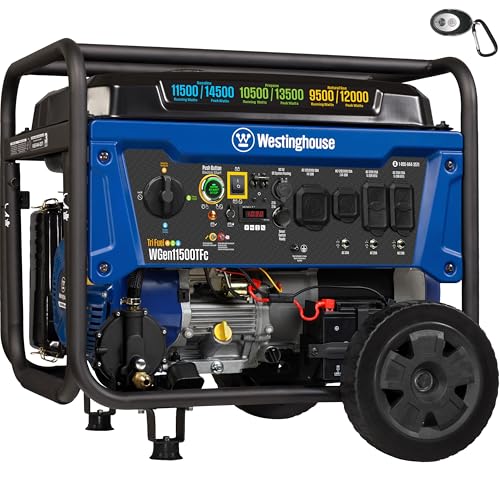
Perfect as a backup power source for larger homes or a dependable source of portable power

13500 Peak Watts, 10500 Running Watts (Gasoline); 12500 Peak Watts, 9500 Running Watts (Propane); Remote Start with Included Key Fob, Electric and Recoil Start; Up to 19 Hours of Run Time on a 9.5 Gallon Fuel Tank with Fuel Gauge
How Much Comfort Do You Need During an Outage?
How comfortably do you want to ride out the next outage? Your answer determines your load plan and generator sizing.
You select a BasicsOnly approach to power essentials—lights, refrigeration, and minimal outlets—or you expand to BasicsPlus, adding garage door operation, laundry capability, and cooking appliances. Each increment in outage comfort forces higher simultaneous demand, elevating both running wattage and startup wattage requirements.
You manage this through deliberate load planning: identifying what you’ll operate concurrently shapes peak energy draw. Load management prompts let you model these scenarios precisely.
For extended outage comfort, you’ll weigh runtime efficiency against cumulative watt-hours—longer disruptions amplify safety margins for fuel and ventilation. A professional assessment translates your selected comfort tier into exact running and starting wattage specifications, ensuring safe, adequate capacity without oversizing.
Recommended Products

Pure sine wave delivers safe, clean power to sensitive electronics

Provides 300 Watts continuous DC to AC power, featuring 2 AC outlets and 1 USB ports for multi-purpose charging.

Delivers 3800 starting watts and 3200 running watts of clean power with THD under 3%, which can safely power delicate devices such as laptops, mobile phones and tablets.
Portable or Standby? Match Type to Your Size and Budget
Why anchor yourself to a decision between portability and permanence? You must weigh standby generators against portable units through the lens of home size and operational demands.
Portable systems cost less upfront but require manual setup, fuel storage, and cord routing. They’re suited for smaller homes or brief outages. Standby generators install permanently, auto-start on utility loss, and connect to natural gas or propane for indefinite runtime.
Your home size dictates capacity requirements. Larger residences with multiple HVAC zones need stationary units (25–150 kW). Wattage matching determines feasibility: motor starting loads (refrigerators, pumps) spike briefly above running watts. Portable units often lack surge margins for whole-house coverage. Analyze your sustained and peak loads precisely—this technical alignment ensures you select architecture that meets both your electrical profile and outage tolerance.
Recommended Products

This is the original, authentic, and patented EZ Generator Switch

🚩【Auxiliary Power for Home Circuits】: The RVMATE generator manual transfer switch is rated at 15A 125V and provides auxiliary power to your home circuits. It allows you to safely connect the generator to your home's electrical system, supplying power to essential circuits such as the refrigerator, heating, outlets, lighting, and more. During short-term power outages, it can quickly and safely switch to emergency power, preventing risks like food spoilage and frozen pipes. Additionally, it enables your heating system to restart during power outages caused by winter storms.
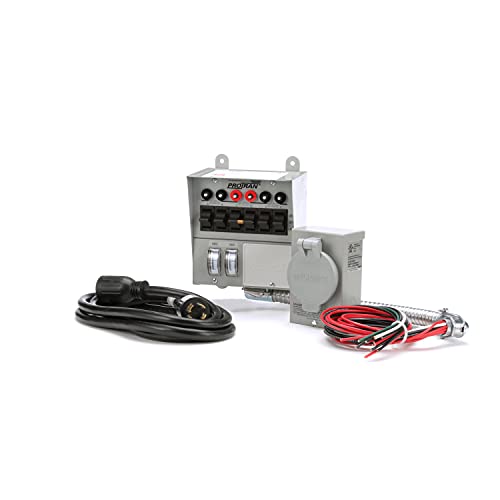
What a Generator Size Calculator Misses
Online sizing tools promise precision, yet they often flatten your electrical reality into oversimplified equations. When you’re performing generator sizing, you’ll discover these calculators lean heavily on square footage rather than scrutinizing your actual appliance inventory. Your load calculation demands more nuance than a generic kW-per-square-foot multiplier delivers.
You’re likely running variable high-priority loads—EV chargers, medical equipment—that shift dramatically by hour or season, and the calculator won’t capture these fluctuations. Startup wattage presents another blind spot: your refrigerator or sump pump motor may surge 3-5× above running watts for seconds, but the tool aggregates only steady-state figures. You’ll also find it omits your exact panel layout, transfer-switch constraints, and local conditions like ambient temperature or typical outage duration that strain practical capacity.
Recommended Products

WORKS WITH EVERY NON-TESLA EV: Standard J1772 connector plugs straight into Ford, Chevrolet, Hyundai, Kia, Nissan, BMW, Volkswagen, Audi, Rivian, Lucid and every other EV or plug-in hybrid sold with a J1772 port - no adapter needed. Tesla drivers can charge too, using the J1772 adapter that comes with the car.

Fast & Efficient Charging: Experience rapid charging with our Level 1-2 EV charger, featuring a robust 16A output and a maximum power delivery of 3.5KW. This ensures a consistent and reliable energy supply to your vehicle, optimizing charging efficiency and contributing to the long-term health of your electric car

【Charge 3X Faster at Home with 40A Power】Tired of waiting hours for your EV to charge? Our Level 2 EV Charger delivers 9.6kW ultra-fast charging (40 Amp), refilling your car’s battery while you enjoy dinner or a movie night. Perfect for busy families needing a quick turnaround.
Why You Need a Pro to Verify Generator Size Before Buying
Although generator sizing calculators offer a starting point, you’re risking costly miscalculations if you rely on them alone. A professional load analysis examines both running and starting wattage demands specific to your home, preventing breaker trips and underpowered circuits during peak surges.
You’ll need an in-home assessment to determine exact panel matching and transfer switch compatibility—critical factors calculators can’t verify. A licensed electrician evaluates your fuel source infrastructure, whether natural gas, propane, or diesel, and ensures code-compliant installation.
Oversizing wastes fuel; undersizing causes failures during startup. A professional balances reliability with efficiency after reviewing your priorities and appliance demands in person. You’ll receive a tailored recommendation for whole-house or partial-load configurations, ensuring your generator performs precisely when you need it.
Recommended Products
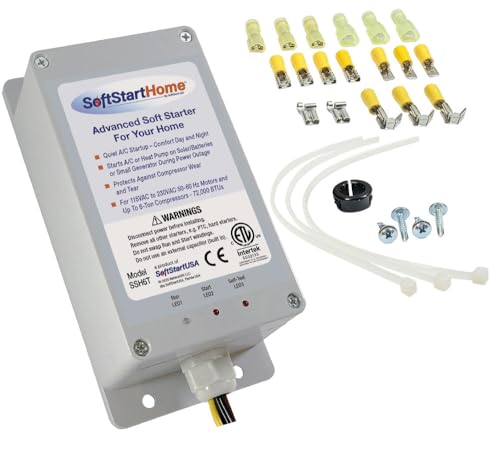
Most Advanced Soft Start Technology for Smooth, Quiet A/C Startup – Eliminates loud thumps and flickering lights by reducing inrush current up to 70%, ensuring seamless operation for your air conditioner or heat pump.
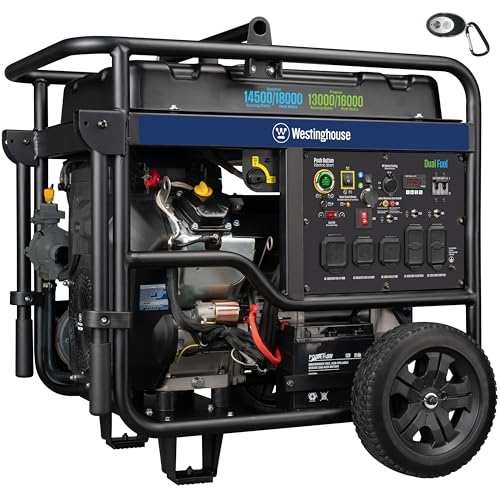
HUGE PORTABLE POWER: The WGen14500DFc dual fuel generator with CO sensor is an ideal power source for jobsites and emergency backup of larger homes. Gas: 18,000 peak watts, 14,500 running watts; Propane: 16,000 peak watts, 13,000 running watts

HUGE PORTABLE POWER: The WGen14500TFc tri fuel generator with CO sensor is an ideal power source for jobsites and emergency backup of larger homes. Gas: 18,000 peak watts, 14,500 running watts; Propane: 16,000 peak watts, 13,000 running watts; Natural gas: 14,400 peak watts, 11,600 running watts
Conclusion
You’ll size your generator by matching square footage estimates to your actual loads—accounting for heating type, EV charging, and backup scope—then verify with a licensed electrician. Skipping professional input risks costly mismatch: undersizing stalls motors, oversizing wastes fuel. Precision demands panel analysis and transfer-switch planning you can’t self-calculate.
Recommended Products

【4000w Heavy Duty Pure Sine Wave Inverter】Pure Sine wave inverter 4000W with true sine wave,8000W peak power,with LED display,DC 12V,AC 120V with four AC Outlets,1x hard wire block terminals for 1500W-4000 watt load and 1x2.4A USB port
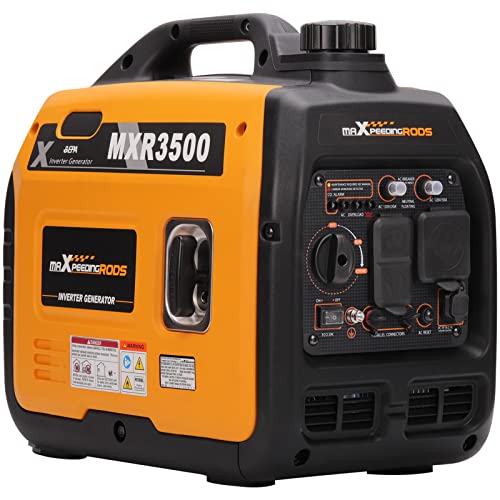
[Versatile Power Supply] With 3500 peak watts and 3000 running watts, our generator can easily power a small house, RV, food truck, and more. It is the ideal product for home backup power under extreme weather. And its compact and lightweight design (47lbs) makes it perfect for outdoor living and travel.
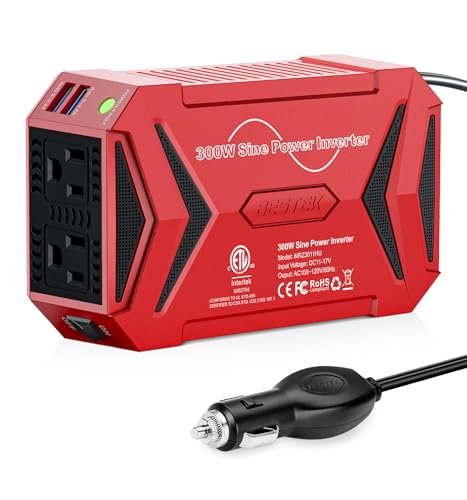
BESTEK 300W Pure Sine Inverter (Patent Number US D818,853 S): Designed for your devices that require careful protection, provide 300W continuous DC to AC power and 700W of peak power featuring 2 AC outlets and 2 USB charging ports, great for Christmas gift, charging string lights, laptop, speakers, camera, nebulizer, game console, kindle, iPad and other