
You need reliable backup power, but you’re unsure if 5000 watts covers your essentials. The answer depends on what you’re running—and when you start it. Get the math wrong, and you’ll overload the breaker. Get it right, and you’ll keep critical systems alive through an outage. Here’s how to match that generator to your actual load.
What Is a 5000-Watt Generator and Who Needs One?
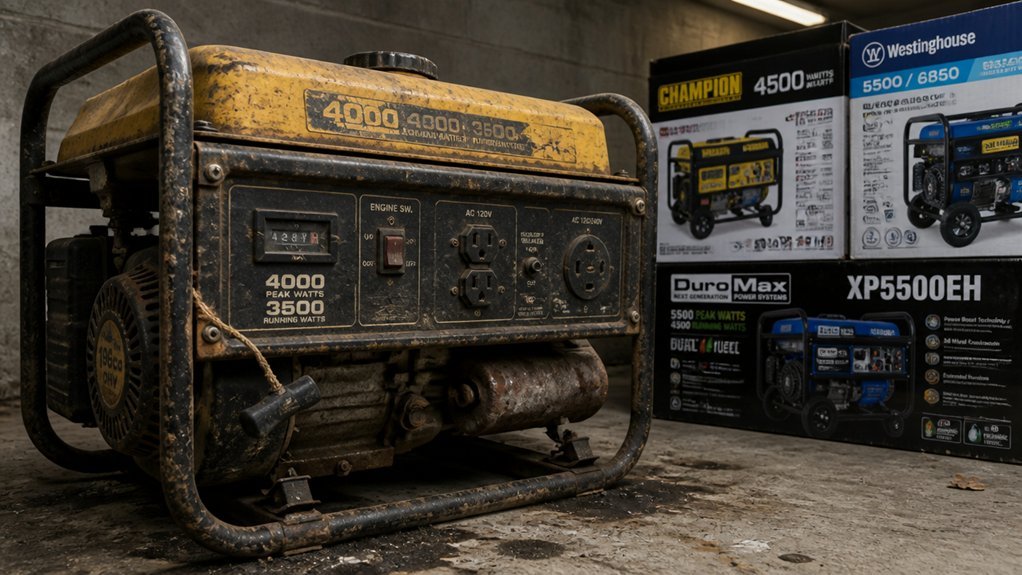
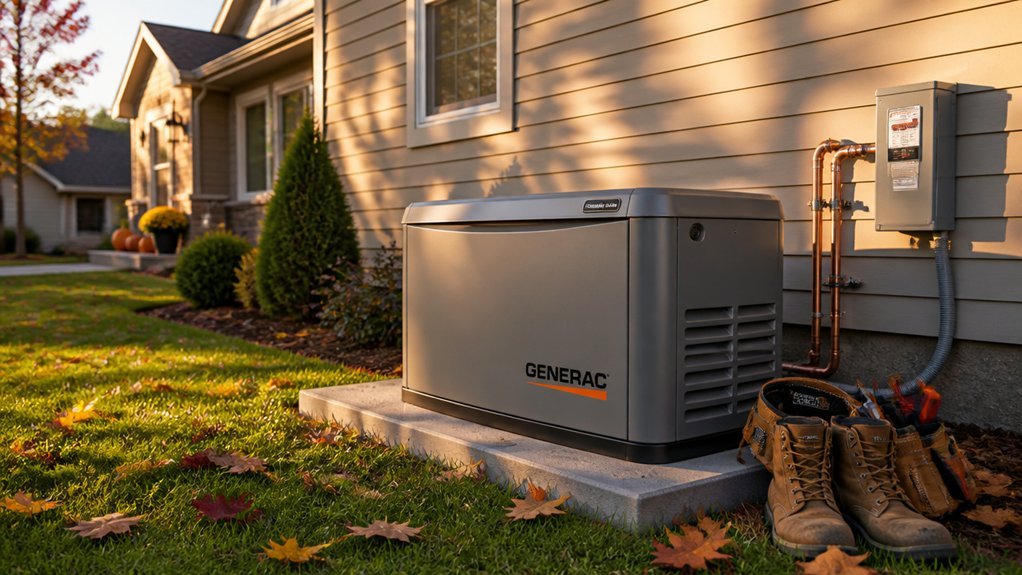
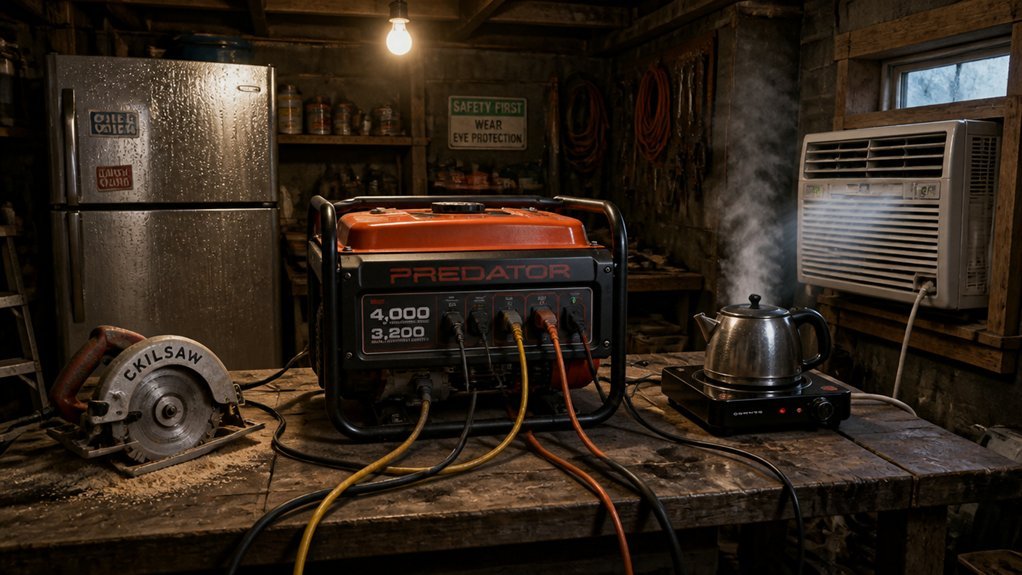
Why exactly does a 5000-watt generator matter? You’re looking at a unit delivering roughly 5000 running watts with additional surge wattage to handle motor startup demands. This power output lets you operate multiple essential appliances simultaneously—your refrigerator, lighting, and connectivity equipment—within safe limits.
You’ll find this generator type serves you well for backup power during outages, RV camping, or remote jobsites where continuous power proves critical.
The starting wattage capacity protects your equipment, but you’ll need disciplined load management when running devices with high startup demands. Consider fuel cost and operational priorities when selecting your generator type: gas models minimize your upfront expense, while inverter variants reduce noise and emissions at higher initial investment. Match your choice to your actual power requirements.
Recommended Products

𝐇𝐢𝐠𝐡 𝐏𝐨𝐰𝐞𝐫 𝐎𝐮𝐭𝐩𝐮𝐭 – 5000 peak watts and 4000 running watts, Includes 1*12V DC port, 2*120V AC ports, 1* 30A RV port, gas powered by 223CC 4-stroke OHV engine, perfect for RV camping, emergency home backup and power tools

𝗥𝗲𝗹𝗶𝗮𝗯𝗹𝗲 𝗣𝗼𝗿𝘁𝗮𝗯𝗹𝗲 𝗚𝗲𝗻𝗲𝗿𝗮𝘁𝗼𝗿 𝗳𝗼𝗿 𝗘𝘀𝘀𝗲𝗻𝘁𝗶𝗮𝗹 𝗕𝗮𝗰𝗸𝘂𝗽 𝗡𝗲𝗲𝗱𝘀: Provides 4000 rated watts and 5000 peak watts to support essential household appliances during temporary outages. Designed for home backup, RV trips, and general outdoor power needs.
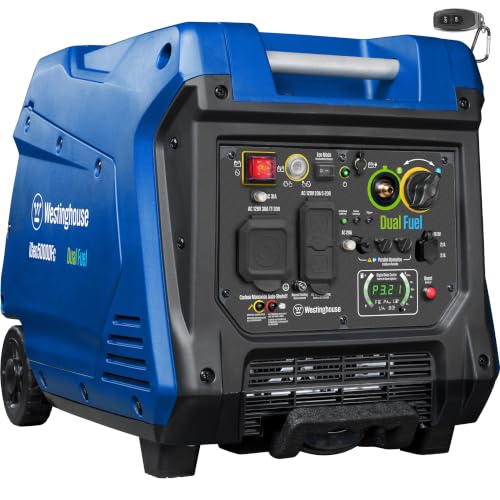
5000 Peak Watts and 3900 Rated Watts at Less Than 3% THD – Telescoping Handle – Gas or Propane Powered – Remote Start With Included Key Fob, Electric and Recoil Start. Grounding System-Floating Neutral
What Can You Run on 5000 Watts? (Home, RV, and Jobsite Lists)
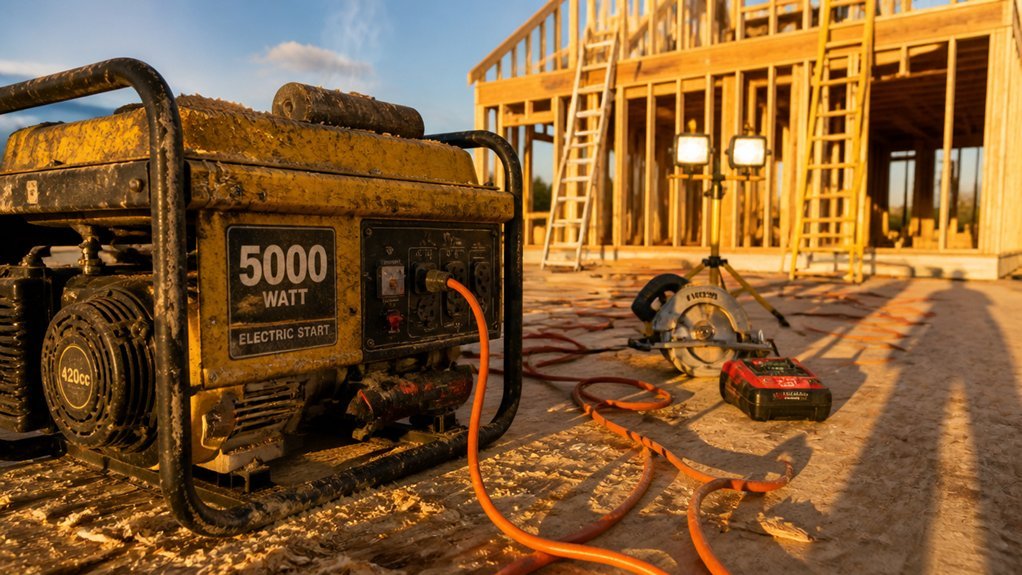
A 5000-watt generator gives you substantial operational flexibility, but you’ll need to respect the boundary between running watts and surge capacity.
For home backup, you’ll power a window AC unit (approximately 1200 watts running wattage), refrigerator, lights, router, and TV simultaneously through disciplined loads management. You’ll avoid central HVAC systems, as their surge demands exceed your generator’s capability.
For RV power, you’ll run LED lighting, kitchen essentials, and either a rooftop AC unit or microwave—not both concurrently—by prioritizing wattage ratings and respecting starting watts demands.
For jobsite tools, you’ll operate drills, saws, and compressors, but you’ll sequence starts carefully since motor-driven equipment demands 2–3× running wattage during startup.
You’ll always verify each device’s surge requirements against your 5000-watt generator’s maximum output to prevent overload conditions.
Recommended Products

Superlative Cooling & Unmatched Energy Efficiency Effortlessly conquer extreme heat with its 12v DC power 10,000 BTU high-efficiency cooling system, delivering 15% more power than standard models for rapid and consistent providing air flow comfort in RVs, vans, Light Truck, Boat, trailers. Our optimized airflow design ensures every corner of your space is perfectly cooled, even the outdoor temp. even over 113℉ it still have 80% of its standard performance.
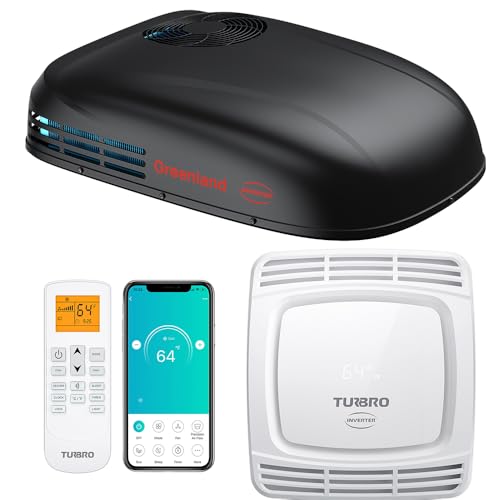
Energy-Saving Inverter Compressor: Delivers up to 30% greater efficiency than non-inverter systems while automatically adjusting speed to minimize energy use and noise. Its smooth start and operation eliminate the need for an additional soft starter.

Efficient Cooling: 10,000 BTU air conditioner cools your RV in just 15 minutes, delivering quick, consistent comfort.
Running Watts vs. Surge Watts: The Calculation That Prevents Tripped Breakers
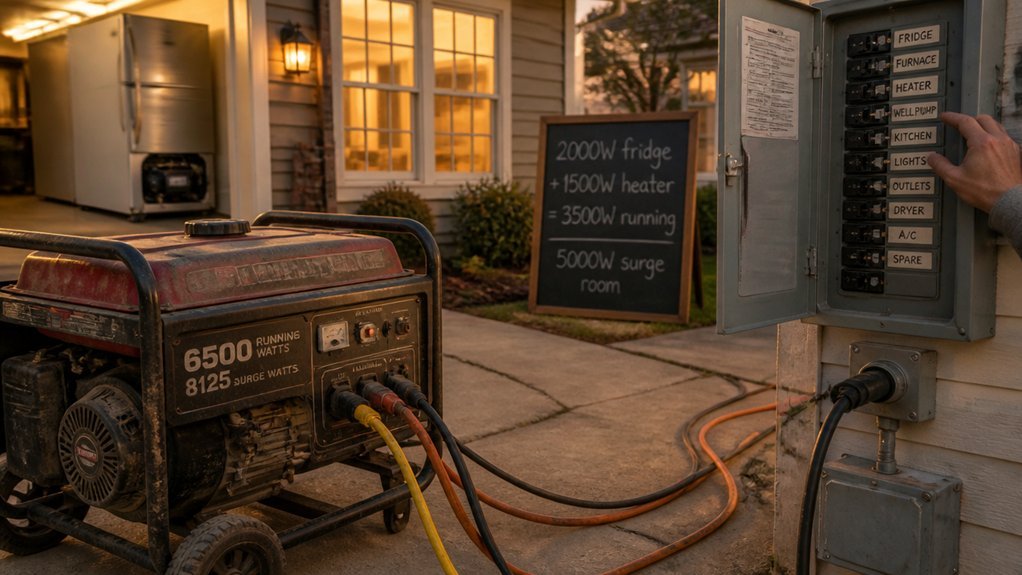
Operating multiple devices on a 5000-watt generator demands that you understand the distinction between running watts and surge watts, since failing to account for startup loads will trip your breaker or stall your generator mid-operation.
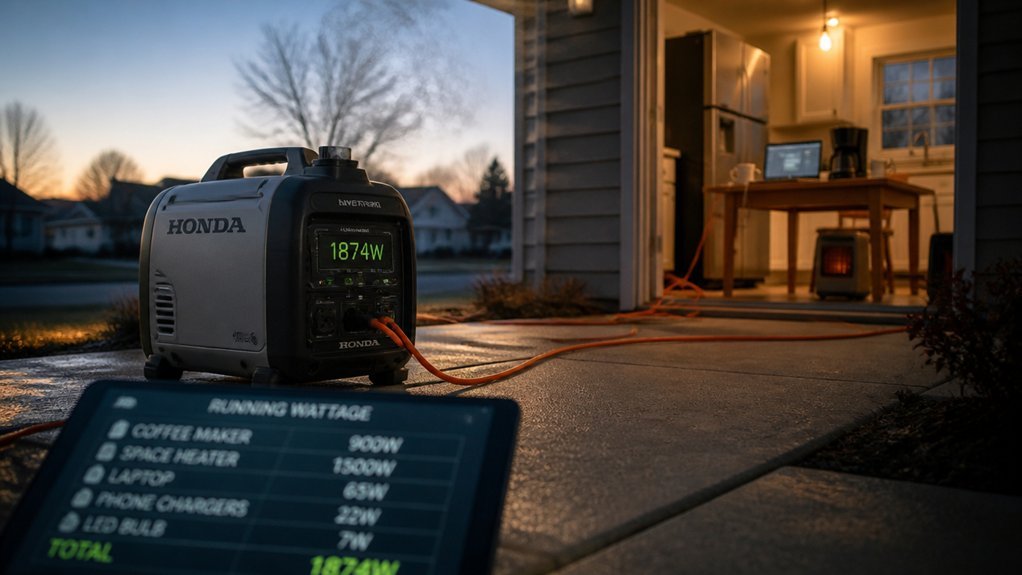
You’ll perform a power calculation by listing each appliance wattage, noting its running watts and any startup surge.
Sum these running watts to establish your running total.
Identify the largest startup figure—perhaps a refrigerator demanding 1500W surge against 700W running.
Add this largest startup surge to your running total, not every startup simultaneously.
Ensure this sum stays below your generator capacity; maintain circuit protection integrity by including a 10–20% safety buffer.
This margin prevents overload when compressors cycle unexpectedly, safeguarding both equipment and operational continuity.
Recommended Products

Tri-Fuel: 12,500/10,000-watt portable generator operates on natural gas, propane, or gasoline, plus natural gas and propane hoses are included so the unit is ready to run on any fuel right out of the box

Operate your 9200-watt portable generator right out of the box on either gasoline or propane, plus features CO Shield carbon monoxide auto shutoff system

Your 6500-watt portable generator operates on natural gas, propane, or gasoline, plus natural gas and propane hoses are included so the unit is ready to run on any fuel right out of the box
Will 5000 Watts Cover Your Whole House: or Just the Essentials?
How far can you stretch a 5000-watt generator before you’re left in the dark? You’ll need to distinguish between running wattage and surge/starting wattage immediately. A refrigerator demands roughly 700W running but spikes to 1500W at startup, and window AC units impose similar burdens. Central air conditioning exceeds your surge/starting wattage entirely, ruling out whole-house coverage.
Your running capacity becomes practical only with disciplined load management. Power essentials—refrigeration, lighting, WiFi, and limited climate control—fit within your continuous rating when you maintain a 10–20% safety buffer. You’ll stagger heavy motor loads through load shedding, preventing simultaneous startup spikes that trip breakers. Essential appliances remain viable; simultaneous whole-house operation does not. Stay below 4000–4500W sustained to protect your equipment.
Recommended Products

【PEAK 4800W POWER & PARALLEL READY】Delivers a powerful 4800 surge watts via a robust 223cc 4-stroke OHV engine. Engineered to handle high-startup loads like air conditioners and sump pumps without effort. Built-in parallel terminals allow for linking two units to double your total power output for heavy-duty demands

Powerful 4800W Surge & Clean Energy:Deliver 4800 starting watts of clean power. Equipped with advanced inverter technology, it provides safe and stable electricity for sensitive electronics like laptops, smartphones, and tablets, making it an essential companion for home backup or outdoor adventures

Powerful Performance: Dual Fuel, 5000/4500 Peak Watts and 3900/3500 Rated Watts (Gas/Propane). Bring power to your home during a power outage or recreational activities RV Ready TT-30R outlet keeps this compact generator versatile for campgrounds, tailgates, and other outdoor activities
How Long Does a 5000-Watt Generator Run? (Gas vs. Solar Runtimes)
You’ve mapped your 5000-watt capacity against your home’s demands; now you must weigh how long each power source sustains those loads.
A gas generator’s runtime hinges on fuel tank capacity and load. With a 5–6 gallon tank, you’ll typically operate 4–12 hours, depending on whether you’re drawing near continuous wattage or lighter loads. Refueling extends operation indefinitely, but efficiency drops under surge demands.
A solar generator’s runtime depends on battery capacity and recharging. A 5040Wh unit runs a 700W refrigerator roughly 6 hours or a 1200W window AC about 3.5 hours. However, cycling loads (refrigerators, heaters) extend actual runtime beyond simple calculations. Rapid solar recharging—achievable in 1.7 hours under optimal conditions—replenishes reserves, though sustained output requires balancing consumption against available solar input.
Recommended Products

❄️ POWERFUL ALL-WEATHER COMFORT: 16,000 BTU cooling and 12,500 BTU heat pump for year-round comfort. Works in ambient temps from 23°F to 115°F. Ideal for RVs 16-24ft including Class B, Class C, Travel Trailers, and Teardrop Campers.

Fast & Efficient Cooling & Heating: The dual-motor, triple-fan system delivers 418 CFM airflow, cooling or heating 30% faster-feel the difference in just 4 minutes. With an EER 11.8 rating, it provides high efficiency while using less power. Requires a 15 or 20-amp time-delay fuse or circuit breaker
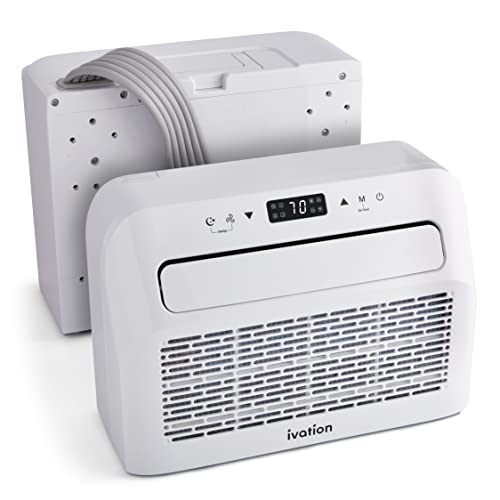
AIR CONDITIONER FOR RVS AND CAMPERS | Powerful 6,500 BTU Air Conditioner, Fan & Dehumidifier Maintains a Cool, Dry & Comfortable Climate Inside Your Motorhome, Caravan, Converted Van, Travel Trailer, Truck & Similar Confined Vehicles & Interior Spaces | Innovative Saddle Mounting on Windowsill Keeps Out Loud Noise, While the Unit’s Shockproof Dampers Absorb Vibration for the Quietest, Most Peaceful Operation Possible
Gas, Propane, or Solar: Which 5000W Setup Matches Your Lifestyle?
Where does your power need actually live? Gas and propane 5000W generators handle startup surge demands—you’ll see compressors on refrigerators pull 1400–2100W momentarily, and these units deliver continuous runtime while fuel lasts. They’re built for portability outdoors, but you must manage emissions and ventilation.
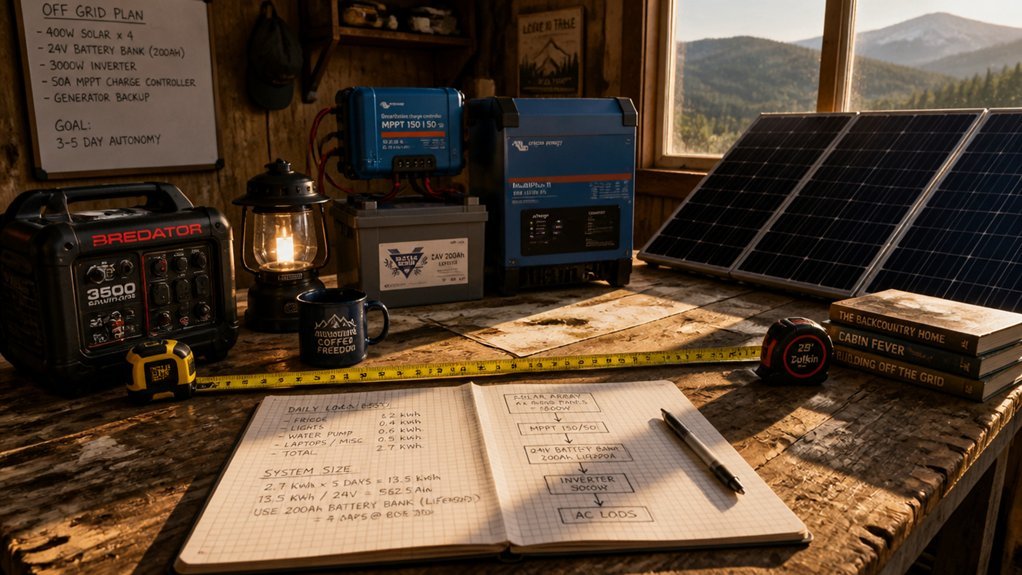
Solar 5000W systems eliminate this entirely; you’ll run appliances indoors with 14400W surge capacity from batteries, though runtime depends on charge state and recharging cycles. Consider your pattern: gas/propane suits job-site flexibility and indefinite refueling, while solar offers scalable batteries and zero fuel costs at higher initial investment.
Match your 5000W choice to where you’ll actually operate—open-air tolerance versus indoor safety, noise constraints, and whether you prioritize surge capacity or expandable storage.
Recommended Products

Ultra-powerful: At 15,000 starting watts and 12,000 running watts, enjoy up to 9 hours of run time on a full tank of gasoline with a noise level of 78 dBA from 23 feet

58 dBA is great for RVs, tailgating, or camping with 3500 starting watts and 2300 running watts and up to 10 hours run time on only 1.2 gallons of gasoline

Your 12,000-watt portable generator operates on natural gas, propane, or gasoline; plus natural gas and propane hoses are included so the unit is ready to run on any fuel right out of the box
Safety Essentials: Ventilation, Transfer Switches, and Cord Sizing?
Why risk your safety when a few precise steps eliminate the hazards?
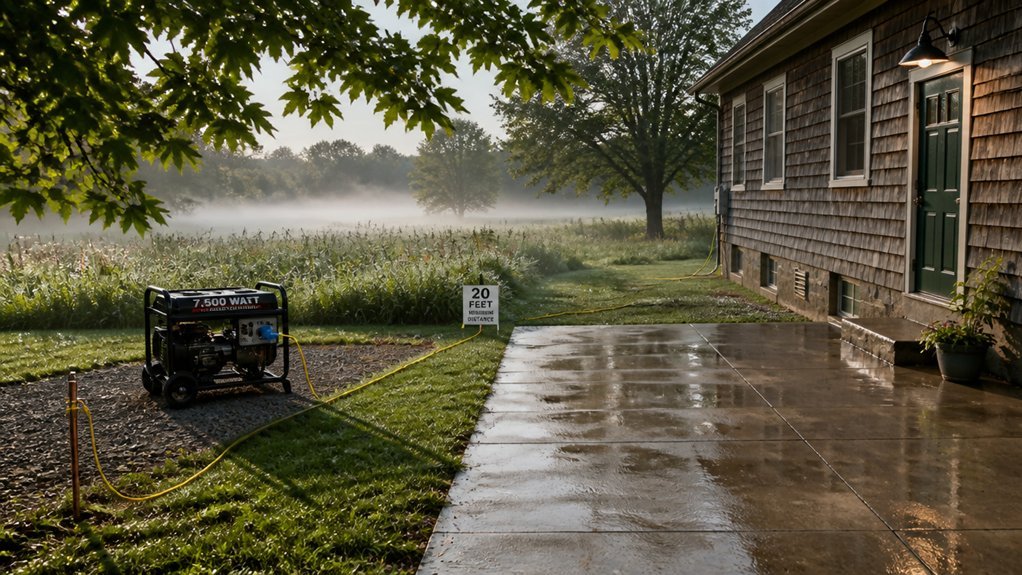
You must prioritize CO safety and ventilation through strict outdoor operation. Position your generator at least 20 feet from doors, windows, and vents to prevent carbon monoxide accumulation. Install a transfer switch before connecting to home circuits, eliminating dangerous backfeeding risks.
For cord sizing, select heavy-duty extension cords—10-gauge or 12-gauge rated for outdoor use—to safely conduct high running watts and starting watts without overheating. You must calculate total load demands, then apply a 10–20% buffer to prevent overload. Regularly inspect cords for damage, keep them dry, and disconnect equipment before refueling. These safety guidelines ensure reliable load management and hazard-free operation.
Recommended Products

[Versatile Power Supply] With 5000 peak watts and 4000 running watts, our generator can easily power a small house, RV, food truck, and more. It is the ideal product for home backup power under extreme weather.

Multipurpose power supply: Dual fuel design runs on both gasoline (5000 surge watts, 4600 rated watts) and propane (4000 surge watts, 3600 rated watts) for home backup power under extreme weather, or outdoor camping with your RV

5500W Peak Power & 120V/240V Versatility: Driven by a robust 223cc 4-stroke OHV heavy-duty engine, this inverter generator delivers 5500 peak watts and 5000 running watts. Featuring a rare L14-30R 120V/240V switchable outlet, it is powerful enough to drive heavy-duty equipment like large table saws and air compressors, or serve as a reliable shore power interface for yachts and boats.
Conclusion
You can run essential appliances and tools on a 5000-watt generator, but you’ll need to calculate both running and surge watts to avoid overload. Run it at 80–90% capacity, sequence startups, and never skip ventilation or transfer switch installation. Match your fuel type to your runtime needs and always use properly rated cords. This generator won’t power your whole house, but it’ll keep critical systems running safely when you need them most.
Recommended Products

🚐❄️10,000 BTU Cooling & Heating – Comfort Within Minutes - This 12V Rooftop Air Conditioner delivers 10000 BTU of Cooling power & Heating Function, stay comfortable in every season with 10,000 BTU high-efficiency cooling and heating. Keeps your RV cool in scorching summers and warm in freezing winters. Built with multi-layer circuit protection against current surges, vibration, and turbulence. Cools down or warms up your RV interior within minutes – no more waiting. Perfect for campers, motorhomes, and off-grid adventures where quick temperature control makes all the difference.
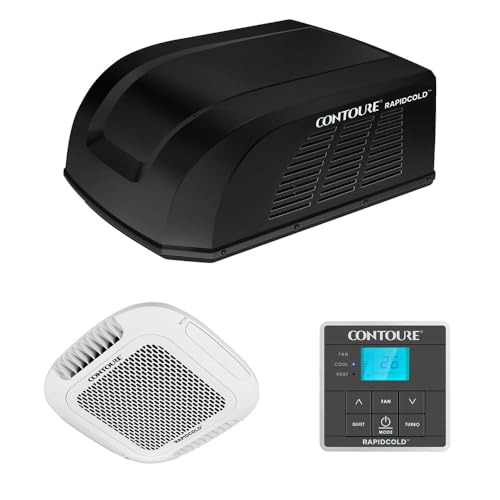
Complete All-in-One AC Package - Includes rooftop air conditioner, ceiling assembly, intuitive LED-controlled display thermostat for total climate control in your RV

Rapid Cooling & Heat: Cooling & Heating: 15,000 BTU/h cooling + 1,500W PTC Ceramic Heating (5,120 BTU/h). PTC heating provides instant warmth with no minimum temperature limitation, delivering reliable heating even in -15°F/-26°C extreme cold snaps.