

You’ll prevent cracked pumps and seized pistons by winterizing your pressure washer correctly, but one missed step can destroy the unit before spring arrives. Start by disconnecting all hoses and draining every water passage completely—residual moisture expands when frozen and fractures cast pump housings. You need to know which fuel treatment your engine requires and whether your pump needs oil or antifreeze to survive months in storage.
Why Winterizing Prevents Costly Freeze Damage
Why risk expensive repairs when a simple winterization routine protects your investment? You eliminate freeze damage by removing water from your pressure washer’s pump and internal passages. When temperatures drop, residual water expands and cracks castings, destroys seals, and ruptures check valves—repairs that cost significantly more than preventive maintenance.
You apply pump saver through the inlet to displace remaining moisture and coat internal surfaces with protective lubricant. This prevents corrosion and keeps pistons, plungers, and packings from seizing during storage. You also add fuel stabilizer to your gasoline to prevent varnish formation and carburetor gumming, ensuring reliable starts next season.
Conduct thorough drainage and flushing before applying protective agents. You’re preventing rust, eliminating moisture damage, and extending operational life. This proactive approach preserves equipment integrity and minimizes long-term maintenance costs.
Recommended Products

Protects Pressure Washer Pumps – Protects pistons and seals from damage during storage to ensure easy start-ups. By keeping internal components protected and lubricated, using this additive solution is ideal equipment maintenance

Heavy-Duty Winter Protection – Shields pressure washer pump internals from freezing down to -25°F. Prevents ice expansion, corrosion, and cracking during long-term storage, keeping your pump safe through the cold off-season.

Protects pressure washer pumps during storage
Disconnect Hoses and Drain Every Drop of Water

Where’s the last place water hides in your pressure washer? You’ll find it trapped in hoses, spray guns, and hose connections. Start by removing the high-pressure hose, garden hose, and spray gun from the unit. Hold each component vertically and shake firmly to drain water completely.
Inspect all hose connections for retained moisture. Tilt the pressure washer body to release pooled water from internal passages. You’re preventing freeze expansion that cracks pumps, seals, and fittings. Let every component air-dry thoroughly; trapped water expands nine percent when frozen, generating enough force to rupture metal.
Verify zero residual water remains in lines, couplings, and the inlet. Proper drainage now strengthens long-term pump integrity and eliminates moisture-related corrosion. Confirm complete dryness before continuing winterization procedures.
Recommended Products

Product 1: Protects pressure washer pumps during storage

FUEL SYSTEM CLEANER: Cleanses the entire fuel system using PEA additives, including fuel injectors, lines, & fuel pumps. This advanced formula removes water, gum, and varnish, ensuring optimal performance & longevity of your fuel system while preventing corrosion.

Product 1: Protects pressure washer pumps during storage
Flush the Pressure Washer Pump Completely
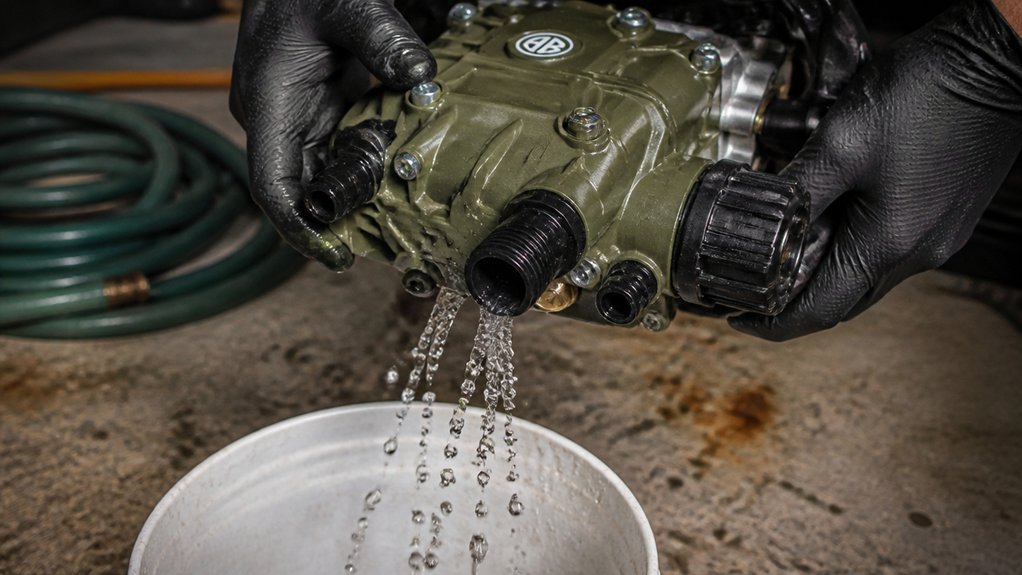
Even though you’ve drained the hoses, residual water still clings to the pump’s internal passages and valving. You’ll need to flush this remaining moisture completely to prevent freeze damage.
Start by disconnecting all hoses from the pump inlet. For gas-powered units, this flush step is critical since you’ll address the fuel system separately; residual water freezing in the pump can crack the manifold or damage plungers regardless of fuel handling. Run the pressure washer for three to five seconds with no hose attached—this expels trapped water from the valving.
Next, place the chemical injection tube into a bucket of clean water. Run the unit on low pressure for two minutes to circulate and clear the pump interior. Afterward, shut off the engine and water supply, then squeeze the spray gun trigger to release trapped pressure.
In sub-freezing climates, consider an anti-freeze flush for additional protection of internal passages.
Recommended Products

Complete Professional Jetting Kit: Includes everything you need for sewer cleaning: 50 ft sewer jet hose x1; pressure washer gun x1; button nose nozzle x1; rotating nozzle x1; corner sewer nozzle x1; 2 adapters: (1 x M22-15mm male, and 1 x M22-14mm male); 1/4'' quick connect plug x1; wrenches x2; corsage pin box x1; watertight tape x1
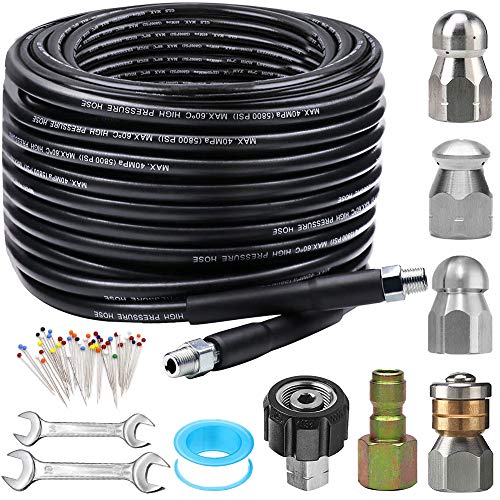
【New Family Set 6 Heads Sewer Jetter Kit】We've included a variety of accessories you might use to make it easy for you to use our sewer jetting kit ! 1 × 100ft sewer jet hose,1 × button nose sewer jet nozzle, orifice 4.0,1 × M22 female to 1/4’’ female NPT coupler,1 × 1/4’’ quick connect plug,1 × rotating sewer jetter nozzle,1 × Side hole sewer jetter nozzle,1 × corner sewer nozzle.1x waterproof tape, 2xspanners, 1x box of pearl corsage pin.

Sewer Jetting Kit with 6 Heads: Our sewer jet kit includes: 1* 150ft sewer jet hose, 1* button nose sewer jet nozzle, orifice 4.0, 1* M22 female to 1/4'' female NPT coupler, 1* 1/4'' quick connect plug, 1* rotating sewer jetter nozzle, 1* Side hole sewer jetter nozzle, 1* corner sewer nozzle, 1* waterproof tape, 1* box of pearl corsage pin, 2* spanners. To meet your various needs.
Stabilize Fuel on Gas Models Before Storing
If you’re storing a gas-powered pressure washer for more than a few weeks, you’ll need to treat the fuel system before it goes dormant. Gasoline degrades in approximately 30 days, forming varnish, gum, and rust that’ll clog carburetors and fuel lines.
Add a high-quality fuel stabilizer to your tank according to the manufacturer’s specified ratio. Start the engine and run it for two minutes to circulate treated fuel throughout the entire system, including the carburetor and internal passages. This ensures stabilized fuel protects all components from corrosion and ethanol-blend deterioration.
Shut off the engine and allow complete cooling before storage. For extended storage periods exceeding six months, drain the system entirely to eliminate risks associated with stored fuel breakdown.
Recommended Products

Prevents corrosion by displacing the water in the pump head.

All‑season freeze protection: Prevents water in pressure washer pumps from freezing down to –25 °F and provides long‑lasting lubrication for off‑season storage. Helps protect components from rust, pitting and harsh wear.

Extend Pressure Washer Life: Kärcher Pump Guard lubricates internal components and protects against rust, corrosion, and harmful mineral deposits, significantly extending your pressure washer's life
Skip Fuel Stabilizer on Electric Pressure Washers
Why complicate your winterization routine with unnecessary steps? You own an electric pressure washer, so you’ll skip fuel stabilizer entirely. Electric motors don’t consume gasoline, eliminating ethanol-blend degradation concerns and fuel system maintenance from your protocol.
Your focus shifts to electrical safety and pump preservation. You’ll unplug the unit completely before proceeding. You’ll drain all water from hoses, spray wand, and pump chamber to prevent freeze damage. You’ll then apply pump saver oil through the inlet fitting, running the unit briefly to coat internal seals and valves against corrosion and mineral deposits.
You’ll verify no moisture remains trapped in the system. You’ll store the unit upright in a climate-controlled space. You’ll complete winterization without handling flammable stabilizers—your electric model requires only water evacuation and pump saver oil protection.
Recommended Products

Our 3/8 inch Pressure Washer Sewer Nozzle is durable and sturdy,Cleaning Tool High-Pressure Nozzle.

Quick Release Coupler Kit: 1 pack M22 14mm swivel + 3/8 inch quick disconnect female socket, and 1 pack M22 14mm swivel + 3/8" male plug

Compatibility Notice: Please verify you have an M22-14mm hose prior to purchasing. The M22-14 SWIVEL SELL features a 14mm fitting with an inside diameter of 14mm, not 15mm. If your fitting is 15mm, it may result in leakage. Therefore, it may not be compatible with some electric pressure washers equipped with M22 15mm fitting
Pull the Recoil Handle to Clear Last Fluids
How do you guarantee the pump’s fully evacuated? You pull the recoil handle approximately six times to clear the last fluids from the system. This action evacuates remaining liquids from the pistons and seals after draining.
You’ll prevent freeze damage by repeating this recoil cycle during maintenance. Each pull forces residual water out of internal chambers, eliminating trapped pockets that expand when temperatures drop.
You’re ensuring no fluid remains to corrode components or crack seals during storage. This step specifically targets last fluids that gravity draining misses—those clinging to cylinder walls and valve interfaces.
You complete this procedure before seasonal shutdown. Your spring startup runs smoother because you’ve prevented dried-out seals and mineral deposits from forming. Pull the recoil handle now, and you’ll avoid costly pump repairs later.
Recommended Products


Genuine OEM Briggs & Stratton Pump Saver

BUY WITH CONFIDENCE - Place your trust in our exceptional OEM Simpson Cleaning pressure washer replacement components. Each product is meticulously tested to ensure top-tier performance and longevity. Choose our reliable OEM Quality solutions to prioritize performance and safety.
Coat the Pump With Saver Oil to Prevent Rust
A pump saver oil treatment protects your pressure washer’s internal components from rust and corrosion during winter storage. To winterize the pump properly, you’ll attach a short garden hose to the inlet adapter and introduce pump saver oil through the system. This displaces residual water while coating internal passages and pistons with a protective film. You’ll reduce freeze damage risk and ensure lubrication reaches critical surfaces.
Pull the recoil handle twice after adding the oil to circulate the protective coating completely. Whether you’re maintaining a gas or electric unit, you’ll need pump saver oil to safeguard the pump system throughout storage. This treatment minimizes moisture-related deterioration and extends operational lifespan. Complete this step before moving to downstream components.
Recommended Products

Fuel stabilizer for long-term storage of boats, generators, lawnmowers, and other powersports equipment

The STA-BIL Pump Protector protects pressure washer pumps and internal components from damage during storage with its anti-freeze and lubricant formula (4oz).

【Features】- The fuel pressure regulator carburetor is precision machined from 6061-T6 aluminum alloy and features a 1/8 inch NPT instrument port, two ORB6 outlet ports and one ORB6 inlet port.
Dry and Store Hoses, Gun, and Nozzles Together
Once you’ve protected the pump’s internal components, you’ll turn your attention to the external system to prevent freeze damage. Disconnect the high-pressure hose, garden hose, and spray gun from the unit. Elevate each hose and allow water to drain completely—residual liquid expands when frozen and cracks components. Shake the spray gun to expel trapped water from the trigger mechanism and wand connection. Wipe all surfaces with a clean rag to eliminate moisture and debris that accelerates corrosion. Coil hoses without kinks to maintain structural integrity. Bundle the hoses, spray gun, and nozzles together using straps or a storage bag to prevent misplacement. Position this assembly in a dry location elevated off concrete surfaces to reduce moisture exposure and inhibit rust formation on metal fittings.
Recommended Products

COMPLETE SEWER JET KIT: Includes a 50ft sewer jet hose, pressure washer short gun, button nose nozzle, rotating nozzle, corner nozzle, 1/4” NPT female to 1/4” quick connect plug adapter, M22-14mm female to M22-15mm male connector, Teflon tape, 2 spanners, and a box of fine needles
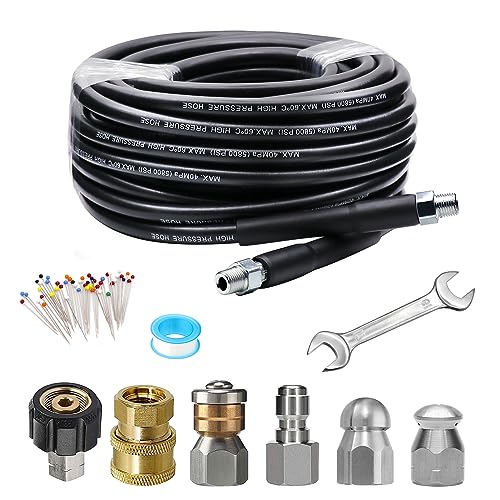
SEWER JETTER KIT LISTS: 1 × 25 ft sewer jet hose, 1 × button nose nozzle; 1 × rotating nozzle; 1 × corner sewer nozzle; 1 × M22 female to 1/4'' female NPT coupler; 1 × 1/4'' quick connect plug; 1 x watertight tape; 2 x spanners; 1x pearl corsage pin

[PROFESSIONAL SEWER JETTER KIT INCLUDES]: 1 x 50FT sewer jet hose, 1 x Spring Nozzle, 1 x Pointed sewer jetter nozzle, 1 x Corner sewer nozzle, 1 x Rotating sewer jetter nozzle, 1 × Mushroom nose nozzle, 1 x M22 female to 1/4’’ female NPT coupler, 1 x 1/4’’ Quick connect plug,1 x Handle strap for storage,1 x Waterproof tape, 1 x Box of pearl corsage pin, 1 x Cleaning cloth, 2 Spanners, 1 Pair of gloves.
Store the Unit Somewhere Dry, Cool, and Elevated
Where should you keep your pressure washer until spring? Select a cool, dry location for storage. You’ll prevent moisture-related damage and corrosion by avoiding damp environments. Elevate the unit off concrete surfaces to stop moisture wicking that degrades components. Clean all dirt, grime, and residual moisture before you store the equipment—this eliminates corrosion risks. Ensure the storage area has adequate ventilation to circulate air and prevent humidity buildup that attacks seals and internal parts. Organize accessories with the main unit so nothing separates or gets lost. Position the pressure washer on shelves, pallets, or blocks to maintain elevation. Your storage site shouldn’t experience temperature extremes or direct moisture exposure. These steps protect your investment against winter degradation and ensure operational readiness when you restore the unit to service.
Recommended Products

Protect During Storage: Protect your pressure washer pumps when storing for the season Piston and Seal Protector: Lubricates pistons and seals to protect the pump Cold...
Verify These Final Checks Before Walking Away
Why risk damage after all your preparation? Perform a final visual inspection now. Check that you’ve drained all water from hoses, spray gun, and nozzle extensions. Wipe exterior surfaces completely dry.
Verify pump saver oil remains at the inlet. Draw the recoil handle smoothly to confirm no residual liquid or pump stiffness exists. Test the spray gun trigger—it must release fully and lock open to prevent pressure buildup or accidental discharge during storage.
For gas models, ensure treated fuel has circulated for two minutes and you’ve run the engine briefly to distribute stabilizer before shutdown.
Position the unit for storage in a cool, dry, ventilated area, elevated off concrete. Organize all accessories to eliminate moisture exposure. Complete these checks, then walk away confident.
Recommended Products

SELL 14mm FITTING. INSIDE DIAMETER IS 14mm, NOT 15mm. It fits pressure washer of most M22-15 brands. If your fitting is 15mm, it may cause leakage.

Includes 8 pieces adapters. Pressure washer adapter set is made of stainless steel. Anti-rust. High quality and hardness.

[50FT FLEXIBILITY UPGRADE] Replaces your stiff, frustrating factory hose! This 1/4-inch inner-diameter hose features a premium low-memory blend that lays flat during use and coils effortlessly. Saves you time and hassle when navigating around vehicles and equipment.
Conclusion
You’ve drained, flushed, and protected your pressure washer’s pump with saver oil. You’ve stabilized or removed fuel on gas models, dried every component, and stored everything in a cool, dry location. These steps prevent freeze damage, corrosion, and costly repairs. Verify no water remains, hoses are coiled loosely, and the unit sits elevated. Your pressure washer will start reliably when you need it again.